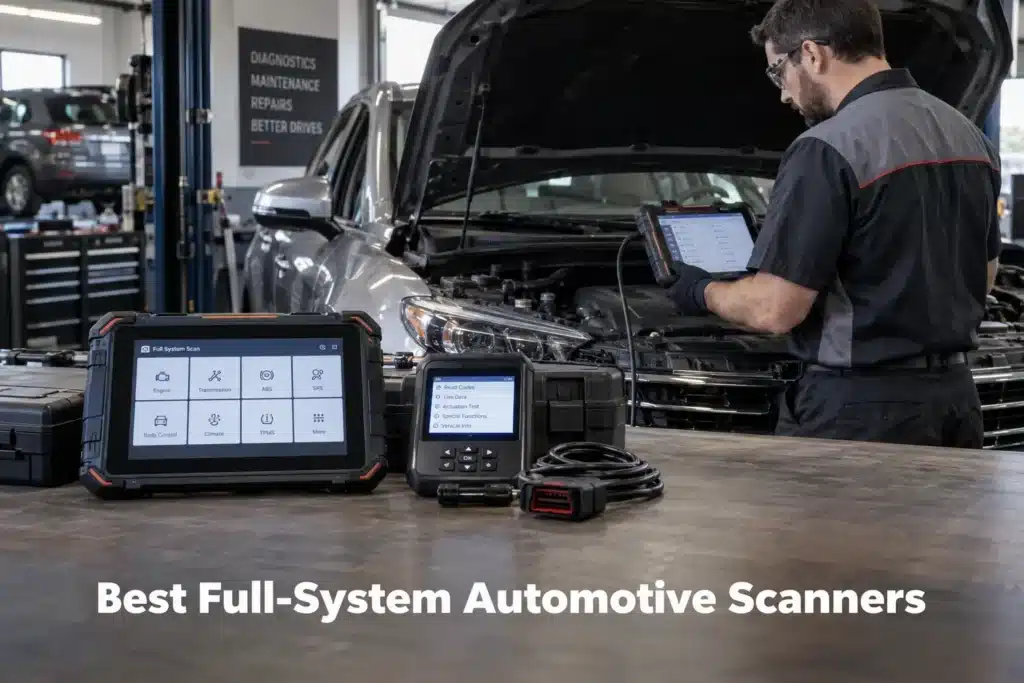
9 Best Full-System Automotive Scanners in 2026: Diagnose More Than the Engine
A full-system automotive scanner is designed for a different job than a basic OBD2 code reader.
Generic OBD2 focuses primarily on standardized emissions-related powertrain diagnostics. A true full-system scanner attempts to communicate with the other supported electronic control modules across the vehicle: ABS, SRS, transmission, body control, HVAC, electronic parking brake, steering, battery management, TPMS and many more.
That difference matters because modern vehicles are networks.
A warning light or drivability problem can involve several modules. One control unit can store a code because another module stopped communicating. A sensor value can affect several systems. A scanner that sees only the engine may therefore show only one part of the diagnostic picture.
For this guide, Scan Choice Guide focused on one question: which scanners provide the most useful full-system diagnostic capability for different types of buyers in 2026?
We evaluated system breadth, live data, bidirectional active tests, service functions, wireless communication, modern protocol support, coding/adaptation capability, hardware workflow, update policy, vehicle coverage and buyer fit.
We did not rank scanners simply by price or by the number of advertised service functions.
Our recommendations are based on current manufacturer documentation, current 2026 market research and SCG comparative analysis. The results we present come from our own research into manufacturer documentation, Amazon listings, and compatibility data.
Our Top Picks for Full-System Scanners
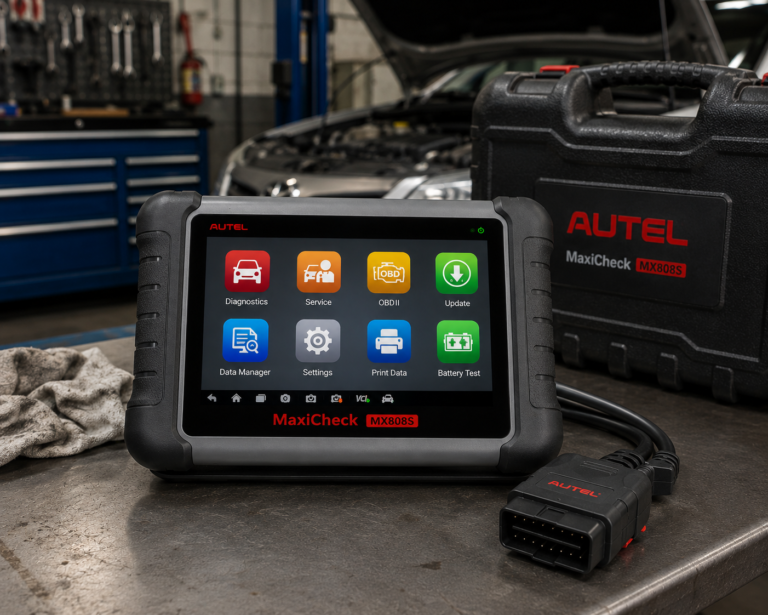
Autel MaxiCheck MX808S
- Full-system diagnostic class
- Dedicated tablet
- Broad supported module access
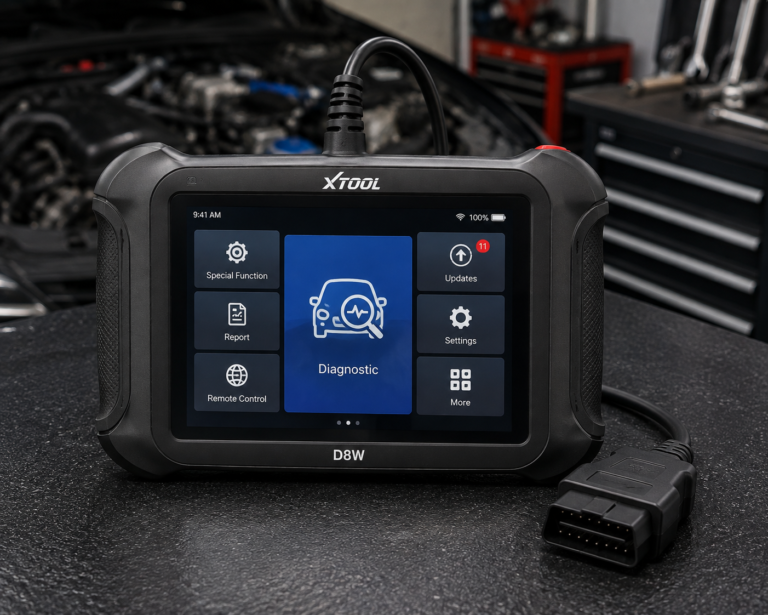
XTOOL D8W
- OE-level full-system diagnostics
- Wi-Fi vehicle communication
- Topology module mapping
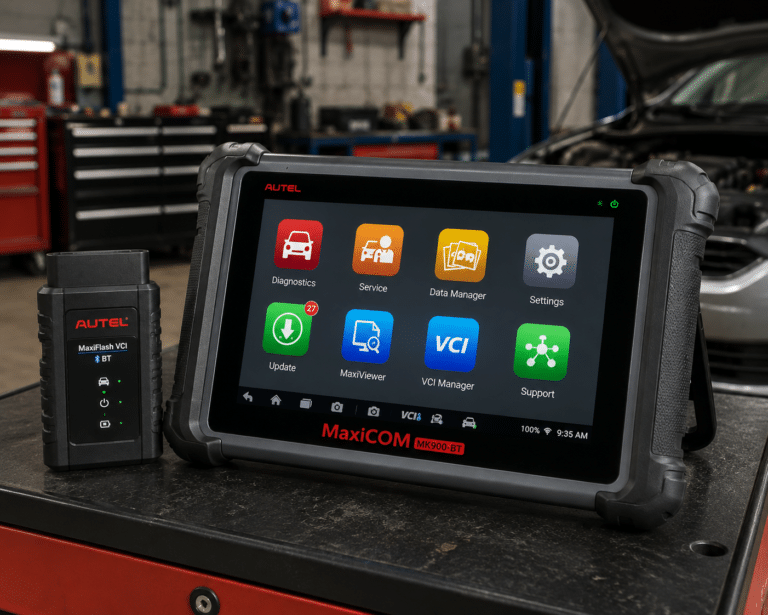
Autel MaxiCOM MK900-BT
- OE-level all-system diagnostic positioning
- Wireless VCI
- Bidirectional active tests on supported vehicles
Affiliate Disclosure: Scan Choice Guide is a participant in the Amazon Services LLC Associates Program, an affiliate advertising program designed to provide a means for sites to earn advertising fees by advertising and linking to Amazon.com.
The 9 Best Full-System Automotive Scanners
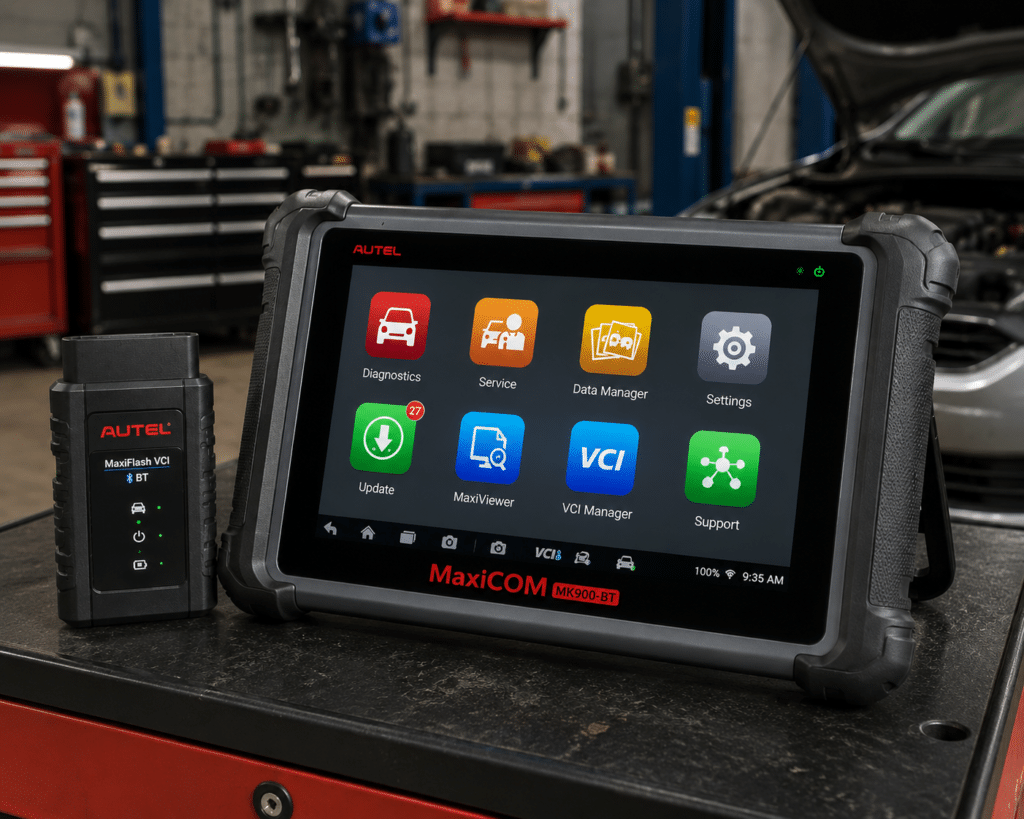
1. Autel MaxiCOM MK900-BT: Best Overall Full-System Automotive Scanner
Why We Picked It
The MK900-BT sits in one of the most useful parts of the modern scanner market.
It is substantially more capable than a simple code reader or four-system scanner, but it does not require every buyer to move directly into Autel’s flagship MaxiSys class.
Autel currently describes the MK900-BT as an all-systems diagnostic and service tablet.
The company lists OE-level system coverage across available electronic systems, broad U.S., Asian and European vehicle coverage and a wireless MaxiVCI V150 connection.
Current Autel documentation also confirms bidirectional active-test capability.
That combination is what makes the MK900-BT our overall choice.
A full-system scanner should do more than list modules. It should provide a practical workflow for scanning them, reviewing DTCs and live data, and, where supported, commanding components during diagnosis.
Where It Falls Short
“OE-level” should not be interpreted as “identical to every dealer tool.”
Coverage and active tests remain vehicle-dependent.
The MK900-BT also introduces a more advanced software ecosystem than a simple handheld scanner. Buyers should understand Autel’s current update terms before treating the purchase price as the entire long-term cost.
It is also unnecessary for someone who only wants Check Engine diagnostics.
| Specification | Details |
|---|---|
| Display | 8-inch LCD capacitive touchscreen, 1280×800 |
| OS / Processor | Android 11, quad-core (1.8GHz) |
| Memory | 4GB RAM, 64GB storage |
| Connectivity | Wi-Fi and Bluetooth via MaxiVCI V150; USB Type-C |
| Battery | 3.7V/7700mAh |
| Protocol support | CAN-FD and DoIP confirmed |
| Bidirectional control | Confirmed (injector, headlamp, fuel pump, A/C clutch, oil pressure, vehicle-level, brake vacuum, valve tests) |
| ECU coding | Not listed on this model’s own page |
| Service functions | 40+ (oil reset, EPB, SAS, battery registration, throttle relearn, ABS bleed) |
| Pros | Cons |
|---|---|
| OE-level all-system diagnostic positioning | Amazon lists 3,000+ active tests; Autel’s own page does not state a figure |
| Wireless VCI | |
| Bidirectional active tests on supported vehicles | |
| Live data | |
| AutoVIN/AutoScan workflow | |
| Broad vehicle-brand coverage | |
| Dedicated 8-inch tablet | |
| Mature Autel diagnostic ecosystem |
Best For
Advanced DIY mechanics, mobile technicians and small repair operations that want a balanced wireless full-system platform.
SCG Verdict
The MK900-BT is our overall full-system choice because it combines broad module access, active testing and wireless operation in a mature diagnostic ecosystem without forcing every buyer into flagship-shop hardware. Our full Autel MaxiCOM MK900-BT review covers the mature diagnostic ecosystem behind its broad module access.
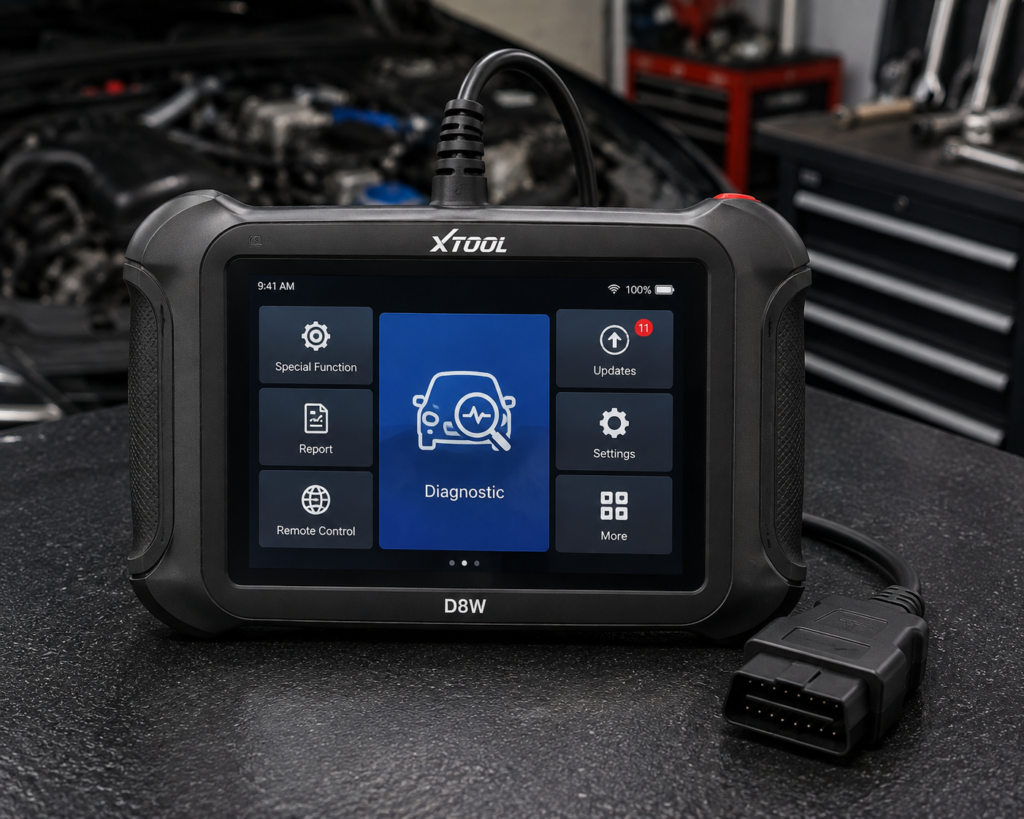
2. XTOOL D8W: Best Wi-Fi Full-System Diagnostic Platform
Why We Picked It
Most wireless scanners use Bluetooth between the tablet and vehicle interface.
XTOOL’s D8W takes a different approach.
XTOOL currently specifies a built-in Wi-Fi vehicle communication interface with support for modern protocols including CAN FD and DoIP.
The manufacturer also lists OE-level all-system diagnostics across engine, transmission, ABS, SRS, TPMS, BCM, HVAC and other supported systems.
Topology mapping is another major differentiator.
Instead of presenting only a flat module list, topology can visually show module communication relationships. That can be useful when several modules report network faults or one controller becomes unreachable.
XTOOL also currently lists more than 4,000 active tests and 42+ service functions for the D8W.
Those numbers should not be interpreted as universal vehicle coverage, but they demonstrate the intended capability class.
Where It Falls Short
The D8W is a serious diagnostic platform and therefore comes with complexity.
A buyer who does not need topology, active tests or advanced service functions may be better served by a simpler scanner.
XTOOL currently lists a three-year free-upgrade period, so long-term software economics should also be considered.
ECU coding and PMI support are vehicle-dependent and should not be described as universal ECU programming.
| Specification | Details |
|---|---|
| Display | 8″ touchscreen, 1024×768 |
| Operating System | Android 10 |
| Processor | Quad-core 1.5GHz |
| RAM / Storage | 4GB / 64GB per XTOOL’s primary technical page (2GB reported on a separate XTOOL storefront) |
| Battery | 5000mAh, 7.2V, USB-C charging |
| Wireless Range | Up to 66 ft, built-in WiFi |
| Protocols | CAN FD, DoIP, FCA V2.0 |
| Bidirectional Control | Confirmed (XTOOL official page); 4,000+ active tests per XTOOL |
| ECU Coding | Confirmed (XTOOL official page, offline coding) |
| Module Programming (PMI) | Confirmed (XTOOL official page) for Ford, Lincoln, Mazda |
| Topology Mapping | Confirmed (XTOOL official page) |
| Update Policy | 3 years free updates, WiFi online upgrade, 22 languages |
| Pros | Cons |
|---|---|
| OE-level full-system diagnostics | PMI module programming is brand-specific: confirmed only for Ford, Lincoln, and Mazda |
| Wi-Fi vehicle communication | |
| CAN FD support | |
| DoIP support | |
| Topology module mapping | |
| Bidirectional control | TPMS: diagnostics and reset; sensor programming not listed |
| 4,000+ active tests currently listed | |
| 42+ service functions currently listed | |
| ECU coding/PMI on supported applications | |
| Live-data graphing and export |
Best For
Advanced DIY users, mobile technicians and smaller shops that want full-system diagnosis plus topology and fast wireless communication.
SCG Verdict
The D8W stands out because full-system diagnostics become more useful when the tool can also help visualize the vehicle network and communicate quickly across modern protocols. See our full XTOOL D8W review for the vehicle-network visualization that sets it apart.
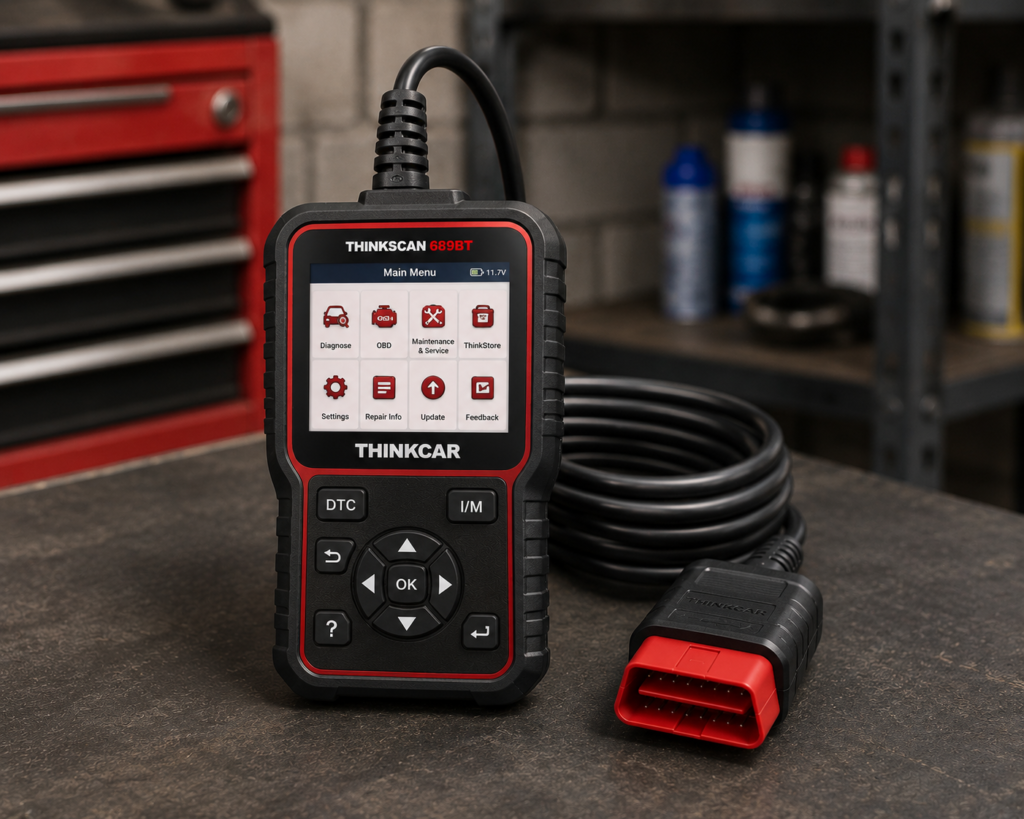
3. THINKCAR THINKSCAN 689BT: Best Advanced Value With Lifetime Updates
Why We Picked It
The THINKSCAN 689BT earns its full-system place through breadth: THINKCAR specifies OE-level all-system diagnosis across the vehicle, not just the engine, backed by ECU coding, bidirectional active tests, CAN FD, DoIP, AutoVIN/AutoScan and FCA SGW AutoAuth, plus 35+ maintenance functions that go well past code reading.
Coverage this wide would normally mean paying for software access module by module, but THINKCAR currently lists lifetime free updates for supported vehicle brands, so the full-system scope doesn’t come with an expiring subscription attached.
The wireless Bluetooth VCI adds one more practical piece for full-system work, moving the tablet around the vehicle instead of staying tethered to one port.
Where It Falls Short
The phrase “lifetime updates” should not override compatibility.
The manufacturer itself provides a coverage checker and notes that specific functions vary by vehicle and software version.
ECU coding is also not universal ECU programming.
And a large service-function menu does not mean every function is supported on every car.
| Specification | Details |
|---|---|
| Screen | 8-inch, 1280×800 touchscreen |
| Operating System | Android 10 |
| Processor | 2.0GHz quad-core Cortex-A53 |
| Memory / Storage | 4GB RAM, 64GB storage |
| Battery | 4150mAh |
| Vehicle Connection | Bluetooth 5.0 dongle; 2.4G/5G Wi-Fi |
| Bidirectional Control | Confirmed; ~99% of vehicle-specific systems/components per Thinkcar |
| ECU Coding | Confirmed; includes replacement-part matching and feature personalization |
| Service Functions | 35+ confirmed by name |
| CAN-FD | Confirmed for 2020+ GM and Chrysler models specifically |
| DoIP | Confirmed for Volvo, Land Rover/Jaguar, BMW F/G chassis specifically |
| Update Policy | Lifetime free updates confirmed, no subscription |
| Pros | Cons |
|---|---|
| OE-level full-system diagnostics | CAN-FD and DoIP support is brand-limited, not universal |
| Bidirectional active tests | |
| ECU coding on supported applications | |
| CAN FD | |
| DoIP | |
| Wireless Bluetooth VCI | Thinkcar markets bidirectional testing as “3X faster” than testing manually |
| 35+ maintenance functions | |
| AutoVIN/AutoScan | |
| FCA SGW AutoAuth | |
| Lifetime free updates currently listed |
Best For
Advanced DIY users and small-shop buyers who want broad modern-protocol support while minimizing recurring scanner-update costs.
SCG Verdict
THINKSCAN 689BT is the ownership-value choice because it combines genuine full-system breadth with a current lifetime-update model rather than trading capability for lower long-term software cost. Our full THINKCAR THINKSCAN 689BT review covers the lifetime-update model behind its ownership-value case.
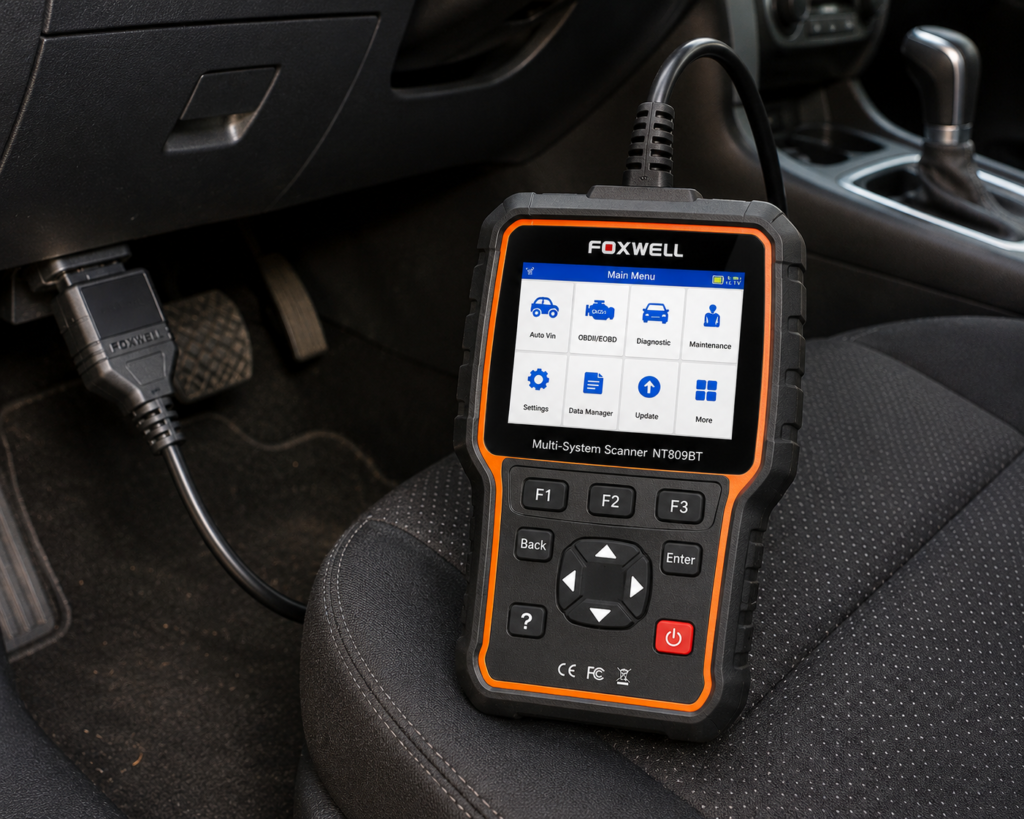
4. Foxwell NT809BT: Best Mid-Range Wireless Full-System Choice
Why We Picked It
Foxwell’s NT809BT provides a useful bridge between consumer multi-system scanners and higher-end professional platforms.
Foxwell currently describes it as a professional-level full-vehicle diagnostic scanner.
The manufacturer lists module access across engine, transmission, ABS, SRS, BMS and other supported systems, along with bidirectional control.
The Bluetooth VCI provides wireless movement around the vehicle.
Foxwell also lists more than 30 reset/service functions and a three-year Wi-Fi update period.
That makes the NT809BT particularly relevant to serious home mechanics and smaller operations that want a dedicated wireless tablet without jumping to Foxwell’s more expensive professional models.
Where It Falls Short
The NT809BT should not be selected by reset count.
Thirty-plus menu items are useful only when the required function is supported on the vehicle being serviced.
The three-year update period also means buyers should understand what happens after the included update term.
It is not a universal ECU-programming platform.
| Specification | Details |
|---|---|
| Screen | 7-inch LCD touchscreen tablet |
| Operating System | Android 9.0 |
| Storage | 32GB |
| Battery | 4000mAh |
| Vehicle Connection | Bluetooth VCI dongle, up to 65-foot range per Amazon; Wi-Fi and USB 2.0 also available |
| Service Functions | 30+ confirmed by Foxwell (oil reset, ABS bleeding, SAS, EPB, TPMS, injector coding, DPF, and more) |
| Bidirectional Control | Confirmed; vehicle-wide active tests across ABS, window, door, solenoid, valve, wiper, headlamp modules |
| ECU Coding | Not listed for this model |
| Vehicle Brand Coverage | 30+ named brands per Foxwell’s product page; a larger figure appears in separate Foxwell marketing |
| CAN-FD Support | Listed on Amazon; not listed on Foxwell’s own product page |
| Update Policy | 3 years free Wi-Fi updates, confirmed by both Foxwell and Amazon |
| Pros | Cons |
|---|---|
| Full-vehicle diagnostics | CAN-FD: listed on Amazon; not listed on Foxwell’s own page |
| Engine, transmission, ABS, SRS, BMS and additional modules | |
| Bidirectional control | |
| Bluetooth wireless VCI | |
| 30+ reset/service functions | |
| Dedicated Android tablet | |
| Three years of Wi-Fi updates currently listed | |
| Good serious-DIY/small-shop positioning |
Best For
Serious DIY mechanics and smaller repair businesses that want wireless full-system diagnostics without moving into a flagship platform.
SCG Verdict
NT809BT is the mid-range wireless choice because it delivers the features that define a real full-system platform (broad module access and supported component control) without making professional-shop complexity mandatory. See our full Foxwell NT809BT review for the full module access and component control it delivers at mid-range.
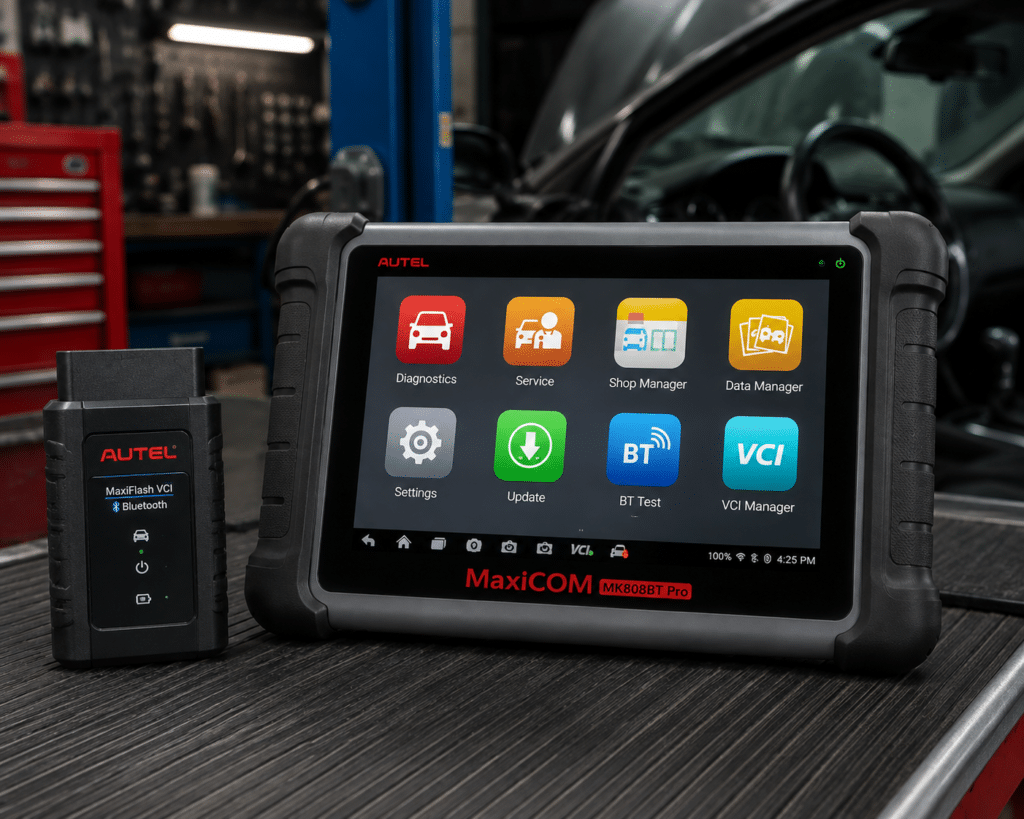
5. Autel MaxiCOM MK808BT Pro: Best Established Autel Mid-Range Platform
Why We Picked It
The MK808BT Pro is one of Autel’s most recognizable steps into wireless all-system diagnostics.
Autel’s current official documentation lists read/erase capability across available vehicle systems, live-data graphing, AutoVIN and OE-level coverage for electronic systems.
The current Autel store also positions the MK808BT Pro around full bidirectional control and 28+ service functions.
That gives the buyer a well-established combination: full-system diagnosis + wireless VCI + active tests + service functions.
For advanced DIY users, that is often enough capability to avoid immediately stepping into a much more expensive professional platform.
Where It Falls Short
Autel’s 808 family contains several similar names.
MK808BT Pro, MK808Z-BT, MK808S, MK808Z and other variants should not be treated as identical.
| Specification | Details |
|---|---|
| Display | 7-inch LCD capacitive touchscreen, 1024×600 |
| OS / Processor | Android 11, Cortex-A55 quad-core (1.8GHz) |
| Storage | 64GB |
| Connectivity | Bluetooth (33ft/10m range) via MaxiVCI Mini, plus Wi-Fi; no CAN-FD/DoIP |
| Battery | 3.7V/5000mAh; ~7 hours continuous use |
| Bidirectional control | Confirmed (ABS, windows, doors, solenoids) |
| ECU coding | Not listed on this model’s own page |
| Service functions | 28+ (oil reset, injector coding, ABS bleeding, EPB, SAS, DPF regen, BMS) |
| Vehicle coverage | 80+ US, Asian, European makes, 1996 and newer |
| Pros | Cons |
|---|---|
| OE-level all-system diagnostic positioning | ECU coding: not listed for this model |
| Wireless Bluetooth VCI | |
| Full bidirectional control on supported applications | |
| 28+ service functions currently listed | |
| AutoVIN | CAN-FD/DoIP protocol support: not listed |
| Live-data graphing | |
| Dedicated tablet | |
| Established Autel ecosystem |
Best For
Advanced DIY users who want an established wireless Autel platform with broad module access and active testing.
SCG Verdict
MK808BT Pro remains relevant because it delivers the core full-system workflow many advanced users actually need without forcing them into the top MaxiSys tier. Our full Autel MaxiCOM MK808BT Pro review covers the core full-system workflow without the top MaxiSys tier price.
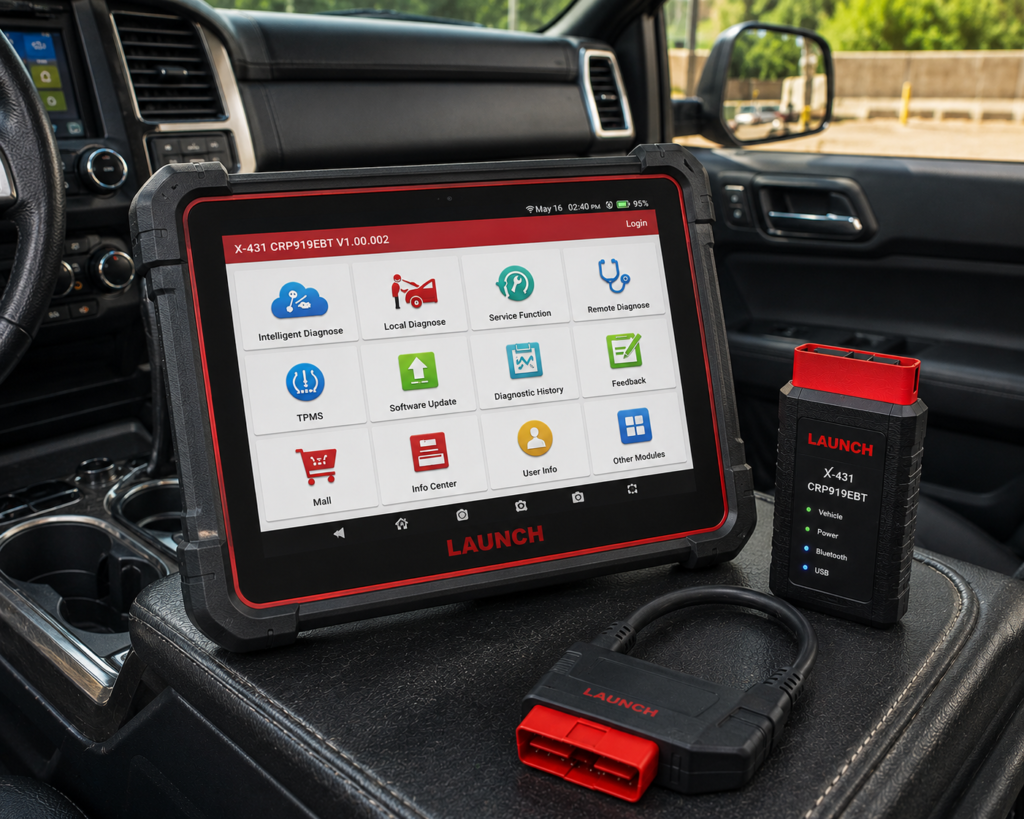
6. LAUNCH X431 CRP919EBT: Best for Serious DIY / Prosumer LAUNCH Users
Why We Picked It
LAUNCH has a broad product family spanning simple code readers through professional X-431 platforms.
The CRP919EBT sits in the advanced prosumer area of that range.
Its purpose is not simply to read more codes.
This class of LAUNCH scanner is designed around broad system access, wireless diagnostics, active testing and service functions.
That makes it a logical full-system candidate for buyers who want the LAUNCH ecosystem but do not need the hardware and business workflow of a top professional X-431 platform.
Where It Falls Short
Exact identity is critical.
CRP919E, CRP919E Lite, CRP919EBT, CRP919XBT and regional versions can appear together in search results.
Before implementation, the exact current U.S. CRP919EBT specification, update policy and supported advanced functions must be revalidated against authoritative LAUNCH documentation.
Until that is done, no claim about a specific coding function should be generalized.
| Specification | Details |
|---|---|
| Operating System | Android 10.0 |
| Processor | 2.0GHz quad-core |
| Memory / Storage | 4GB RAM, 64GB storage |
| Vehicle Connection | Bluetooth, wireless |
| Vehicle Coverage | 150+ makers, 10,000+ vehicles, 1996-2024 |
| Bidirectional Control | Confirmed across ECM, ABS, SRS, TCM, EPB, TPMS, SAS, A/C, BMS, ESP |
| ECU Coding | Confirmed for BMW, VW, Audi, Skoda specifically, not universal |
| TPMS | Confirmed, TPMS reset function documented |
| Maintenance Functions | 31 confirmed, including ABS bleeding |
| Update Policy | 2 years free update confirmed per Amazon listing |
| Pros | Cons |
|---|---|
| Advanced full-system product class | Launch's official storefronts are fragmented across several regional domains |
| Wireless diagnostic workflow | |
| Bidirectional/active-test positioning | |
| Broad service-function environment | |
| LAUNCH diagnostic ecosystem | |
| Strong serious-DIY/prosumer fit |
Best For
Serious DIY mechanics and prosumers who prefer LAUNCH and want wireless full-system diagnostics with active-test capability.
SCG Verdict
CRP919EBT belongs in this comparison because it represents the point where LAUNCH’s prosumer tools become genuine whole-vehicle diagnostic platforms, but exact model matching is mandatory. See our full LAUNCH X431 CRP919EBT review for the exact-model matching this pick requires.
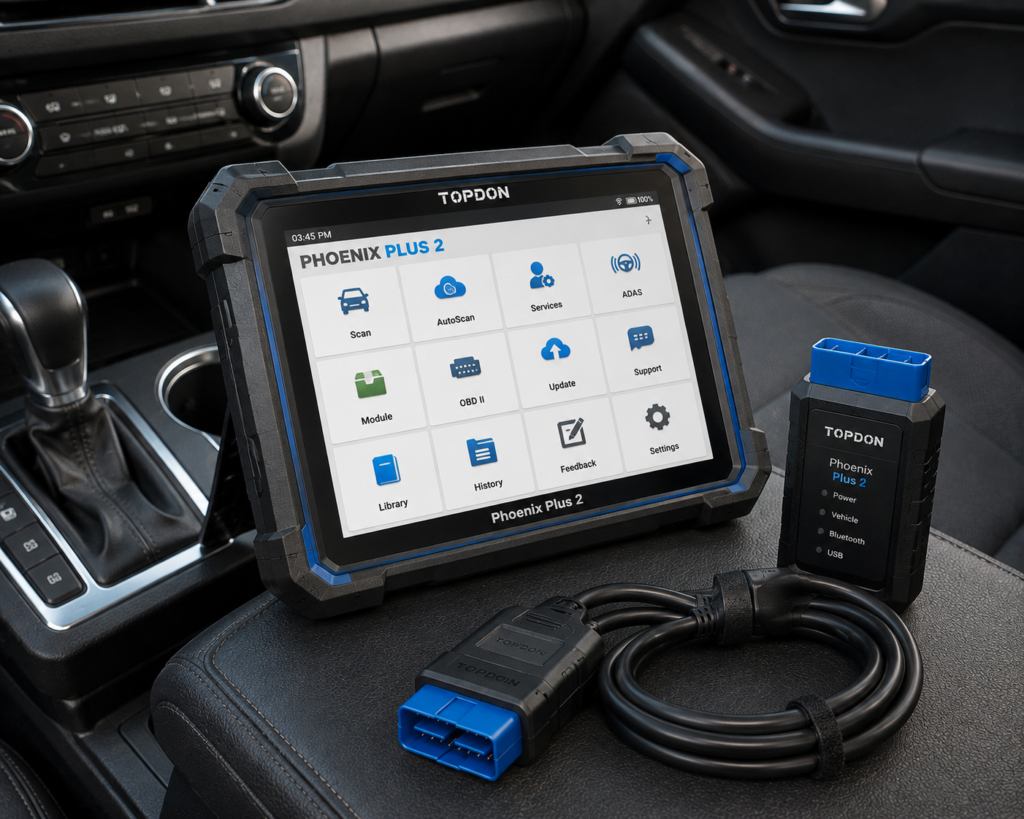
7. TOPDON Phoenix Plus 2: Best Professional Upgrade
Why We Picked It
Some buyers searching for a full-system scanner are already beyond ordinary DIY work.
They may service multiple vehicles, perform paid repair work or need deeper diagnostic workflows.
TOPDON’s Phoenix family is aimed at that higher level.
Phoenix Plus 2 represents a step above ordinary consumer and prosumer tablets, with the broader system access and advanced functions expected from TOPDON’s professional diagnostic range.
That makes it appropriate here as the professional-upgrade option rather than as the default recommendation for everyone.
Where It Falls Short
Professional depth creates professional complexity.
A buyer should not choose Phoenix Plus 2 merely because it has more features.
Software ownership terms also matter more in professional platforms because current vehicle coverage can be part of the tool’s business value.
| Specification | Details |
|---|---|
| Display | 10.1-inch LCD, 1280×800 |
| OS / Processor | Android 10.0, 4-core 2.0GHz |
| Memory / Storage | 4GB RAM / 64GB ROM |
| Battery | 12,600mAh |
| Connectivity | WiFi 2.4GHz/5GHz |
| Protocols | CAN-FD, DoIP, J2534 pass-through |
| Vehicle coverage | 160+ brands (TOPDON); 150+ brands (Amazon listing) |
| Bidirectional control | Yes (TOPDON does not list a function count) |
| ECU coding (online) | Mercedes-Benz, BMW, VW/Audi/Skoda/SEAT, Porsche, Renault |
| ECU coding (offline programming) | Ford, Mazda, Vauxhall, Opel |
| Service/reset functions | 41+ (TOPDON); 40+ (Amazon listing) |
| Weight | 1.56kg (3.42lb) |
| Warranty / updates | 1-year warranty, 2 years free updates |
| Pros | Cons |
|---|---|
| Professional full-system platform class | GM and Toyota coding: listed on Amazon; not listed on TOPDON’s own page |
| Broad module diagnosis | |
| Advanced service workflow | |
| Suitable for multi-vehicle work | Continued Tesla and FCA Secure Gateway access requires a separate paid subscription |
| Dedicated professional tablet environment | |
| Stronger upgrade path than consumer scanners |
Best For
Advanced users, mobile technicians and smaller professional shops that have outgrown mainstream DIY full-system scanners.
SCG Verdict
Phoenix Plus 2 is the upgrade choice, not because every buyer needs professional depth, but because a full-system guide should include a clear path for users whose diagnostic work has moved beyond the prosumer tier. Our full TOPDON Phoenix Plus 2 review covers the clear upgrade path it offers toward professional depth.
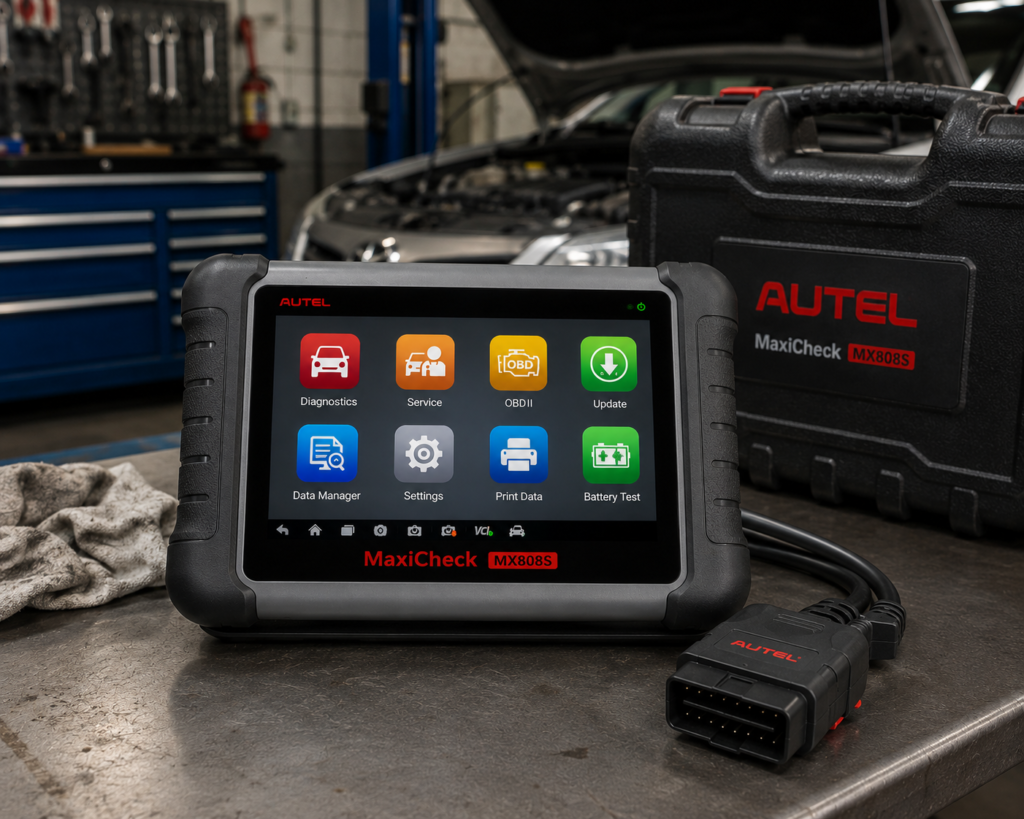
8. Autel MaxiCheck MX808S: Best Compact Autel Alternative
Why We Picked It
Not every full-system buyer needs a wireless VCI.
For many home mechanics, the diagnostic session takes place from the driver’s seat or directly beside the vehicle.
The MX808S provides a dedicated Autel tablet workflow with broad system diagnosis without making wireless VCI operation the central selling point.
Autel’s current documentation positions the MX808S in the full-system diagnostic class with access to supported vehicle control systems, live data and service functions.
That makes it a strong alternative for buyers who want Autel’s software environment but prefer a simpler hardware configuration.
Where It Falls Short
The MX808S overlaps functionally with several Autel products.
Buyers should compare the exact current MX808S with MK808BT Pro and MK900-BT rather than assuming the cheaper or more expensive model is automatically better.
The absence or presence of wireless VCI, active-test depth and current update terms can materially change the decision.
| Specification | Details |
|---|---|
| Display | 7-inch LCD capacitive touchscreen, 1024×600 |
| OS / Processor | Android 11, Rockchip RK3566 (1.8GHz) |
| Memory | 4GB RAM, 64GB storage |
| Connectivity | Wi-Fi 2.4/5GHz only; no Bluetooth; no CAN-FD/DoIP |
| Battery | 3.7V/5000mAh; ~7 hours continuous use |
| Bidirectional control | Confirmed |
| ECU coding | Autel’s own page says “perform Coding and Adaptations” |
| Service functions | 28+ (oil reset, EPB, ABS auto bleed, SAS calibration, DPF regen, injector reset) |
| Vehicle coverage | 80+ makes and models, 1996 and newer (per Autel); Amazon lists “200+ Brands” |
| Pros | Cons |
|---|---|
| Full-system diagnostic class | No Bluetooth; Wi-Fi only |
| Dedicated tablet | |
| Broad supported module access | |
| Live data | |
| Service-function environment | |
| Mature Autel software ecosystem | |
| Strong advanced-DIY fit |
Best For
Advanced DIY users who want a dedicated Autel full-system tablet without making wireless vehicle communication a requirement.
SCG Verdict
The MX808S remains a rational full-system choice because hardware format matters. Not every buyer benefits enough from wireless VCI operation to make it mandatory. See our full Autel MaxiCheck MX808S review for why hardware format matters as much as wireless VCI operation.
9. Innova 5610: Best Full-System Scanner for Maximum Simplicity
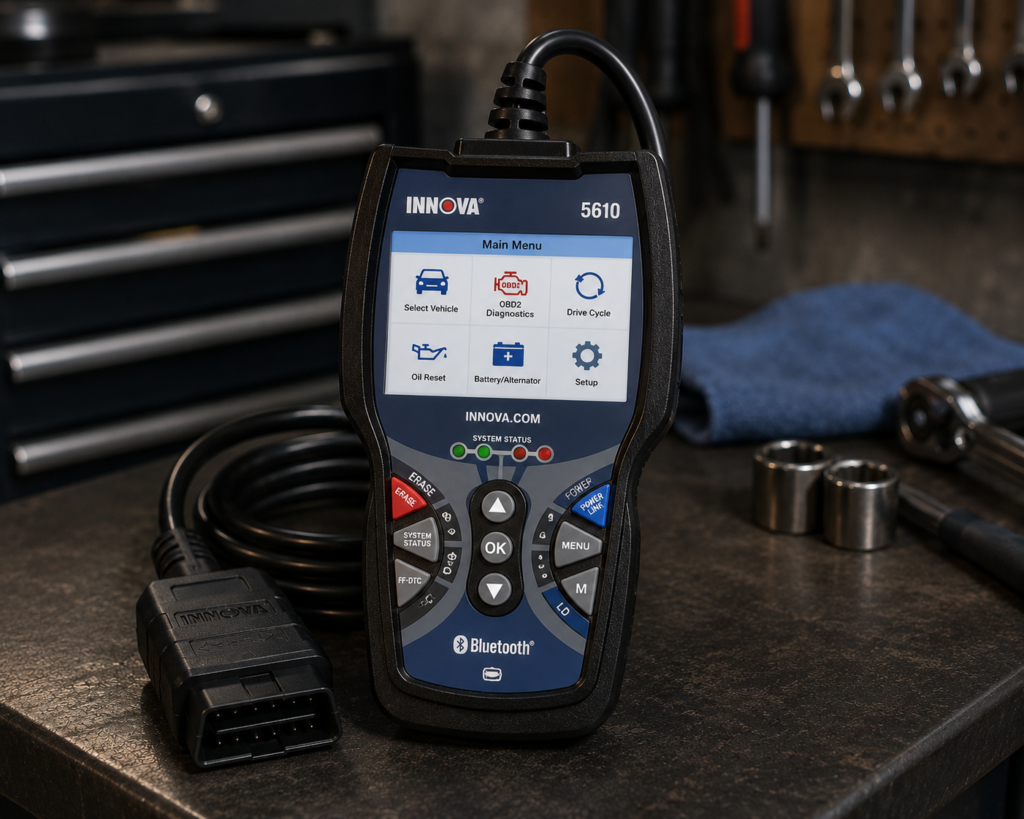
Why We Picked It
Full-system capability does not have to mean a large Android tablet.
Innova’s 5610 takes a more traditional handheld approach.
Innova currently positions it as an all-system scanner with bidirectional active tests on supported vehicles and a no-subscription/no-update-fee ownership model.
That combination makes it particularly attractive to North American DIY owners who want deeper module access without adopting a larger professional-style tablet ecosystem.
The RepairSolutions2 environment can also add repair context around diagnostic results.
Where It Falls Short
The 5610 is not designed to compete with D8W or Phoenix Plus 2 on professional workflow.
Its smaller hardware and North American focus make it a different type of full-system tool.
Secure-gateway restrictions can also affect certain functions on newer vehicles.
And it does not provide universal ECU programming.
| Specification | Details |
|---|---|
| Form Factor | Handheld unit with dedicated screen |
| App Integration | RepairSolutions2 app (Innova states 4M users) |
| Bidirectional Control | Confirmed; commands ABS pumps, fuel injectors, and other components directly |
| Reset Functions | 20+ confirmed by Innova, including oil, battery, EPB, DPF, TPMS relearn, key coding, injector coding, EV/HEV/PHEV battery health |
| ECU Coding / Reprogramming | Not supported, stated directly by Innova |
| Vehicle Coverage | Most 1996-2023 US/Canada OBD2 vehicles; North America only |
| FCA Vehicles | 2018+ requires Innova’s AutoAuth process for full functionality |
| Update Policy | Free updates, no subscription, confirmed directly by Innova |
| Pros | Cons |
|---|---|
| All-system diagnostic positioning | North America only; not for use outside the US/Canada |
| Bidirectional active tests on supported vehicles | |
| Dedicated handheld | |
| No subscriptions currently stated | |
| No update fees currently stated | |
| RepairSolutions2 ecosystem | |
| Vehicle compatibility checker | |
| Straightforward North American ownership model |
Best For
U.S. and Canadian DIY mechanics who want broad vehicle-system diagnosis with the simplest possible ownership model.
SCG Verdict
The 5610 is here because “full-system” should describe diagnostic access, not tablet size. For the right owner, a simpler handheld can provide a better experience than a feature-heavy professional platform. Our full Innova 5610 review makes the case for a simpler handheld over a larger tablet for the right owner.
What Does “Full-System” Actually Mean?
A full-system scanner is designed to communicate with the electronic modules available on a supported vehicle.
Depending on the vehicle, those can include: ECM/Engine, TCM/Transmission, ABS, SRS/Airbag, BCM/Body Control, HVAC, Electronic Parking Brake, Battery Management, Steering, TPMS, Instrument Cluster, Door Modules, Lighting, Immobilizer-related systems, Suspension, ADAS-related modules, other manufacturer-specific ECUs.
The exact list varies by vehicle.
“Full-system” therefore should never be translated into: “Every module and every function on every car.”
Full-System Diagnostics vs. Generic OBD2
Generic OBD2 is standardized primarily around emissions-related powertrain diagnostics.
It is excellent for tasks such as: reading Check Engine DTCs, clearing supported emissions DTCs, viewing standardized live data, checking I/M readiness, freeze-frame data.
Full-system diagnostics go beyond that standardized layer.
They attempt to communicate with manufacturer-specific modules across the vehicle.
That is why a full-system scanner can often identify faults that a basic OBD2 reader never sees.
Full-System Does Not Automatically Mean Bidirectional
These terms describe different things.
Full-system = diagnostic breadth.
Bidirectional = ability to send supported commands to vehicle modules/components.
A scanner can read every supported module but have limited active-test capability.
Another scanner can provide both.
If active tests matter, verify them separately.
What Are Bidirectional Active Tests?
A bidirectional scanner can command supported vehicle functions.
Examples can include: fuel pump activation, cooling fan commands, injector tests, EVAP valve commands, A/C clutch activation, window/door commands, ABS pump operation, lighting commands, other supported actuators.
This can help isolate a fault.
But the scanner does not automatically diagnose the failed part.
The result still requires interpretation.
Full-System Does Not Automatically Mean ECU Coding
Module access and coding are separate capabilities.
Some scanners in this guide provide supported coding or adaptation functions.
That does not mean universal ECU programming.
SCG distinguishes: Diagnostics, Active tests, Service functions, Adaptation, Coding, Programming.
Manufacturers and sellers sometimes blur these terms.
Why CAN FD and DoIP Matter
Modern vehicles increasingly use newer communication technologies.
CAN FD provides higher data capacity than classic CAN in supported applications.
DoIP carries diagnostic communication over IP-based networking on supported vehicles.
If a scanner’s hardware cannot communicate through the protocol required by a vehicle, software features alone cannot solve that limitation.
Buyers working on newer vehicles should therefore check protocol support as part of compatibility, not as a marketing badge.
Why Topology Mapping Can Help
Traditional scanners display a module list.
Topology-enabled scanners can visually represent modules and communication relationships.
This can be useful when: several modules report communication faults, one module is offline, a network branch has problems, the technician wants a fast pre/post scan overview.
Topology does not repair the vehicle.
It organizes diagnostic information.
Wireless VCI: Bluetooth vs. Wi-Fi
Wireless vehicle communication lets the user move around the vehicle while the scanner remains connected.
Bluetooth is common and practical.
Wi-Fi-based VCI systems can offer greater bandwidth or range depending on implementation.
XTOOL D8W is notable in this guide because Wi-Fi vehicle communication is a central part of its design.
The better choice depends on workflow, not the technology label alone.
How Many Service Functions Do You Actually Need?
Manufacturers frequently advertise: 28+, 35+, 40+, 50+ service functions.
Those numbers are poor buying criteria by themselves.
A buyer may need only: oil reset, EPB, BMS, ABS bleed, SAS calibration, DPF regeneration, injector coding, throttle relearn.
A scanner with 50 menu items but no support for the one function required on your vehicle is worse than a scanner with 10 that includes it.
Verify function-level coverage.
Full-System Scanner or Professional Scan Tool?
These categories overlap but are not identical.
A serious full-system scanner can provide: broad module access, live data, active tests, service functions, supported coding.
A professional shop platform may additionally emphasize: J2534 programming, topology, remote diagnostics, ADAS integration, oscilloscope integration, TPMS ecosystems, repair information, shop/customer management, heavy-duty support, higher-end VCI hardware, technical support workflows.
Do not buy a professional platform unless your work justifies it.
Best Professional Automotive Scan Tools in 2026
Full-System Scanner or Four-System Scanner?
A four-system scanner usually focuses on: Engine, Transmission, ABS, SRS.
For many DIY users, that is enough.
Full-system becomes valuable when you diagnose body, HVAC, steering, parking brake, battery, TPMS and other manufacturer-specific modules.
If your actual work stops at the four major systems, a four-system scanner can be the better purchase.
Best OBD2 Scanners for ABS and SRS in 2026
Common Full-System Scanner Buying Mistakes
Mistake 1: Believing “Full-System” Means Universal Coverage
It does not. Verify the exact vehicle.
Mistake 2: Assuming Every Full-System Scanner Is Bidirectional
It is not.
Mistake 3: Confusing Coding With Programming
These are different capabilities.
Mistake 4: Buying by Reset Count
Feature count is not coverage.
Mistake 5: Ignoring VCI Hardware
Modern protocols can require compatible hardware.
Mistake 6: Ignoring Software Ownership
An advanced scanner is only as current as the software coverage available to it.
Mistake 7: Buying a Professional Tablet for Basic Check Engine Work
More scanner does not automatically mean better value.
Mistake 8: Ignoring Product-Version Names
MK900-BT is not MK900. MK808BT Pro is not every other 808 variant. CRP919EBT is not automatically CRP919E Lite. Exact identity matters.
How This Guide Differs From Our Bidirectional Guide
The bidirectional guide is controlled by one advanced capability: can the scanner command supported components?
This guide is controlled by breadth: can the scanner diagnose the vehicle across supported control modules?
Many products do both, but the search intents are different.
A scanner can be full-system without being the strongest active-test tool.
Best Bidirectional Scan Tools in 2026
How This Guide Differs From Our Professional Guide
Professional scanners are evaluated around business and technician workflow.
Full-system scanners are evaluated first around whole-vehicle diagnostic access.
A serious DIY owner can need full-system diagnostics without needing a J2534 programming workflow, ADAS ecosystem or shop-management platform.
That distinction keeps this guide useful to a wider group of buyers.
How This Guide Differs From Our DIY Guide
The DIY guide begins with the user.
This guide begins with the diagnostic architecture.
A DIY buyer may choose a simple handheld, Bluetooth scanner or full-system tablet depending on skill and repair needs.
This article is specifically for the buyer who already knows that broad module access matters.
Best OBD2 Scanners for DIY Mechanics in 2026
Our Final Recommendations
For the best overall balance of broad system access, wireless operation and supported active testing, Autel MaxiCOM MK900-BT is our current overall choice.
For buyers who want Wi-Fi vehicle communication, topology, modern protocols and extensive active-test capability, XTOOL D8W is the advanced platform choice.
For strong all-system capability combined with a current lifetime-update policy, THINKCAR THINKSCAN 689BT offers an unusually attractive ownership proposition.
For mid-range wireless full-vehicle diagnosis, Foxwell NT809BT provides a strong dedicated-tablet alternative.
For buyers who prefer an established Autel platform, MK808BT Pro remains a serious option.
For LAUNCH-oriented prosumers, CRP919EBT belongs on the shortlist, but exact current U.S. model-level verification is mandatory before implementation.
For users moving toward professional work, TOPDON Phoenix Plus 2 provides the upgrade path.
For a simpler dedicated Autel tablet, MX808S remains a practical full-system choice.
And for North American DIY owners who want broad module access without a large tablet or recurring scanner subscription, Innova 5610 offers the simplest ownership experience in this group.
The best full-system scanner is not the one that advertises the most functions.
It is the one that communicates with the systems you need, performs the functions you need and fits the way you actually work.
Quick Picks
Best Overall Full-System Scanner: Autel MaxiCOM MK900-BT
A wireless all-system tablet with broad OE-level diagnostics, bidirectional active tests, modern hardware and a mature Autel ecosystem.
Best Wi-Fi Diagnostic Platform: XTOOL D8W
A full-system scanner with Wi-Fi vehicle communication, topology mapping, CAN FD/DoIP, extensive active tests and broad service capability.
Best Advanced Value With Lifetime Updates: THINKCAR THINKSCAN 689BT
A wireless all-system scanner with bidirectional control, ECU coding, CAN FD, DoIP and a current lifetime-update policy.
Best Mid-Range Wireless Choice: Foxwell NT809BT
A Bluetooth full-vehicle scanner with bidirectional controls, 30+ resets and a straightforward dedicated-tablet workflow.
Best Established Autel Mid-Range Platform: Autel MaxiCOM MK808BT Pro
A wireless all-system Autel tablet with bidirectional controls and broad service functions for advanced DIY and small-shop use.
Best for Serious DIY / Prosumer LAUNCH Users: LAUNCH X431 CRP919EBT
A full-system wireless platform aimed at buyers who want LAUNCH active tests and service capability without moving to the highest X-431 shop tier.
Best Professional Upgrade: TOPDON Phoenix Plus 2
A higher-level full-system platform for advanced users and smaller professional operations that need broader diagnostic depth than ordinary DIY tablets.
Best Compact Autel Alternative: Autel MaxiCheck MX808S
A dedicated full-system tablet for buyers who want broad module access and serious DIY capability without prioritizing wireless VCI operation.
Best Full-System Scanner for Maximum Simplicity: Innova 5610
A handheld all-system platform with supported bidirectional controls and a particularly clear no-subscription ownership model for North American DIY users.
Frequently Asked Questions
What is a full-system automotive scanner?
A full-system scanner is designed to access multiple electronic control modules across a supported vehicle rather than only standardized engine OBD2 diagnostics. Exact module coverage varies by vehicle.
What is the best full-system scanner in 2026?
SCG’s current overall choice is Autel MaxiCOM MK900-BT for its balance of all-system diagnostics, wireless VCI operation and supported bidirectional testing. Different users may be better served by D8W, THINKSCAN 689BT, NT809BT or another platform depending on workflow.
Does full-system mean bidirectional?
No. Full-system describes module-access breadth. Bidirectional describes the ability to send supported commands to vehicle systems. Verify both separately.
Can a full-system scanner diagnose ABS and airbags?
A compatible full-system scanner normally targets systems such as ABS and SRS in addition to engine and transmission. Exact vehicle coverage must still be verified.
Can a full-system scanner code ECUs?
Some can perform supported coding or adaptation. That does not mean universal ECU programming.
Do I need CAN FD or DoIP?
It depends on the vehicles you service. These protocols are increasingly relevant on newer platforms. Verify the exact vehicle’s communication requirements.
Do full-system scanners require subscriptions?
Ownership models vary. Some include a fixed update period, some currently offer lifetime updates, and some continue working after updates expire but require payment for newer software. Check the exact policy.
Is a full-system scanner worth it for DIY work?
Yes, when your repairs involve systems beyond the engine. If you only need Check Engine diagnostics, a simpler scanner may be better value.
Can a full-system scanner replace a dealer diagnostic tool?
Not universally. Aftermarket scanners can provide broad and sometimes very advanced functionality, but OEM tools can still be required for certain programming, security, guided procedures and manufacturer-specific operations.
Bottom Line
Modern cars are networks of computers.
A basic OBD2 reader sees only a limited part of that network.
A good full-system scanner expands the diagnostic view across the vehicle.
But broad access is only the beginning.
You still need to ask: Does it support my vehicle? Does it access the module I need? Does it provide the active test or service procedure I need? Does its VCI support the required protocol? What happens when the included software-update period ends?
Answer those questions before comparing feature counts.
That is how a full-system scanner becomes a useful diagnostic tool rather than simply a more expensive code reader.