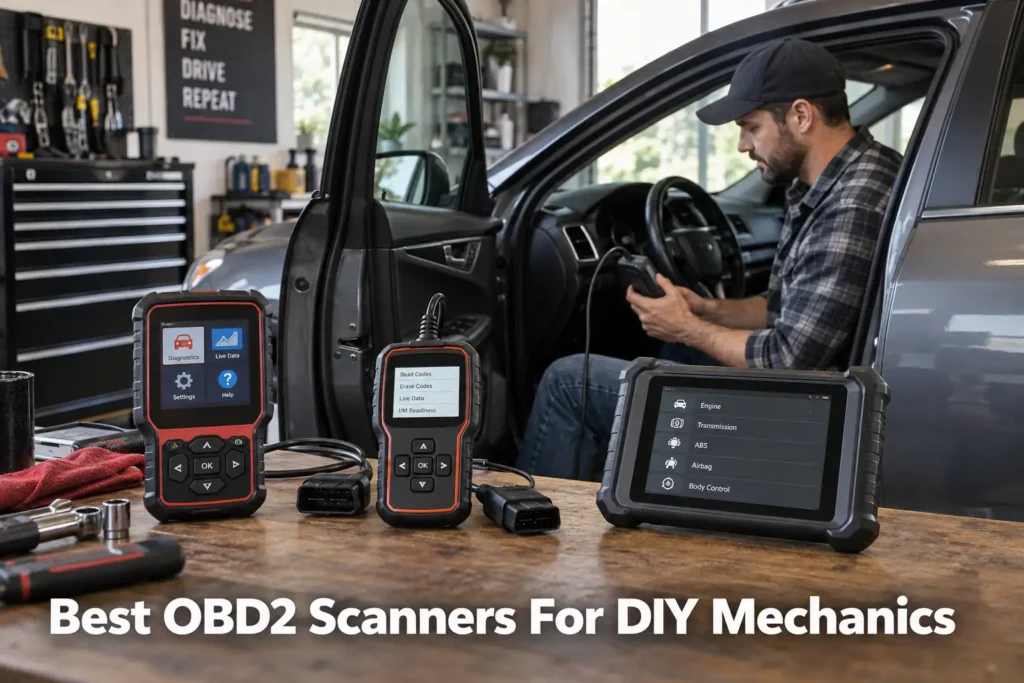
7 Best OBD2 Scanners for DIY Mechanics in 2026: From First Repairs to Advanced Diagnostics
Working on your own car changes what you should expect from an OBD2 scanner.
A driver who only wants to understand a Check Engine light may be satisfied with basic code reading. A DIY mechanic needs more. Once you start diagnosing ABS or airbag faults, replacing batteries, servicing electronic parking brakes, bleeding ABS systems, monitoring live data or testing components, the scanner becomes part of the repair process rather than simply a warning-light reader.
That does not mean every home mechanic needs a professional diagnostic tablet.
The right DIY scanner is the least complicated tool that reliably supports the systems and functions you actually need on the vehicles you work on.
For this guide, Scan Choice Guide evaluated scanners across several levels of DIY work. We considered diagnostic depth, system coverage, live data, bidirectional testing, service functions, vehicle coverage, hardware format, software and update policies, ease of use and how much diagnostic knowledge each tool expects from its owner.
We also deliberately avoided turning this guide into a copy of our Bluetooth or general OBD2 rankings. A DIY guide should answer a different question: which tools best support people who actually maintain and repair their own vehicles?
Our recommendations are based on manufacturer documentation, vehicle-coverage information where available, current 2026 market research and SCG comparative analysis. The results we present come from our own research into manufacturer documentation, Amazon listings, and compatibility data.
Our Top Picks for DIY Mechanics
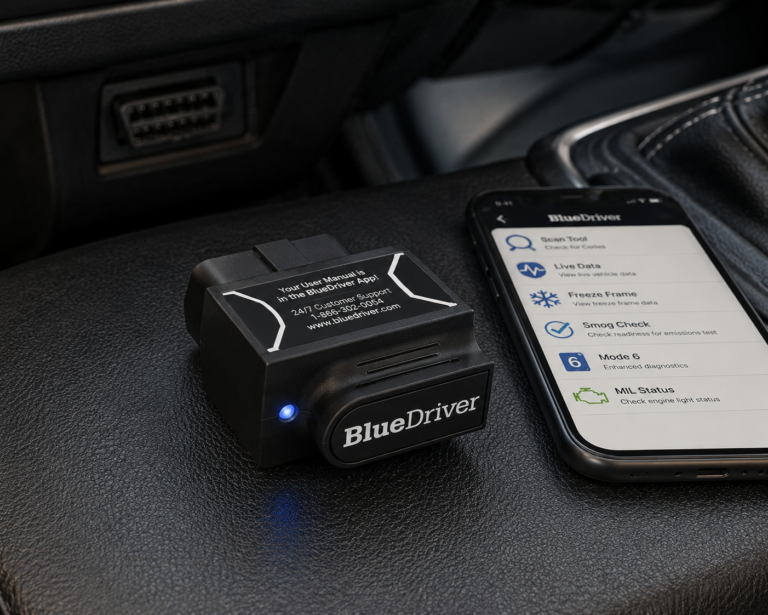
BlueDriver Pro
- Beginner-friendly integrated app
- Enhanced diagnostics on supported vehicles
- Repair Reports
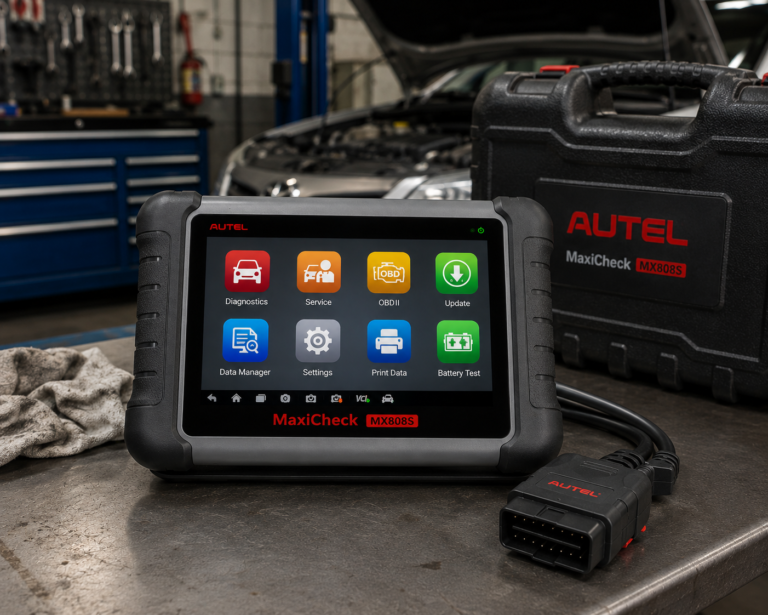
Autel MaxiCheck MX808S
- All-system code reading and clearing
- Bidirectional Active Tests
- Dedicated 7-inch tablet
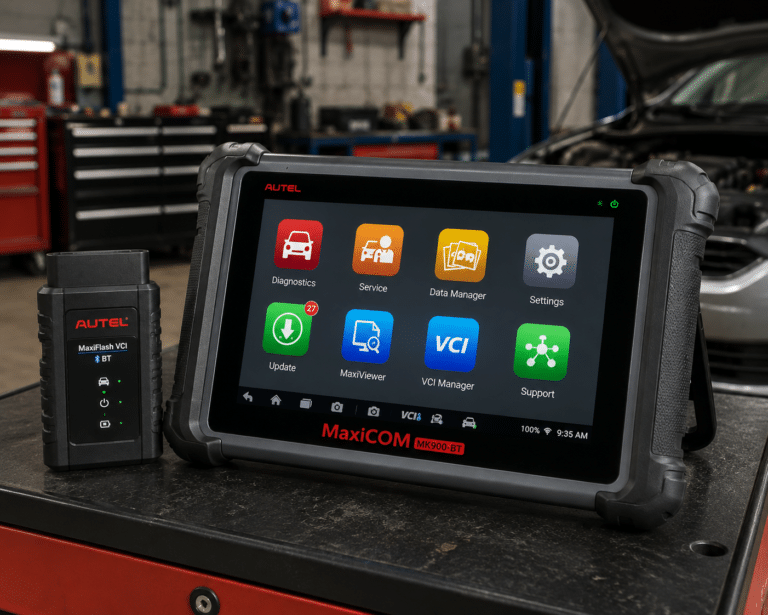
Autel MaxiCOM MK900-BT
- Dedicated 8-inch tablet
- All-system diagnostic platform
- Advanced service capability
Affiliate Disclosure: Scan Choice Guide is a participant in the Amazon Services LLC Associates Program, an affiliate advertising program designed to provide a means for sites to earn advertising fees by advertising and linking to Amazon.com.
The 7 Best OBD2 Scanners for DIY Mechanics, Reviewed
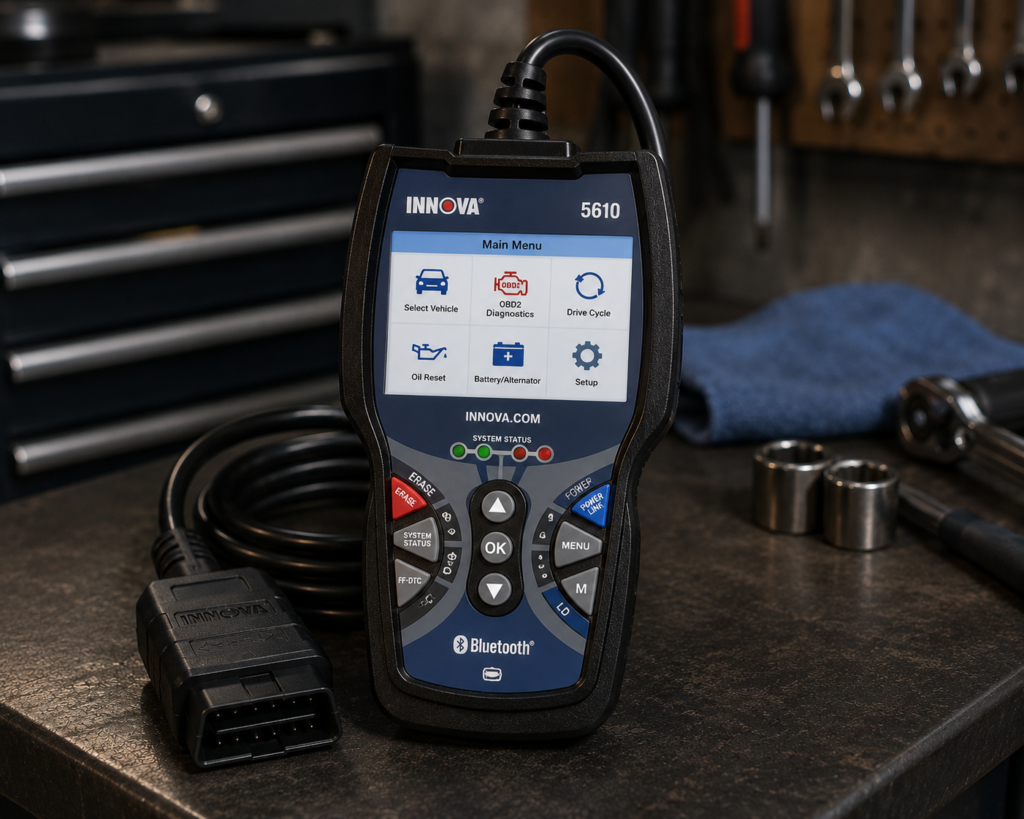
1. Innova 5610: Best Overall OBD2 Scanner for DIY Mechanics
Why We Picked It
The Innova 5610 fits the point where many home mechanics eventually arrive.
A basic code reader is no longer enough, but a professional diagnostic platform would be unnecessary.
Innova specifies all-system diagnostics on supported vehicles, including access to systems such as engine, transmission, ABS and SRS. It also provides bidirectional controls that can command supported components during diagnosis.
That matters because a trouble code only tells you what the vehicle detected, not whether the suspect part is actually the problem.
Bidirectional active tests close that gap: on a supported vehicle, the 5610 can command components like ABS pumps or fuel injectors directly, so a home mechanic can confirm a part responds before spending money replacing it on the strength of a code alone.
The 5610 also supports vehicle-dependent service, reset and relearn functions.
For a home mechanic, those functions can reduce unnecessary shop visits after certain maintenance or component-replacement jobs.
Another advantage is format.
The 5610 is a standalone handheld scanner. Your personal phone does not have to become the primary diagnostic screen, although Innova’s RepairSolutions2 ecosystem can add connected information.
Where It Falls Short
The 5610 does not replace a professional diagnostic platform.
It does not provide the topology environment, broad coding workflow or supported programming capabilities found on higher-level tablets.
More importantly, advanced functionality is vehicle-dependent.
Innova directs buyers to check coverage by year, make and model. That warning should be taken seriously.
A scanner can support bidirectional control as a platform while still lacking a particular active test on a particular vehicle.
| Specification | Details |
|---|---|
| Form Factor | Handheld unit with dedicated screen |
| App Integration | RepairSolutions2 app (Innova states 4M users) |
| Bidirectional Control | Confirmed; commands ABS pumps, fuel injectors, and other components directly |
| Reset Functions | 20+ confirmed by Innova, including oil, battery, EPB, DPF, TPMS relearn, key coding, injector coding, EV/HEV/PHEV battery health |
| ECU Coding / Reprogramming | Not supported, stated directly by Innova |
| Vehicle Coverage | Most 1996-2023 US/Canada OBD2 vehicles; North America only |
| FCA Vehicles | 2018+ requires Innova’s AutoAuth process for full functionality |
| Update Policy | Free updates, no subscription, confirmed directly by Innova |
| Pros | Cons |
|---|---|
| All-system diagnostics on supported vehicles | North America only; not for use outside the US/Canada |
| Bidirectional active tests | |
| Standalone handheld design | |
| Useful service and relearn functions | |
| Optional connected ecosystem | |
| Strong balance for serious home use | |
| Less complex than a professional tablet |
Best For
Home mechanics who perform their own maintenance and repairs and need substantially more than basic Check Engine diagnostics.
SCG Verdict
The Innova 5610 remains our best overall DIY choice because it occupies the useful middle ground: enough diagnostic depth to support real repair work without turning every garage job into a professional-tablet workflow. See our full Innova 5610 review for why that middle ground works so well for real repair work.
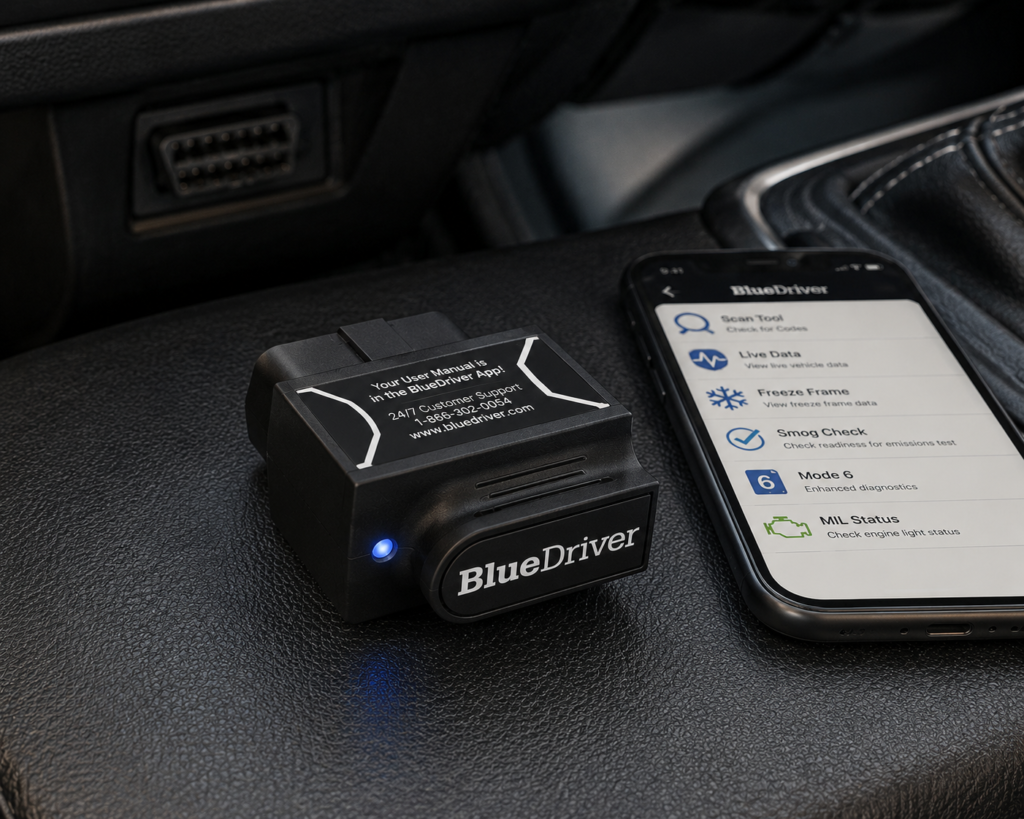
2. BlueDriver Pro: Best for DIY Beginners
Why We Picked It
Learning to repair your own vehicle is difficult enough without learning a complicated professional scan-tool interface at the same time.
BlueDriver keeps the diagnostic side relatively approachable.
The adapter connects to an iOS or Android phone and works through BlueDriver’s integrated app. It supports standard OBD2 diagnostics such as Check Engine codes, freeze-frame information, emissions readiness and live data.
On supported vehicles, it also provides enhanced diagnostics for additional systems such as ABS, airbags and transmission.
For a DIYer standing in the driveway, BlueDriver’s most useful feature is what happens after the code appears.
Repair Reports pulls up what other owners with the same code on the same vehicle actually found and fixed, turning a code number into an actual next step. That does not diagnose the car automatically, and it should never be treated as proof that a suggested component has failed.
But it can give a new DIYer a more useful starting point than a diagnostic code alone.
Where It Falls Short
A developing DIY mechanic can outgrow BlueDriver.
Once your repairs require extensive bidirectional component testing, broad service procedures, coding or professional-style module workflows, another class of scanner becomes more appropriate.
It is also phone-dependent.
| Specification | Details |
|---|---|
| Connectivity | Bluetooth dongle, pairs with the free BlueDriver app on iOS/Android |
| Vehicle compatibility | 1996 and newer gas, diesel, and hybrid vehicles sold in North America (confirm your exact vehicle via the SCG Finder) |
| Enhanced code reading | ABS, SRS/airbag, transmission, TPMS, 4WD/AWD, hybrid/EV codes on a documented brand list; coverage varies by model/year |
| Repair context | “Confirmed Fix” reports showing real repairs for the same code on the same vehicle |
| Subscription policy | “No subscriptions. No add-ons. Ever.” per BlueDriver’s official page |
| Screen | None; requires a compatible phone with the BlueDriver app |
| Pros | Cons |
|---|---|
| Beginner-friendly integrated app | No standalone screen; requires a compatible phone |
| Standard OBD2 diagnostics | |
| Enhanced diagnostics on supported vehicles | |
| Repair Reports | |
| Live data | |
| Compact hardware |
Best For
New DIY mechanics who want to understand vehicle faults and build diagnostic confidence before moving into active testing and advanced service work.
SCG Verdict
BlueDriver earns a place in this DIY guide because beginners need a different kind of value than advanced users. Clear diagnostic context can be more useful at this stage than a tablet full of functions the owner does not yet need. See our full BlueDriver review for the diagnostic context it gives beginners that a bare code reader doesn’t.
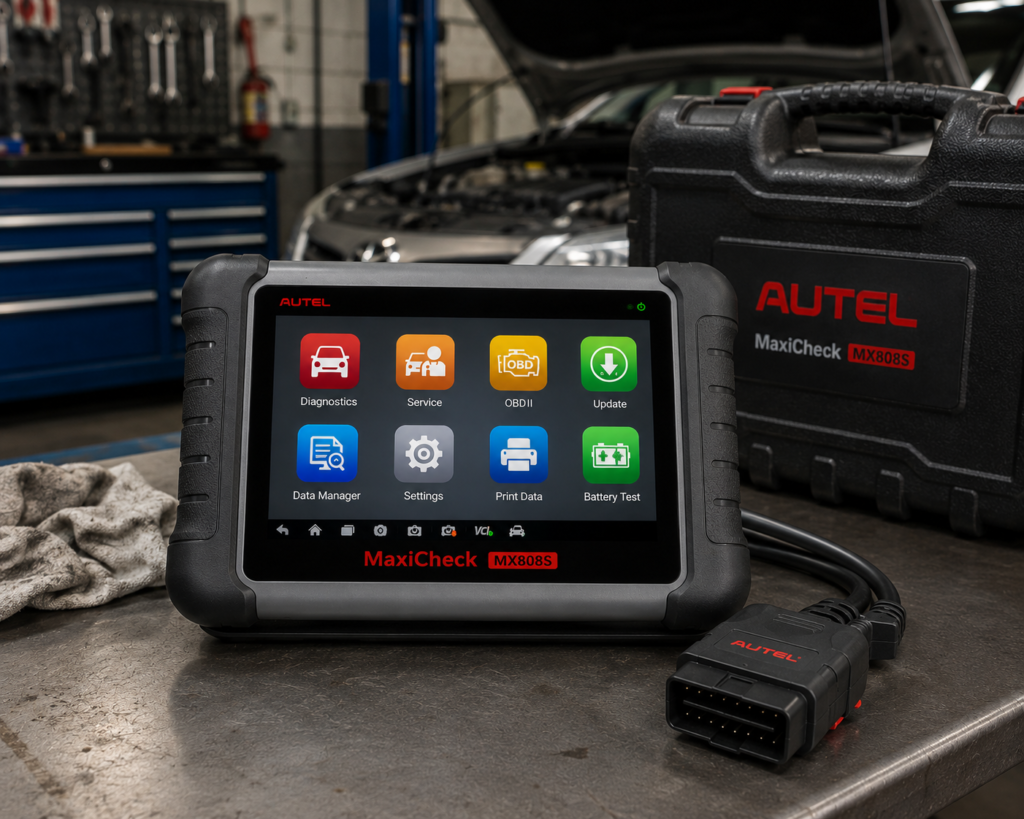
3. Autel MaxiCheck MX808S: Best Value Full-System DIY Tablet
Why We Picked It
The Autel MaxiCheck MX808S is an important step up from consumer scanners without automatically pushing the owner into a high-end professional platform.
Autel’s current documentation specifies reading and clearing codes across available systems, live-data viewing and graphing, AutoVIN, bidirectional Active Tests, Coding and Adaptations, and a range of maintenance procedures.
Those procedures include functions such as steering-angle reset, electronic parking-brake service, DPF regeneration, injector reset and battery registration on supported vehicles.
For a DIY mechanic, that combination is far more relevant than simply having a long list of generic OBD2 modes.
It means the scanner can participate in the repair workflow.
The 7-inch dedicated tablet also gives the owner a purpose-built diagnostic screen rather than requiring a personal phone.
Where It Falls Short
The MX808S is not the right tool for every home garage.
A beginner who only needs engine codes and basic live data would be buying capability that may sit unused.
The phrase “Coding and Adaptations” also needs careful interpretation. It does not mean universal ECU programming, nor does it guarantee every coding function on every vehicle.
The same applies to active tests and service procedures.
Coverage must be checked for the exact vehicle and function.
| Specification | Details |
|---|---|
| Display | 7-inch LCD capacitive touchscreen, 1024×600 |
| OS / Processor | Android 11, Rockchip RK3566 (1.8GHz) |
| Memory | 4GB RAM, 64GB storage |
| Connectivity | Wi-Fi 2.4/5GHz only; no Bluetooth; no CAN-FD/DoIP |
| Battery | 3.7V/5000mAh; ~7 hours continuous use |
| Bidirectional control | Confirmed |
| ECU coding | Autel’s own page says “perform Coding and Adaptations” |
| Service functions | 28+ (oil reset, EPB, ABS auto bleed, SAS calibration, DPF regen, injector reset) |
| Vehicle coverage | 80+ makes and models, 1996 and newer (per Autel); Amazon lists “200+ Brands” |
| Pros | Cons |
|---|---|
| All-system code reading and clearing | No Bluetooth; Wi-Fi only |
| Live-data viewing and graphing | |
| Bidirectional Active Tests | |
| Coding and adaptations on supported applications | |
| Useful maintenance functions | |
| AutoVIN | |
| Dedicated 7-inch tablet | |
| Strong bridge between consumer and advanced tools |
Best For
Intermediate DIY mechanics who have outgrown consumer scanners and want a compact full-system tablet with active tests and maintenance functions.
SCG Verdict
The MX808S is one of the most logical upgrades for a home mechanic who wants a real diagnostic tablet without immediately buying a much larger professional platform. Our full Autel MaxiCheck MX808S review covers exactly what that upgrade gets you.
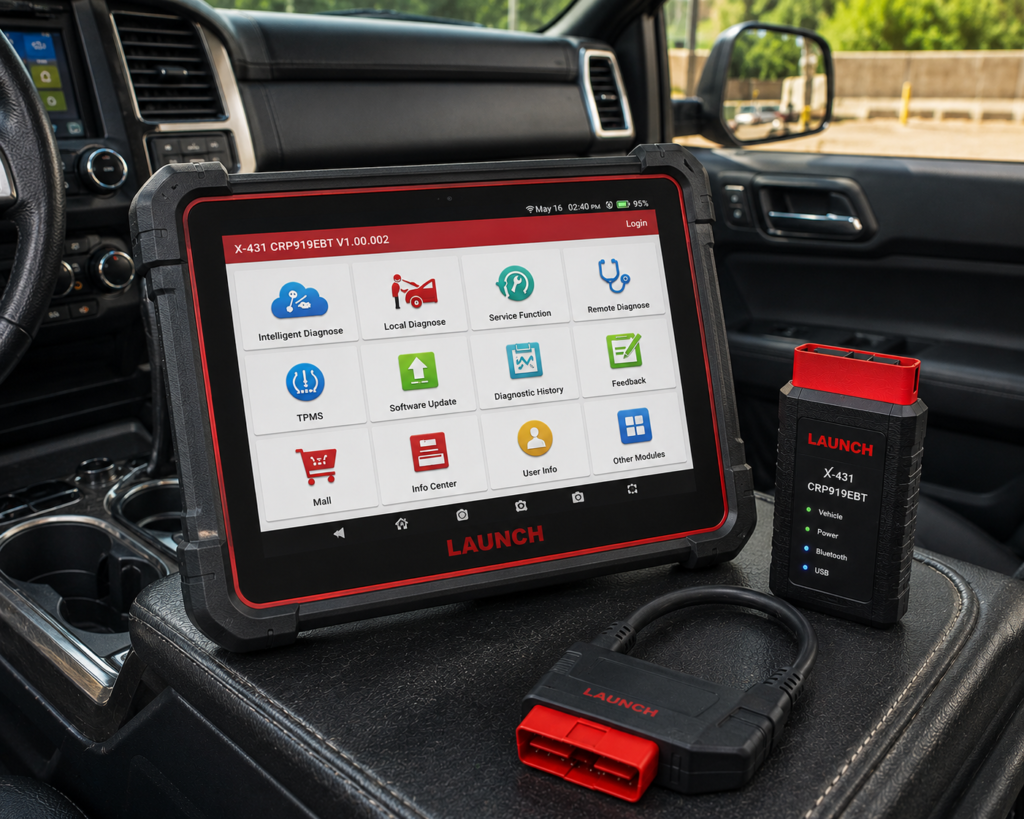
4. LAUNCH X431 CRP919EBT: Best Wireless DIY Tablet
Why We Picked It
Wireless vehicle communication becomes genuinely useful when diagnosis requires you to move around the car.
A DIY mechanic may need to watch a component under the hood, listen for an actuator, observe a wheel area or work away from the driver’s seat while the scanner remains connected.
The LAUNCH X431 CRP919EBT belongs to the class of full-system wireless tablets designed for that type of workflow.
The CRP919 family is positioned around broad system diagnosis, active testing and maintenance/service functions rather than simple engine-code reading.
For a serious DIY owner, that makes it a meaningful alternative to phone dongles and entry-level handheld tools.
It also sits below LAUNCH’s larger professional platforms, which is useful for owners who want advanced capability without buying a shop flagship.
Where It Falls Short
LAUNCH model naming and regional listings require careful verification.
Function availability also varies by vehicle.
A platform-level claim for active tests or service functions should never be converted into a promise for one specific car without coverage confirmation.
| Specification | Details |
|---|---|
| Operating System | Android 10.0 |
| Processor | 2.0GHz quad-core |
| Memory / Storage | 4GB RAM, 64GB storage |
| Vehicle Connection | Bluetooth, wireless |
| Vehicle Coverage | 150+ makers, 10,000+ vehicles, 1996-2024 |
| Bidirectional Control | Confirmed across ECM, ABS, SRS, TCM, EPB, TPMS, SAS, A/C, BMS, ESP |
| ECU Coding | Confirmed for BMW, VW, Audi, Skoda specifically, not universal |
| TPMS | Confirmed, TPMS reset function documented |
| Maintenance Functions | 31 confirmed, including ABS bleeding |
| Update Policy | 2 years free update confirmed per Amazon listing |
| Pros | Cons |
|---|---|
| Dedicated wireless diagnostic workflow | Launch's official storefronts are fragmented across several regional domains |
| Full-system class | |
| Active-test capability on supported vehicles | |
| Broad service-function positioning | |
| Better mobility around the vehicle | |
| Serious DIY/prosumer fit |
Best For
Serious DIY mechanics who want a dedicated wireless full-system scanner and prefer the LAUNCH ecosystem.
SCG Verdict
The CRP919EBT earns its place as a wireless DIY choice, but SCG will treat exact model identity and vehicle-specific coverage as mandatory verification items rather than relying on marketplace naming. See our full LAUNCH X431 CRP919EBT review for the exact model-identity and coverage verification this pick requires.
5. TOPDON TopScan: Best Advanced Phone-Based Scanner for DIYers
Why We Picked It
A phone-based scanner does not have to be a basic code reader.
TOPDON TopScan demonstrates that clearly.
TOPDON specifies full-system diagnostics and bidirectional control across the TopScan family. That allows supported versions to move beyond generic engine diagnostics and communicate with additional vehicle modules.
For a DIY mechanic, active tests can be particularly valuable because the scanner can command supported components during diagnosis.
TopScan also provides service functions, with the number and depth depending on the Lite, Pro or Master version.
Modern vehicle support is another consideration. The current family includes newer protocol support at different levels, so version choice matters.
Where It Falls Short
TopScan’s versions and software model require attention.
Lite, Pro and Master are not identical products.
Your phone also becomes part of the diagnostic system.
Finally, bidirectional support is not a universal promise that every actuator command exists for every vehicle.
| Pros | Cons |
|---|---|
| Full-system diagnostic platform | Requires a smartphone |
| Bidirectional active tests on supported vehicles | |
| Compact phone-based format | |
| Service functions | Advanced software can involve renewal costs |
| Multiple capability levels | |
| Strong advanced-DIY potential |
Best For
DIY mechanics who want advanced full-system and bidirectional capability while keeping the hardware compact.
SCG Verdict
TopScan is retained here because it solves a genuinely important DIY use case: advanced diagnosis without a dedicated tablet. It is not here simply because it also ranked in our Bluetooth guide.
6. Autel MaxiCOM MK900-BT: Best Advanced DIY Workshop Tablet
Why We Picked It
There is a point in DIY work where a phone adapter or smaller tablet stops being the most convenient long-term solution.
If you regularly diagnose several systems, perform service procedures and work on multiple vehicles, a dedicated wireless workshop tablet can make more sense.
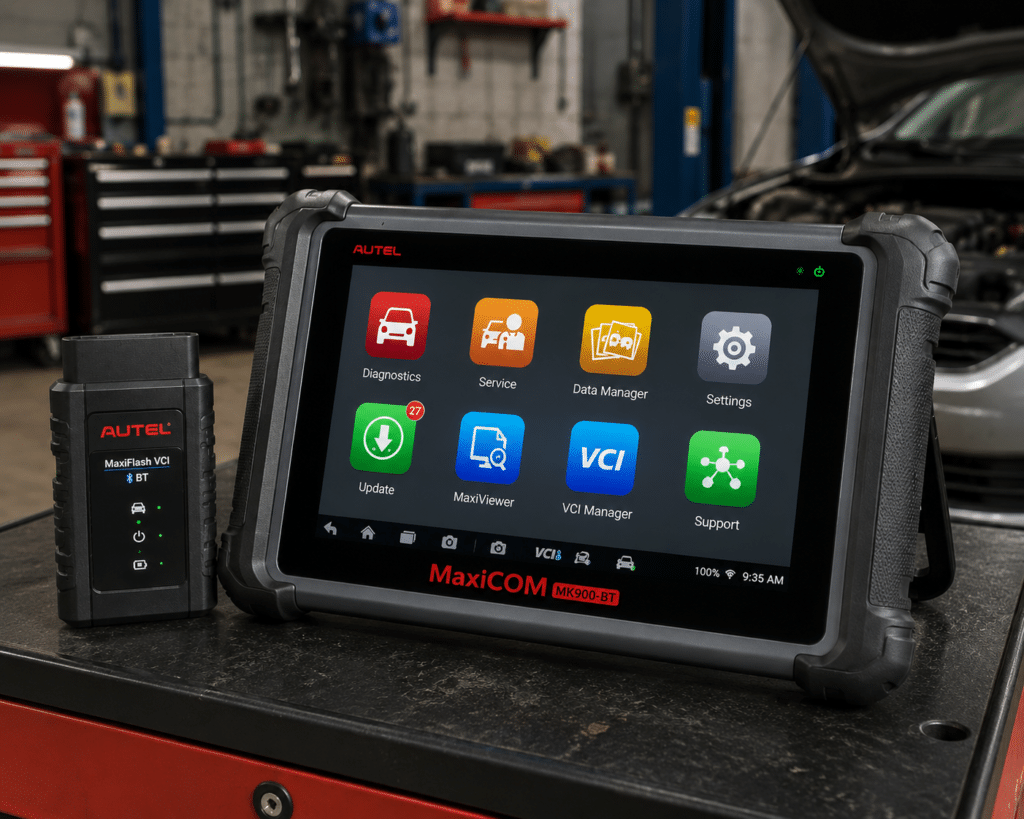
The Autel MaxiCOM MK900-BT is designed for that class of work.
Autel positions the MK900-BT as an all-systems diagnostic and service tablet with an 8-inch touchscreen and wireless vehicle communication.
The larger dedicated format gives an experienced home mechanic a workshop tool that does not depend on a personal phone and provides room for a broader diagnostic workflow.
Where It Falls Short
The MK900-BT should not be purchased merely because it looks more professional.
A home mechanic who performs basic maintenance and occasional Check Engine diagnosis may never use enough of its capability to justify this class of scanner.
Advanced functions must also be verified by vehicle.
“All systems” describes diagnostic breadth. It does not guarantee every service, coding or active-test function on every vehicle.
Software/update policy should also be checked as part of long-term ownership.
| Specification | Details |
|---|---|
| Display | 8-inch LCD capacitive touchscreen, 1280×800 |
| OS / Processor | Android 11, quad-core (1.8GHz) |
| Memory | 4GB RAM, 64GB storage |
| Connectivity | Wi-Fi and Bluetooth via MaxiVCI V150; USB Type-C |
| Battery | 3.7V/7700mAh |
| Protocol support | CAN-FD and DoIP confirmed |
| Bidirectional control | Confirmed (injector, headlamp, fuel pump, A/C clutch, oil pressure, vehicle-level, brake vacuum, valve tests) |
| ECU coding | Not listed on this model’s own page |
| Service functions | 40+ (oil reset, EPB, SAS, battery registration, throttle relearn, ABS bleed) |
| Pros | Cons |
|---|---|
| Dedicated 8-inch tablet | Amazon lists 3,000+ active tests; Autel’s own page does not state a figure |
| Wireless vehicle communication | |
| All-system diagnostic platform | |
| Broad multi-brand positioning | |
| Advanced service capability | |
| Purpose-built garage workflow | |
| Room to grow with the user’s skills |
Best For
Experienced home mechanics who regularly diagnose multiple systems and want a dedicated workshop platform.
SCG Verdict
The MK900-BT is our advanced workshop choice for DIY users who have genuinely outgrown consumer tools and smaller diagnostic platforms. Our full Autel MaxiCOM MK900-BT review details the workshop-grade features that set it apart.
7. XTOOL D8W: Best for Serious DIY Diagnostics
Why We Picked It
Some home mechanics work at a level that overlaps with independent technicians.
They diagnose multiple vehicles, chase network faults, use active tests regularly and need service procedures that basic consumer scanners cannot provide.
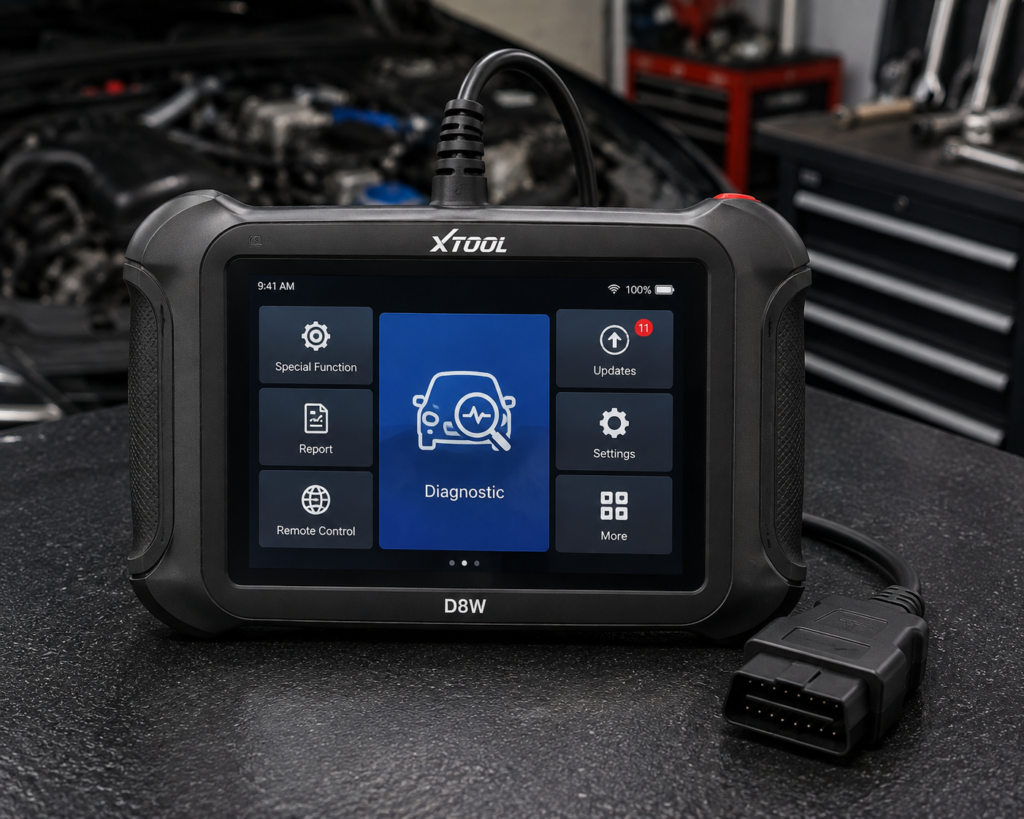
The XTOOL D8W is aimed at that level.
XTOOL’s current platform documentation specifies full-system diagnostics, extensive bidirectional active testing, topology mapping and a broad set of service functions.
It also supports advanced functions such as ECU coding and PMI on supported applications, while modern protocol support helps with newer vehicle architectures.
Topology is especially relevant for serious diagnostics.
Modern vehicles contain many communicating modules. A topology view can help visualize that network and make module or communication faults easier to understand than a simple flat list of systems.
Where It Falls Short
Capability can become overkill.
If your DIY work consists mainly of routine maintenance and occasional Check Engine diagnosis, a D8W-class tablet adds complexity you may never use.
The distinction between coding and programming also matters.
Coding support should not be interpreted as universal ECU programming.
Advanced functions remain vehicle-, module- and region-dependent.
| Specification | Details |
|---|---|
| Display | 8″ touchscreen, 1024×768 |
| Operating System | Android 10 |
| Processor | Quad-core 1.5GHz |
| RAM / Storage | 4GB / 64GB per XTOOL’s primary technical page (2GB reported on a separate XTOOL storefront) |
| Battery | 5000mAh, 7.2V, USB-C charging |
| Wireless Range | Up to 66 ft, built-in WiFi |
| Protocols | CAN FD, DoIP, FCA V2.0 |
| Bidirectional Control | Confirmed (XTOOL official page); 4,000+ active tests per XTOOL |
| ECU Coding | Confirmed (XTOOL official page, offline coding) |
| Module Programming (PMI) | Confirmed (XTOOL official page) for Ford, Lincoln, Mazda |
| Topology Mapping | Confirmed (XTOOL official page) |
| Update Policy | 3 years free updates, WiFi online upgrade, 22 languages |
| Pros | Cons |
|---|---|
| Full-system diagnostics | PMI module programming is brand-specific: confirmed only for Ford, Lincoln, and Mazda |
| Extensive bidirectional active tests | |
| Topology mapping | |
| Broad service-function coverage | |
| ECU coding on supported applications | TPMS: diagnostics and reset; sensor programming not listed |
| Modern protocol support | |
| Wireless diagnostic workflow | |
| Strong serious-DIY/technician crossover |
Best For
Highly experienced DIY mechanics, enthusiasts maintaining multiple vehicles and users whose home-garage diagnostic work approaches technician level.
SCG Verdict
The D8W is the serious-DIY choice because it provides professional-style diagnostic depth without making a top-tier shop platform the default recommendation for a home garage. See our full XTOOL D8W review for the professional-style diagnostics it brings to a serious DIY budget.
Comparison: Which DIY OBD2 Scanner Fits You?
| Scanner | DIY Level | Format | Diagnostic Depth | Bidirectional Control | Best Reason to Choose It |
|---|---|---|---|---|---|
| Innova 5610 | Intermediate to advanced | Standalone handheld | All-system diagnostics on supported vehicles | Yes, supported vehicles | Balanced capability without professional-tablet complexity |
| BlueDriver Pro | Beginner to intermediate | Smartphone + Bluetooth | Standard OBD2 plus enhanced diagnostics on supported vehicles | Not its primary role | Simple app and repair guidance |
| Autel MaxiCheck MX808S | Intermediate | Dedicated 7-inch tablet | All-system | Yes, supported vehicles | Compact full-system tablet with active tests and service functions |
| LAUNCH X431 CRP919EBT | Intermediate to advanced | Dedicated wireless tablet | Full-system class | Supported applications | Wireless serious-DIY workflow |
| TOPDON TopScan | Intermediate to advanced | Smartphone + Bluetooth | Full-system | Yes, supported vehicles | Advanced diagnostics without dedicated tablet hardware |
| Autel MaxiCOM MK900-BT | Advanced | Dedicated wireless tablet | All-system diagnostic platform | Vehicle-dependent | Dedicated workshop workflow and room to grow |
| XTOOL D8W | Serious advanced DIY / technician crossover | Dedicated wireless tablet | Full-system | Extensive on supported vehicles | Topology, active tests and advanced service capability |
What Does a DIY Mechanic Actually Need From an OBD2 Scanner?
The answer depends on the work you perform.
A scanner should solve real garage problems. It should not simply give you the largest possible feature list.
Level 1: Basic DIY Diagnostics
Typical jobs: Check Engine light diagnosis, emissions readiness, reading and clearing generic codes, viewing freeze-frame data, monitoring basic live data.
A quality consumer scanner can be enough.
Level 2: Enhanced DIY Diagnostics
Typical jobs: ABS fault diagnosis, airbag/SRS fault diagnosis, transmission codes, manufacturer-specific data, more detailed live-data analysis.
At this level, verify enhanced-system coverage for your exact vehicle.
Level 3: Active Repair and Service Work
Typical jobs: ABS bleeding, battery registration, electronic parking-brake service, steering-angle calibration, throttle relearn, DPF procedures, injector-related functions, bidirectional component tests.
This is where a full-system scanner with appropriate service functions becomes much more valuable.
Level 4: Advanced DIY Diagnostics
Typical jobs: network/module fault diagnosis, extensive active testing, topology analysis, supported ECU coding, module initialization or relearn procedures, work across several vehicles and brands.
At this level, a dedicated advanced tablet can become justified.
Do You Really Need Bidirectional Control?
Not every DIY mechanic does.
If you mainly read codes and monitor sensors, paying for active tests may add little value.
Bidirectional control becomes useful when you want the scanner to command supported components during diagnosis.
A supported active test might command a cooling fan, fuel pump, injector, solenoid, window or another actuator.
That can provide diagnostic evidence that passive code reading cannot.
But an active test is not an automatic diagnosis.
If a component does not respond, the problem could involve the component, wiring, power, ground, communication, control logic or the conditions required for the test.
Use bidirectional control as evidence, not as a parts-replacement button.
Best Bidirectional Scan Tools in 2026
Phone-Based vs. Handheld vs. Tablet for DIY Work
Phone-Based
Best when you value portability, a familiar interface and compact hardware.
BlueDriver and TopScan represent two very different versions of this idea: one emphasizes accessible diagnostic guidance; the other moves toward full-system active diagnosis.
Standalone Handheld
Best when you want a scanner that lives in the toolbox and works independently.
The Innova 5610 represents this middle ground well.
Compact Diagnostic Tablet
A tool such as the Autel MX808S provides a dedicated diagnostic environment without immediately moving into a larger advanced wireless platform.
Wireless Workshop Tablet
LAUNCH CRP919EBT and Autel MK900-BT represent the next step for owners who regularly move around the vehicle while diagnosing and servicing it.
Advanced Diagnostic Platform
XTOOL D8W adds topology and deeper professional-style capabilities for serious home diagnostics.
More hardware is not automatically better.
Choose the format that matches how you work.
How Much Should a DIY Mechanic Spend?
There is no single correct amount.
The better question is: what is the least expensive class of scanner that reliably performs the functions I need?
A basic scanner can be excellent value if your work is limited to generic OBD2 diagnostics.
A more advanced scanner can be better value if it supports service procedures or diagnostic work you regularly perform yourself.
SCG does not publish fixed current Amazon prices for individual scanners because retailer prices change.
We can still use price bands and price classes when they help buyers understand the market.
The key is to compare capability and ownership model, not one temporary retailer price.
Subscriptions and Updates Matter
DIY mechanics often keep tools for years.
That makes software policy important.
Before buying, ask:
- How long are updates included?
- What happens if updates expire?
- Do existing functions continue working?
- Are advanced features tied to an active plan?
- Are manufacturer packages purchased separately?
- Does secure-gateway access require another account or fee?
A lower initial price can be misleading if the functions you need depend on recurring software access.
Likewise, free updates do not make a scanner a good purchase if it lacks the vehicle coverage you need.
Vehicle Coverage Is More Important Than the Feature List
A scanner can advertise: “Full-system diagnostics.” “Bidirectional control.” “40+ service functions.” “ECU coding.”
All of those statements can be true at platform level.
None proves that the exact function you need works on your exact vehicle.
Before purchasing an advanced scanner:
- Identify your year, make and model.
- Identify the exact system.
- Identify the exact function.
- Check your vehicle in our Scanner Finder.
- If coverage remains unclear, don’t assume the function is supported.
This step matters more than comparing scanners by feature counts alone.
Common DIY Scanner Buying Mistakes
Mistake 1: Buying for the Feature List Instead of the Repair
Start with what you need to do. Then find the least complicated tool that reliably does it.
Mistake 2: Assuming a Trouble Code Identifies the Failed Part
A trouble code identifies a detected condition or circuit/system problem. It does not automatically tell you which part to replace.
Mistake 3: Assuming “OBD2 Compatible” Means Full Vehicle Coverage
Generic OBD2 compatibility does not guarantee ABS, SRS, transmission, body, service, coding or active-test coverage.
Mistake 4: Confusing Bidirectional Tests, Service Functions, Coding and Programming
These are different capabilities. Verify them separately.
Mistake 5: Buying a Professional Tool Too Early
More capability means more menus, more complexity and often more software cost. A professional platform is not automatically a better DIY scanner.
Mistake 6: Buying Too Little Scanner
The opposite mistake can also be expensive. If you routinely work on ABS, SRS, electronic parking brakes, batteries, modern transmissions or other modules, repeatedly outgrowing basic code readers can cost more than choosing the appropriate diagnostic class once.
How This Guide Differs From Our Bluetooth Guide
Our Best Bluetooth OBD2 Scanners guide focuses on phone-based ecosystems, apps and Bluetooth hardware.
This DIY guide focuses on repair capability.
Only two scanners from that Bluetooth ranking are intentionally retained here: BlueDriver Pro, because it fills the beginner-DIY role, and TOPDON TopScan, because it fills the advanced phone-based DIY role.
The remaining recommendations are different and emphasize handheld and dedicated-tablet workflows.
Best Bluetooth OBD2 Scanners in 2026
How This Guide Differs From Our General Best OBD2 Scanners
Our general Best OBD2 Scanners guide serves a wider audience, from ordinary drivers through professional users.
This page assumes the reader actually performs at least some maintenance and repair work.
That changes the weighting.
For DIY use, SCG places more emphasis on: useful live data, enhanced-system access, service functions, active testing, long-term ownership, vehicle coverage, ease of learning, whether the tool can grow with the owner’s skills.
A scanner can therefore rank differently here than in a general guide.
Our Final Recommendations
For the broadest range of home mechanics, Innova 5610 is our best overall DIY choice. It provides enough diagnostic depth for serious repair work while remaining a straightforward standalone tool.
For beginners, BlueDriver Pro provides an easier path into enhanced diagnostics and repair context.
For intermediate users ready for a dedicated full-system tablet, Autel MaxiCheck MX808S provides a strong combination of active tests, service functions and manageable hardware.
For serious DIY users who prefer a wireless LAUNCH platform, X431 CRP919EBT deserves consideration once exact model identity and required vehicle coverage are confirmed.
For DIYers who specifically want advanced diagnostics from a phone, TOPDON TopScan remains the specialist choice.
For experienced home mechanics building a dedicated workshop diagnostic setup, Autel MaxiCOM MK900-BT moves into a deeper all-system platform.
And for serious DIY users whose diagnostic work approaches technician level, XTOOL D8W adds topology, extensive active testing and advanced service capability.
Do not buy the most advanced scanner you can afford.
Buy the scanner that matches the work you actually do, and verify that it supports that work on your vehicles.
Quick Picks
Best Overall for DIY Mechanics: Innova 5610
A strong middle ground between consumer code readers and professional tablets, with all-system diagnostics, useful bidirectional tests on supported vehicles and a straightforward standalone format.
Best for Beginners: BlueDriver Pro
An approachable phone-based route into standard and enhanced diagnostics, live data and repair guidance for owners beginning to diagnose their own vehicles.
Best Value Full-System Tablet: Autel MaxiCheck MX808S
A compact dedicated tablet with all-system diagnostics, live-data graphing, bidirectional active tests, coding/adaptations and useful maintenance functions on supported vehicles.
Best Wireless DIY Tablet: LAUNCH X431 CRP919EBT
A wireless full-system platform aimed at serious DIY and prosumer users who want active tests and service functions without moving immediately to a flagship shop scanner.
Best Advanced Phone-Based Option: TOPDON TopScan
A compact smartphone-based platform offering full-system diagnostics and bidirectional control on supported vehicles, with important version and software-plan differences.
Best Advanced DIY Workshop Tablet: Autel MaxiCOM MK900-BT
A dedicated wireless tablet for experienced home mechanics who regularly work across multiple vehicle systems and want a purpose-built garage tool.
Best for Serious DIY Diagnostics: XTOOL D8W
A powerful full-system platform with extensive active tests, topology mapping, modern protocol support and advanced service capability for owners approaching technician-level work.
Frequently Asked Questions
What is the best OBD2 scanner for DIY mechanics in 2026?
For the broadest range of serious home mechanics in this comparison, our current choice is Innova 5610 because it balances all-system diagnostics, supported bidirectional testing and standalone operation without requiring a professional tablet workflow.
More advanced DIY users may be better served by a dedicated tablet.
What is the best OBD2 scanner for a beginner DIY mechanic?
BlueDriver Pro is our beginner choice because its integrated app and enhanced diagnostics on supported vehicles provide an approachable path from trouble code to diagnostic understanding.
When should a DIY mechanic move to a tablet scanner?
A tablet becomes more useful when you regularly diagnose multiple vehicle systems, need service procedures or active tests, work on several vehicles, or want a dedicated workshop device rather than relying on a personal phone.
Do DIY mechanics need a full-system scanner?
Not always. If you only diagnose Check Engine faults, generic OBD2 may be enough. If you work on ABS, airbags, transmission, electronic parking brakes, battery systems or other modules, full-system or enhanced diagnostics become much more useful.
Do DIY mechanics need a bidirectional scanner?
Can a DIY scanner bleed ABS brakes?
Some scanners provide automated ABS bleed procedures on supported vehicles. Do not assume that full-system or bidirectional capability automatically includes the exact ABS procedure your vehicle requires.
Can a DIY OBD2 scanner code modules?
Some advanced tools support certain coding and adaptation functions. Coverage varies by manufacturer, vehicle and module and should not be confused with universal ECU programming.
Should I choose a scanner with free updates?
Update policy matters, especially for a tool you plan to keep for years. But coverage comes first. Free updates have little value if the scanner cannot perform the function you need.
Bottom Line
The best DIY scanner is not necessarily the scanner with the longest specification sheet.
A home mechanic needs a tool that helps move from fault detection to diagnosis and repair without adding unnecessary professional complexity.
Start with the jobs you perform.
Determine which systems and functions those jobs require.
Choose the appropriate scanner class.
Then verify coverage for your exact vehicles.
For one owner, that may mean BlueDriver. For another, it may mean Innova 5610. For someone deeper into repair work, it may mean MX808S, CRP919EBT, TopScan, MK900-BT or D8W.
The right answer depends on the work.