Knowledge Hub
ECU Coding vs Programming vs Adaptation: What’s the Difference?

A scan tool product page says: ECU Coding.
Another says: ECU Programming.
A third lists: Coding, Adaptation, Relearn and J2534 Pass-Thru.
Are these different names for the same feature?
No. They can overlap in a repair workflow, and manufacturers do not always use every term identically, but they represent different types of work.
The practical distinction is: programming/reflashing writes or updates ECU software/calibration through the required programming process; coding/configuration sets supported configuration, variants or options so a control module matches the vehicle or required configuration; and adaptation/relearn/basic setting runs a procedure that resets, teaches, calibrates, initializes or stores learned/operating values.
And one more capability must stay separate: bidirectional/active testing, which commands a supported component or function for diagnostic testing.
A scanner can support one of these without supporting all of them. That distinction matters when you buy a diagnostic tool.
The Fastest Way to Understand the Difference
Imagine a replacement control module. Depending on the vehicle and module, the job might require several separate steps.
Programming. The module may need the correct software/calibration installed.
Coding. It may need configuration telling it how this particular vehicle is equipped.
Adaptation or relearn. The vehicle may then need to learn values, positions or operating relationships.
Diagnostics. Finally, you may need to scan for faults and verify the repair.
One replacement job can therefore involve program → code → adapt/relearn → verify. But that is only an example. The exact sequence depends on the manufacturer, module and repair procedure.
What Is ECU Programming?
In automotive service, programming/reprogramming commonly refers to writing software or calibration data to an electronic control module. Examples can include updating an existing module with a manufacturer calibration, programming a replacement module, or reflashing a module as part of an OEM service procedure.
This is different from merely reading codes or changing a configuration option. Programming can alter the software/calibration the controller runs.
What Is Reflashing?
“Reflash” is commonly used for rewriting/updating module software or calibration. In service discussions, programming, reprogramming, flashing and reflashing can overlap substantially. But do not assume every vendor uses the words with perfectly identical scope.
The important buying question is not “Does the box say programming?” It is “What exact module/software operation does this tool support on my exact vehicle, and what additional OEM software/subscription is required?”
What Is J2534 Pass-Thru Programming?
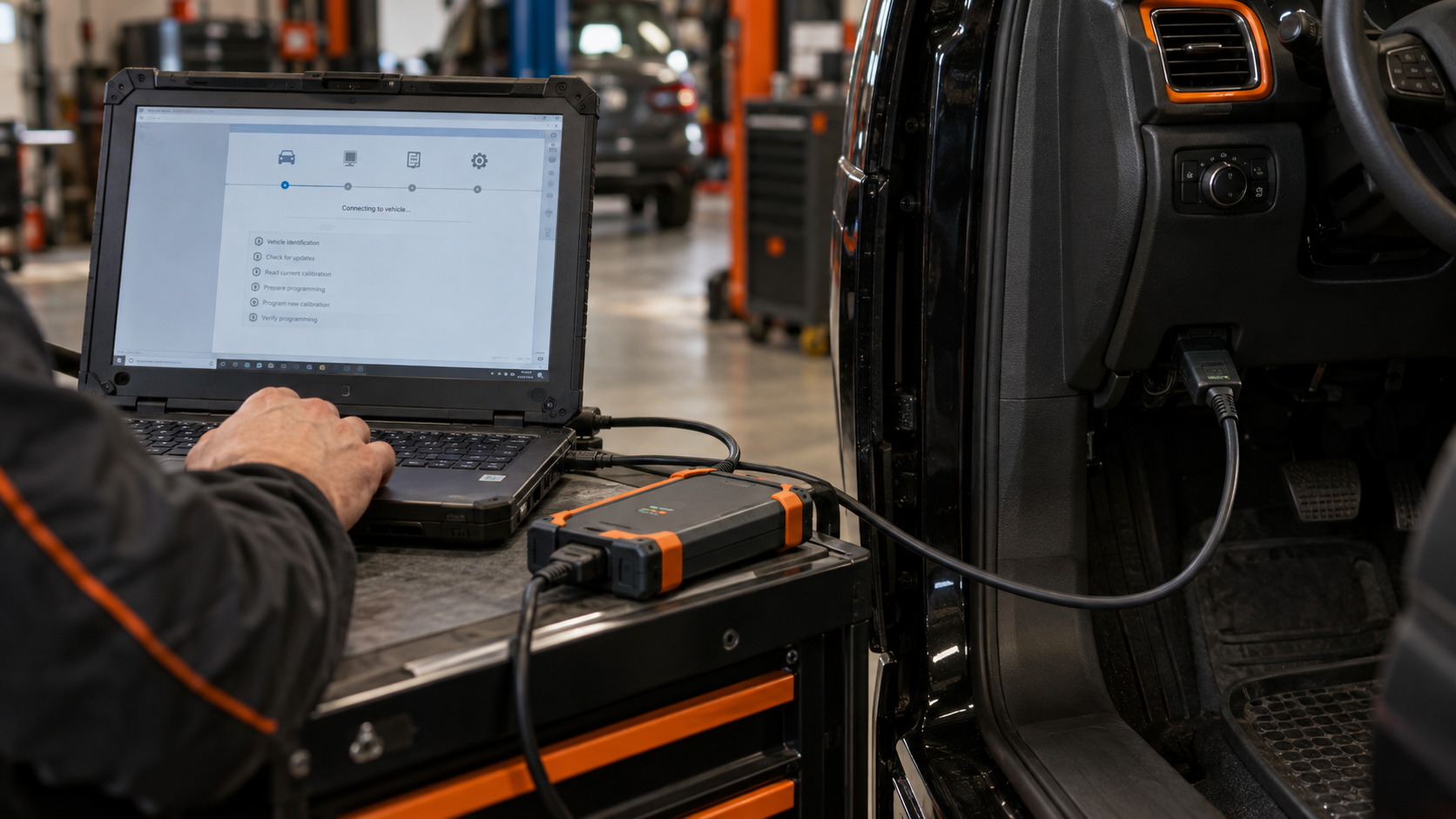
SAE J2534 is one of the most misunderstood scanner features. It does not mean “This scanner contains universal OEM programming for every vehicle.”
SAE describes J2534 as a standardized interface framework that allows vehicle-manufacturer reprogramming applications to work with compatible vehicle interface hardware.
Think of the chain as: OEM programming software → J2534 interface → vehicle. The vehicle manufacturer still controls the programming application and programming sequence.
OEM reprogramming software/calibrations are typically obtained through manufacturer service-information sites, and fees can apply.
So: J2534-capable hardware is one part of a programming system. It is not automatically the entire system.
Does J2534 Mean the OEM Software Is Included?
No. This is a critical buying distinction.
A J2534-capable device may provide the compatible vehicle interface. You may still need a Windows PC or other required computer environment, OEM programming software, OEM service/subscription access, calibration files, internet access, account/security authorization, an appropriate power supply/battery support system, and post-programming scan-tool procedures.
Requirements vary by OEM. Never buy a tool based only on a “J2534” logo without checking the complete workflow for the vehicles you intend to service.
What Is ECU Coding?
Coding generally refers to setting supported configuration or variant information within a control module: describable as changing allowed parameters within existing software, while programming installs or updates software.
Coding can be involved when a replacement module must be configured for the vehicle, supported vehicle options must be assigned, variant/configuration data must match the installed equipment, or a manufacturer-defined configuration procedure is required.
But the word “coding” is used differently across manufacturers. Do not assume that because Scanner A supports “ECU Coding” on one BMW it can perform the same type or depth of coding on a Ford, Toyota or Mercedes-Benz. Coverage is vehicle-specific.
Is Coding the Same as Programming?
No. A useful simplified distinction: programming changes or installs the software/calibration; coding changes supported configuration within the applicable module/vehicle system.
However, a real replacement-module workflow may require both: for example, install/program correct software, code/configure the module to the vehicle, perform required relearn/adaptation, then clear faults and verify.
Do not treat that sequence as universal. Follow the OEM procedure for the exact repair.
What Is ECU Adaptation?
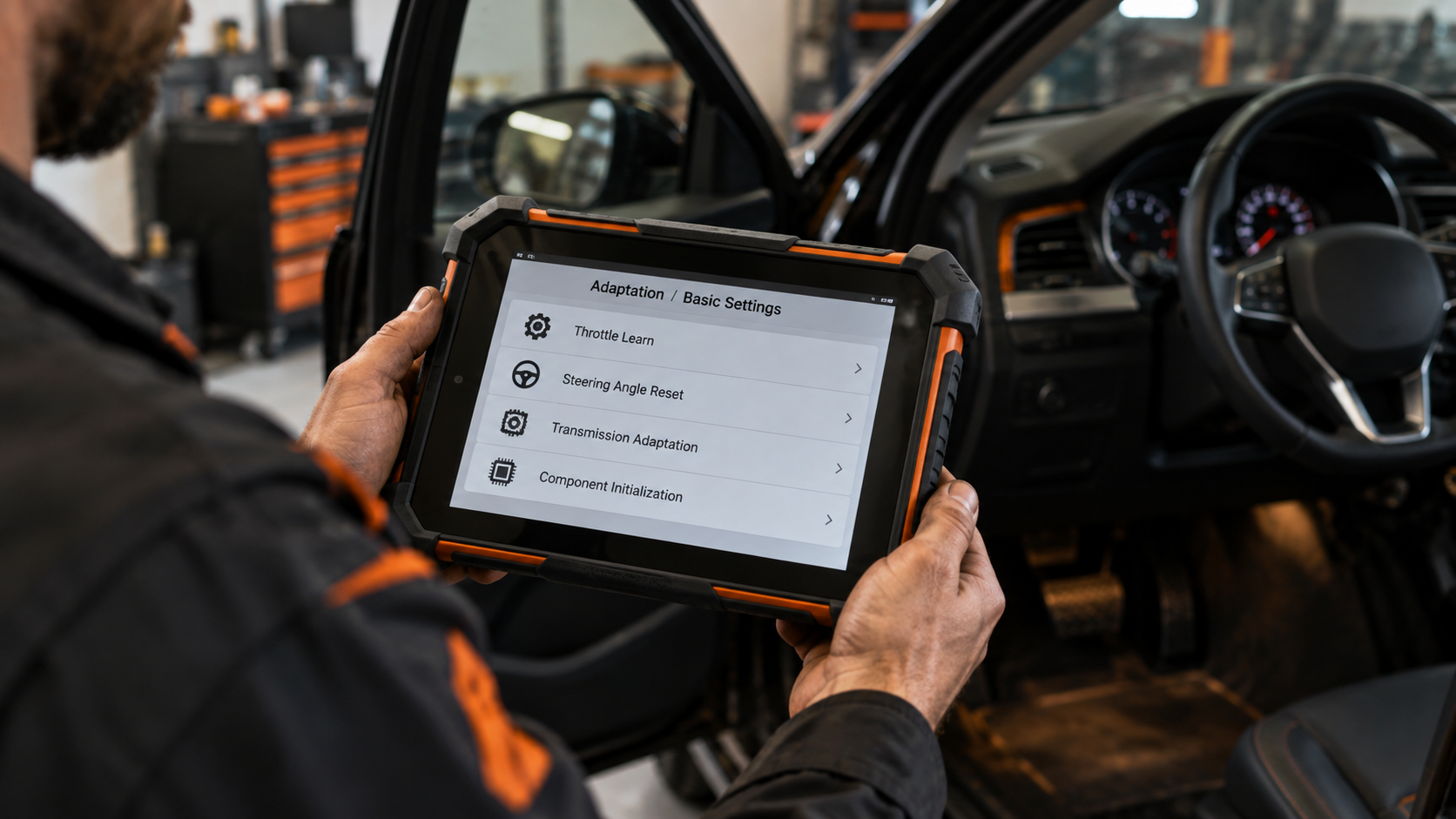
“Adaptation” usually refers to a procedure in which the control system resets, learns, stores or adjusts values needed for correct operation.
Depending on the manufacturer/system, examples can include transmission adaptation, throttle-related learning, steering-angle-related procedures, component initialization, learned-value resets, basic settings, and calibration/standardization procedures.
Major scan-tool platforms commonly list Adaptation, Basic Setting, Learning, Standardization and Coding as separate supported function categories: useful evidence that even one manufacturer’s own software does not treat all these terms as one universal function.
Is Adaptation the Same as Relearn?
They can overlap, but do not assume perfect equivalence. Different OEMs and scan-tool vendors use terms such as adaptation, relearn, learn, initialization, calibration, basic setting and standardization.
The practical meaning depends on the system. For SCG, the safest umbrella explanation is: these procedures establish or reset learned/configuration-related operating values without necessarily rewriting the module’s core software. Always use the terminology and procedure for the exact vehicle.
Is Adaptation the Same as Coding?
Not necessarily. Consider the difference: coding/configuration asks “what equipment/configuration should this module use?” while adaptation/relearn asks “what operating value, position or learned relationship should this system establish?”
That is simplified, but it helps separate the two jobs. A module may require coding and then a separate adaptation. Or only one.
Is Bidirectional Control the Same as Coding?
No. Bidirectional control lets a scanner send supported commands to a vehicle system: for example, commanding a fan, a solenoid, a pump, a relay, or another supported actuator, usually for diagnostic testing.
Coding changes supported configuration. Programming writes software/calibration. Adaptation runs learning/reset/calibration procedures.
These capabilities may exist on the same professional scanner, but they should not be treated as synonyms. For the complete active-test explanation, read What Is Bidirectional Control on a Scan Tool? Active Tests Explained.
Diagnostics vs Active Tests vs Adaptation vs Coding vs Programming
Use this capability ladder.
Diagnostics: question: what does the module know? Typical functions: read DTCs, live data, module information.
Active tests: question: can I command this supported component/function? Typical function: actuator/output command.
Adaptation/relearn: question: can the system learn/reset/initialize the required value or state? Typical functions: relearn, basic setting, initialization.
Coding/configuration: question: can the module be configured for the vehicle/options? Typical function: variant/configuration changes.
Programming/reflash: question: can the required software/calibration be written to the module? Typical function: OEM reprogramming/reflash.
A tool advertised as “advanced diagnostics” does not automatically support the top of this ladder.
Why “Full-System Scanner” Does Not Automatically Mean “ECU Programmer”
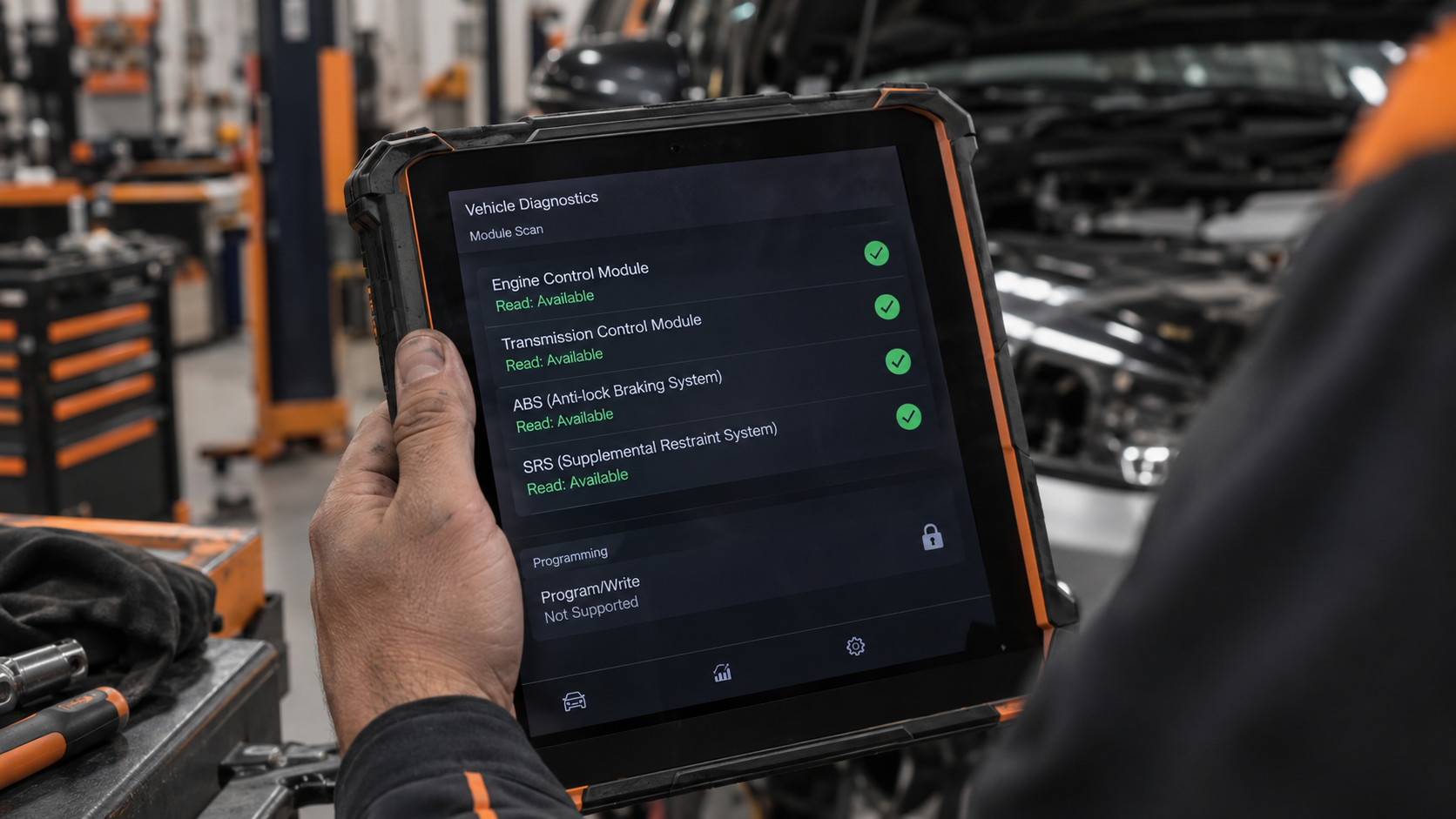
A full-system scanner can access many vehicle modules for diagnostic purposes. That does not automatically mean it can rewrite their software.
Think of access and write capability as different questions. A tool may read engine, transmission, ABS, SRS and body modules yet have no OEM reprogramming capability for those modules.
For the access side, read What Does Full-System Diagnostics Mean on a Scan Tool?
Why “ECU Coding” on a Product Page Is Not Enough
Suppose two scanners both advertise ECU Coding. That does not prove equivalent capability.
You still need to verify exact make, model, year, module, coding function, online/offline requirement, account/security requirement, software version, and regional coverage.
The same applies to adaptation and programming. Feature labels are category names. Coverage is the actual capability.
For the verification process, read Will Any OBD2 Scanner Work With My Car? OBD2 Compatibility Explained.
Can a Basic OBD2 Scanner Program an ECU?
A basic code reader normally focuses on generic diagnostic functions such as reading/clearing emissions-related DTCs, readiness, basic live data and freeze frame.
Do not assume it can program modules. Programming requires the appropriate hardware, software, vehicle support and procedure. Some advanced diagnostic platforms combine scan-tool functions with J2534 or other programming capabilities: that is a different class of functionality.
Can a Scanner Code an ECU Without Programming It?
Potentially, yes, where the exact vehicle/module/tool supports a coding/configuration operation that does not require reflashing the software.
This is precisely why the terms must remain separate. But never assume the workflow. Some repairs may require programming first. Others may require only coding. Others may require adaptation. The OEM repair procedure decides.
What Happens After Replacing an ECU or Module?
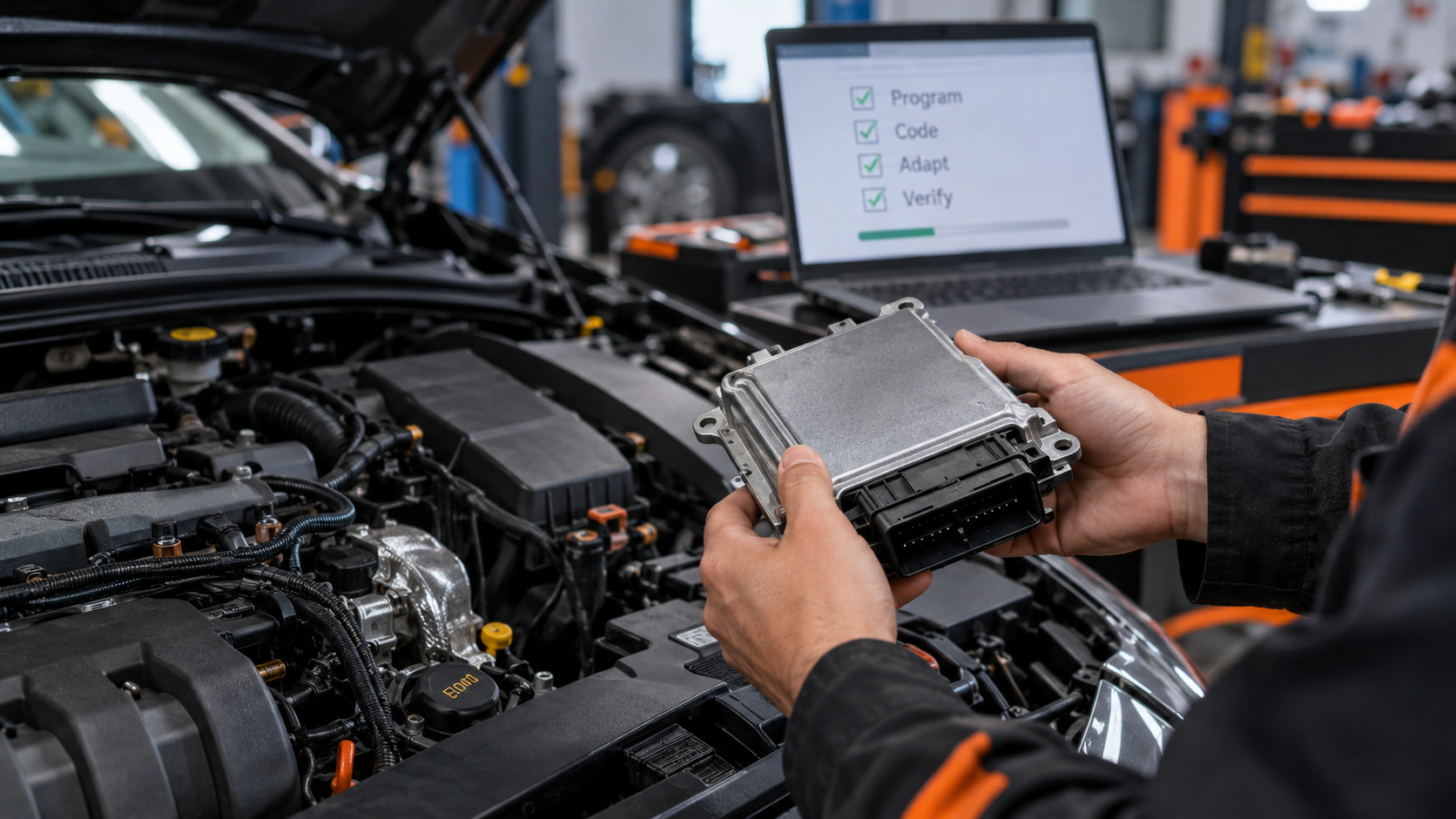
There is no single universal answer.
Depending on the vehicle/module, replacement may require some combination of software programming, coding/configuration, immobilizer/security authorization, adaptation/relearn, calibration, DTC clearing and verification.
A replacement module may also come blank, pre-programmed, used, remanufactured, or already loaded with some software. Those situations can require different procedures. Before replacing a module, determine the exact OEM workflow.
Why Stable Voltage Matters During Programming
Programming is different from reading codes. During a reflash, the module is being written. An interruption can create a much more serious problem than a failed scan.
Potential risks include programming failure, corrupted/incomplete module software, a module that no longer communicates, recovery procedures, and module replacement.
Professional programming workflows commonly require appropriate battery support/power stabilization. Do not treat a household trickle charger as automatically suitable for every programming procedure. Follow the OEM/tool requirements.
Is ECU Programming the Same as Tuning?
No. This distinction matters.
OEM reprogramming/reflashing generally refers to installing manufacturer-provided software/calibration as part of service/repair. Tuning changes calibration to alter vehicle behavior/performance.
Both can involve writing ECU data. They are not the same service objective. A J2534 pass-thru claim should not be interpreted as “this is an ECU tuning tool.”
Does Programming Require an Internet Connection?
Sometimes, but not universally. Modern OEM programming workflows may require online account authentication, subscription access, downloading calibration/software, or server authorization. Other procedures may use software/files already available in the required environment.
Check the exact OEM workflow. Do not assume “online programming” and “ECU programming” are always identical terms.
Do You Need a Professional Scanner for Coding?
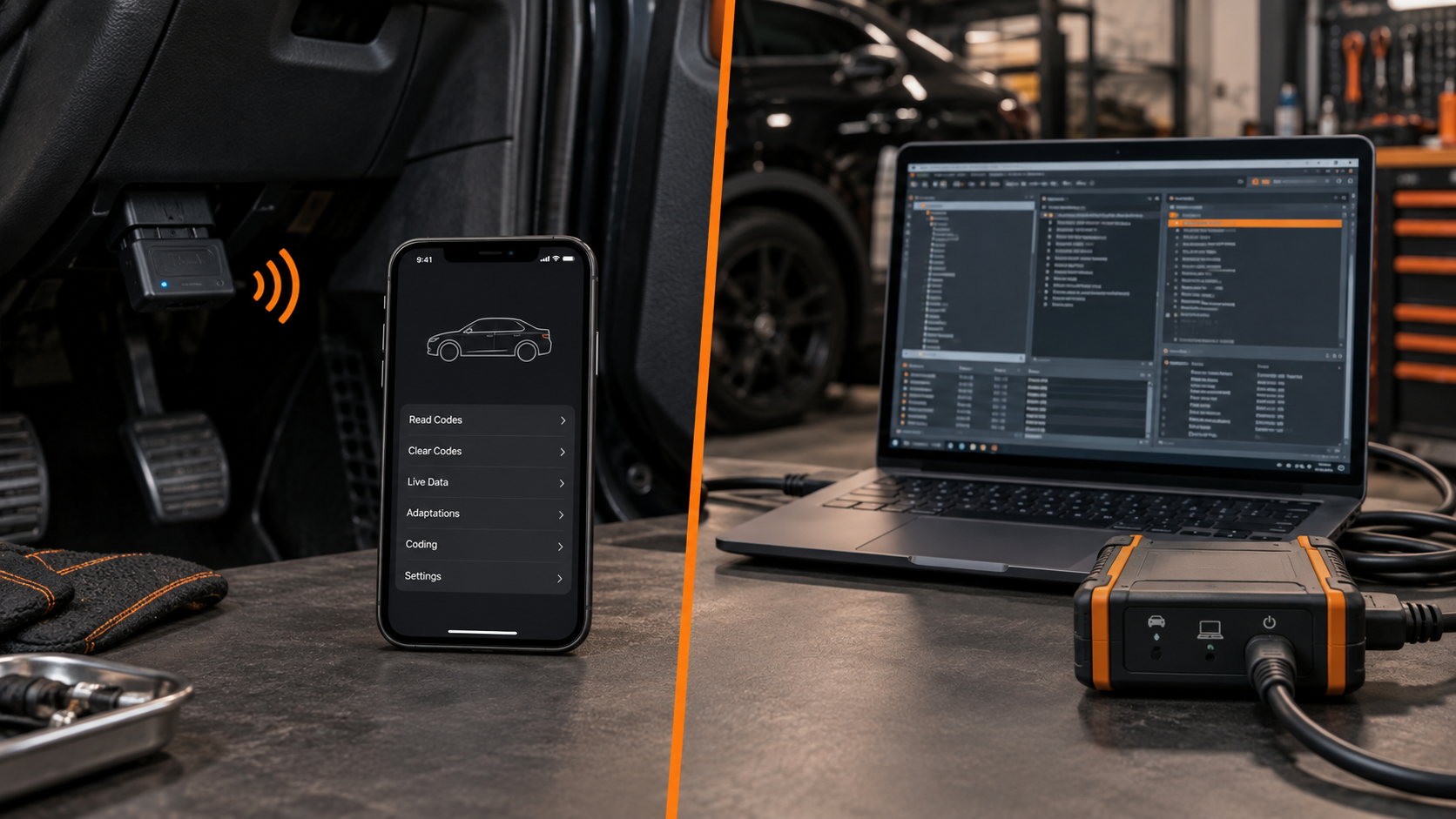
It depends on the job. Some supported configuration/adaptation tasks are available on relatively affordable tools or specialized apps. Other jobs require advanced scan platforms, OEM software, security access, special interfaces, and professional procedures.
Choose by exact job, not by the prestige of the feature name. If you’re deciding how much diagnostic capability is worth paying for, read How Much Should You Spend on an OBD2 Scanner?
How to Evaluate a Scanner That Claims ECU Coding or Programming
1. What exact job do I need? Coding? Adaptation? Relearn? Active test? Programming/reflash? Do not buy before you know the operation.
2. Which exact vehicle and module? Record make, model, year, engine/configuration, module.
3. Is the function native to the scan tool or performed through OEM software? This matters especially for J2534.
4. What additional software or subscription is required? Check OEM subscription, tool subscription, account, security authorization.
5. Does the coverage list confirm the exact function? Do not accept “ECU Coding” at the product-family level as proof.
6. What hardware is required? Potential requirements include VCI, J2534 interface, PC, cables/adapters, stable power supply.
7. What happens if programming fails? Professional workflows need a recovery plan.
8. What must happen after the operation? Possible post-work: coding, relearn, calibration, DTC clear, verification.
Common Mistakes
Mistake 1: Treating coding and programming as synonyms. They can be different operations.
Mistake 2: Assuming J2534 includes OEM software. J2534 is the standardized interface framework; OEM software/access is a separate part of the workflow.
Mistake 3: Assuming “ECU Coding” means every vehicle. Coverage varies by make/model/year/module/function.
Mistake 4: Confusing programming with tuning. OEM service reflashing and performance tuning are different objectives.
Mistake 5: Confusing active tests with coding. Commanding an actuator is not the same as changing configuration.
Mistake 6: Assuming a replacement module only needs one step. It may require programming, coding, adaptation, security procedures and verification.
Mistake 7: Programming without appropriate power support. An interrupted write can create a serious module problem.
FAQ
What is the difference between ECU coding and ECU programming?
Programming writes or updates module software/calibration. Coding generally changes supported configuration/variant information within the applicable vehicle/module system.
What is ECU adaptation?
Adaptation is generally a supported procedure that resets, learns, initializes, calibrates or stores operating values. Exact terminology varies by OEM.
Is ECU coding the same as flashing?
No. Flashing/reflashing is generally associated with writing software/calibration. Coding is generally configuration-oriented.
Is J2534 ECU programming?
J2534 is a standardized pass-thru interface framework used by compatible vehicle-manufacturer reprogramming applications. The interface is one part of the programming workflow.
Does a J2534 scanner include OEM software?
Not automatically. OEM programming software, subscriptions/calibrations and authorization can be separate requirements.
Can an OBD2 scanner program an ECU?
Some advanced diagnostic platforms support programming workflows, including J2534 pass-thru. Basic OBD2 code readers generally should not be assumed to have ECU programming capability.
Can a scanner code but not program?
Yes, depending on the exact tool/vehicle/module. Coding and programming are separate capability categories.
Is adaptation the same as coding?
Not necessarily. Coding generally concerns configuration; adaptation/relearn generally concerns learned/initialized/calibrated values or procedures. OEM terminology varies.
Is bidirectional control the same as ECU coding?
No. Bidirectional control commands supported vehicle components/functions for testing; coding changes supported configuration.
Do replacement ECUs need coding?
Some do, but the exact procedure varies. A replacement module may require programming, coding, security authorization, adaptation/relearn or a combination.
Can ECU programming damage a module?
A failed or interrupted programming event can leave a module in an unusable or recovery-required state. Follow the OEM/tool procedure and power requirements. For the broader picture of what can and cannot go wrong with a scan tool in general, see Can an OBD2 Scanner Damage My Car?
Is ECU programming the same as chip tuning?
No. OEM service programming/reflashing and performance tuning are different workflows/objectives even though both can involve writing controller data.
The Bottom Line
When a scanner advertises Coding, Programming, Adaptation, J2534 or Bidirectional Control, do not treat those words as one feature.
Use this model: diagnose (read information), test (command supported functions/components), adapt/relearn (teach, reset, initialize or calibrate supported operating values/procedures), code/configure (set supported vehicle/module configuration), and program/reflash (write or update software/calibration).
And remember: J2534 is an interface framework, not a promise that all OEM software, subscriptions and vehicle programming coverage are included.
Before buying a scanner for any of these jobs, verify exact vehicle → exact module → exact function → required software → required hardware → subscription/security → power/procedure.
If you only need to command components for diagnosis, read What Is Bidirectional Control on a Scan Tool? Active Tests Explained.
If you need to know whether the scanner can even access the required module, read What Does Full-System Diagnostics Mean on a Scan Tool?
If you are evaluating a purchase, continue to Will Any OBD2 Scanner Work With My Car? OBD2 Compatibility Explained.
To see scanners that offer real coding, compare the Best Bidirectional Scan Tools; for module programming specifically, read our Autel MaxiSys Ultra review.