Knowledge Hub
What Is Bidirectional Control on a Scan Tool? Active Tests Explained

A basic scan tool asks the vehicle for information.
A bidirectional scan tool can also ask a supported control module to do something.
That ability is called bidirectional control. You may also see it described as active tests, actuator tests, output controls, component activation, or bidirectional tests.
For example, depending on the vehicle and scanner, an active test may let you command a cooling fan, fuel pump, injector, EVAP valve, relay, window motor or another electronically controlled component.
That can make diagnosis much more powerful.
But there is an important catch: “bidirectional” does not mean “can control everything on every car.” The exact commands available depend on the scanner, vehicle, model year, control module, software coverage and sometimes vehicle security/access requirements.
So the feature name alone is not enough.
What Does Bidirectional Control Mean?
Vehicle diagnostics normally involve communication between a scan tool and one or more electronic control modules.
With ordinary diagnostic functions, the tool requests information such as Diagnostic Trouble Codes, live data, freeze-frame data, readiness information and module information. The vehicle responds.
Bidirectional control adds the ability for the scan tool to send a supported control request back to a module. The module may then command an output or perform a test.
In simple terms: read-only diagnostics say “Tell me what you see.” Bidirectional diagnostics say “Now command this supported function so I can observe what happens.”
That second capability can help turn a diagnostic theory into a test.
Passive Diagnostics vs Active Diagnostics
Imagine that your vehicle’s radiator fan is not operating when you think it should.
With passive diagnostics, you might read DTCs, inspect coolant temperature, inspect fan-related data, and check wiring diagrams and service information. All of that can be useful.
But if the vehicle and scanner support the correct active test, you may also be able to request: Cooling fan ON.
Now you can observe what happens. Does the fan run? Does the module report the command? Does electrical activity occur? Does the component fail to respond?
The command gives you another piece of evidence. That is active diagnosis.
What Is an Active Test?
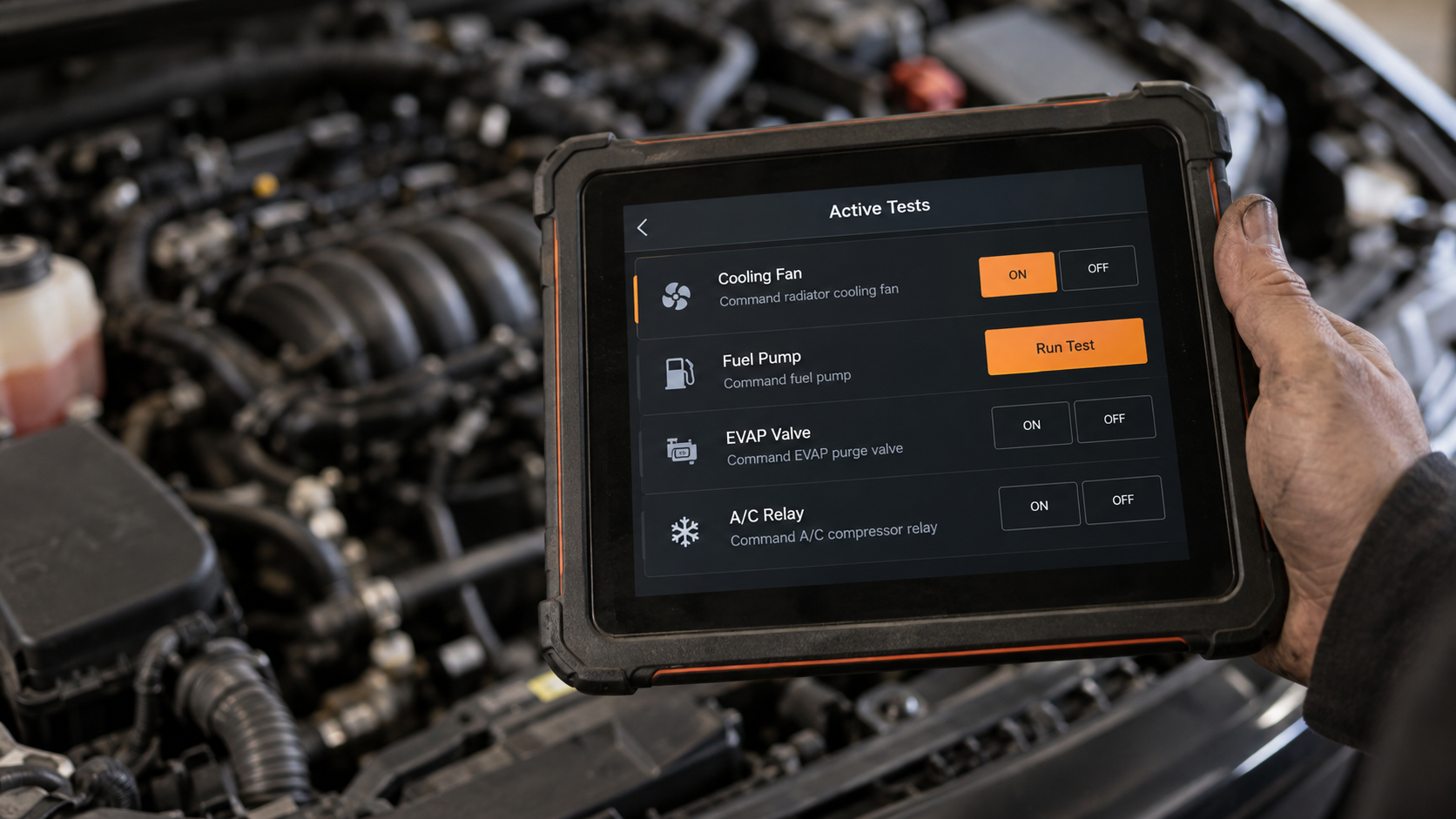
An active test is a scanner command that asks a supported vehicle module to operate or change a specific output or function for diagnostic purposes.
SAE diagnostic standards have long included the concept of requesting control of an onboard system, test or component.
However, the broad active-test menus advertised on modern professional scanners often rely on manufacturer-specific diagnostic capabilities beyond basic generic emissions OBD.
That distinction matters. A vehicle being “OBD2 compatible” does not mean every advanced active test is available.
What Can a Bidirectional Scan Tool Command?
Depending on the exact vehicle and scanner, active tests can include commands involving cooling fans, fuel pumps, fuel injectors, EVAP purge or vent valves, relays, solenoids, A/C-related components, electronic throttle systems, door locks, windows, lights, horns, transmission-related solenoids, ABS-related components, and other body, chassis or powertrain outputs.
This is not a universal feature list. One vehicle may expose dozens of commands. Another may expose only a few. A scanner may support an active test on one model year but not another.
That is why SCG treats exact function coverage as more important than the word “bidirectional” on the product box.
Example: Testing a Cooling Fan
Suppose a cooling fan is not operating. A DTC might point toward the fan circuit, but the code alone does not tell you which part failed.
If the vehicle supports a fan active test, the scanner can request fan operation. If the fan runs when commanded, you have learned something useful: the fan system is at least capable of responding under that test condition.
That can shift your investigation toward the conditions that normally trigger the fan, sensor inputs, control logic, intermittent wiring problems, or other parts of the circuit.
If the fan does not run, you have also learned something, but you still have not automatically proven that the fan motor is bad. The cause could involve the motor, relay/control hardware, power supply, ground, wiring, connector, module output, or communication or test conditions.
The active test narrows the problem. It does not replace electrical diagnosis.
Example: Testing an EVAP Purge Valve
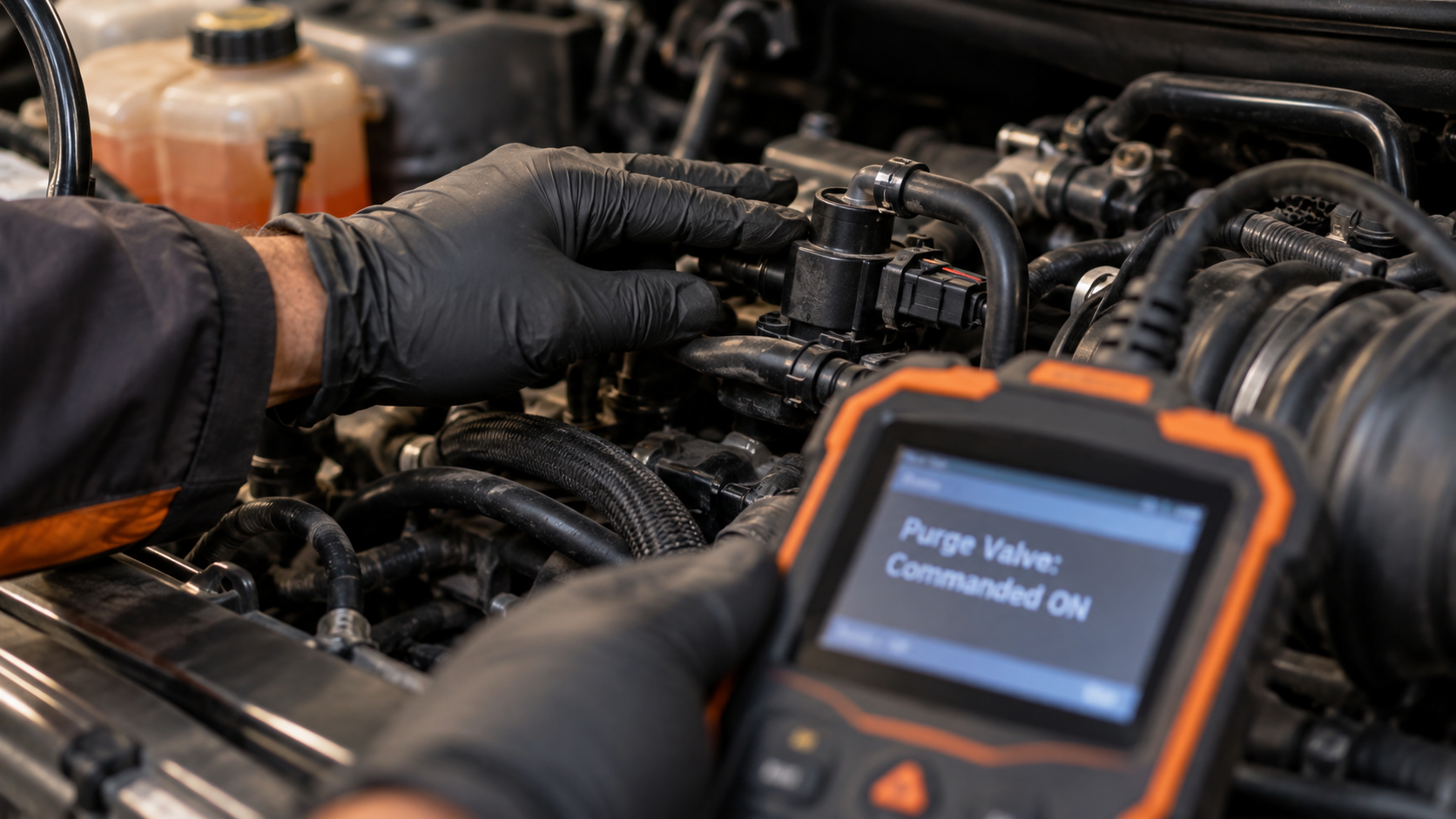
Imagine you are investigating an EVAP-related fault. If the scanner and vehicle support an appropriate purge-valve active test, you may be able to command the valve while observing the system.
That can help answer questions such as: does the valve respond to a command? Can you hear or feel it operate? Do related data values change? Does the system behave differently when the command changes?
But again, the result must be interpreted correctly. A click does not prove that the valve flows correctly. No click does not automatically prove the valve itself is defective. The command is one test inside a larger diagnostic process.
What an Active Test Can, and Cannot, Prove
This is the most important section of the article.
Bidirectional control is powerful because it lets you deliberately change a condition and observe the response. But avoid the shortcut: “It didn’t move, therefore the component is bad.”
An active test usually evaluates a system path, not just one isolated part. Depending on the circuit, that path may include the scan tool, vehicle communication network, control module, module driver, fuse, relay, power, ground, wiring, connector, actuator and mechanical load.
If the commanded component responds correctly, that is strong evidence that important parts of the path can function under the test condition.
If it does not respond, additional testing is normally required to determine where the failure is.
Use the scanner to narrow the diagnosis. Do not use it as permission to guess which part to replace.
Bidirectional Control vs Full-System Diagnostics
These terms are related, but they do not mean the same thing.
Full-system diagnostics describes the breadth of modules a scanner can access for diagnostic information. Depending on the vehicle, that can include systems such as engine, transmission, ABS, SRS/airbag, body control, HVAC, steering, parking brake and other modules.
Bidirectional control describes whether the scanner can send supported commands to those modules.
A scanner can confirm that a power window module responds normally to every diagnostic request, report no stored faults, and still have no command anywhere in its menu that actually moves the glass. So: module access does not automatically equal command capability.
When shopping, check both. SCG covers the module-access side separately in What Does Full-System Diagnostics Mean on a Scan Tool?
Active Tests vs Service Functions
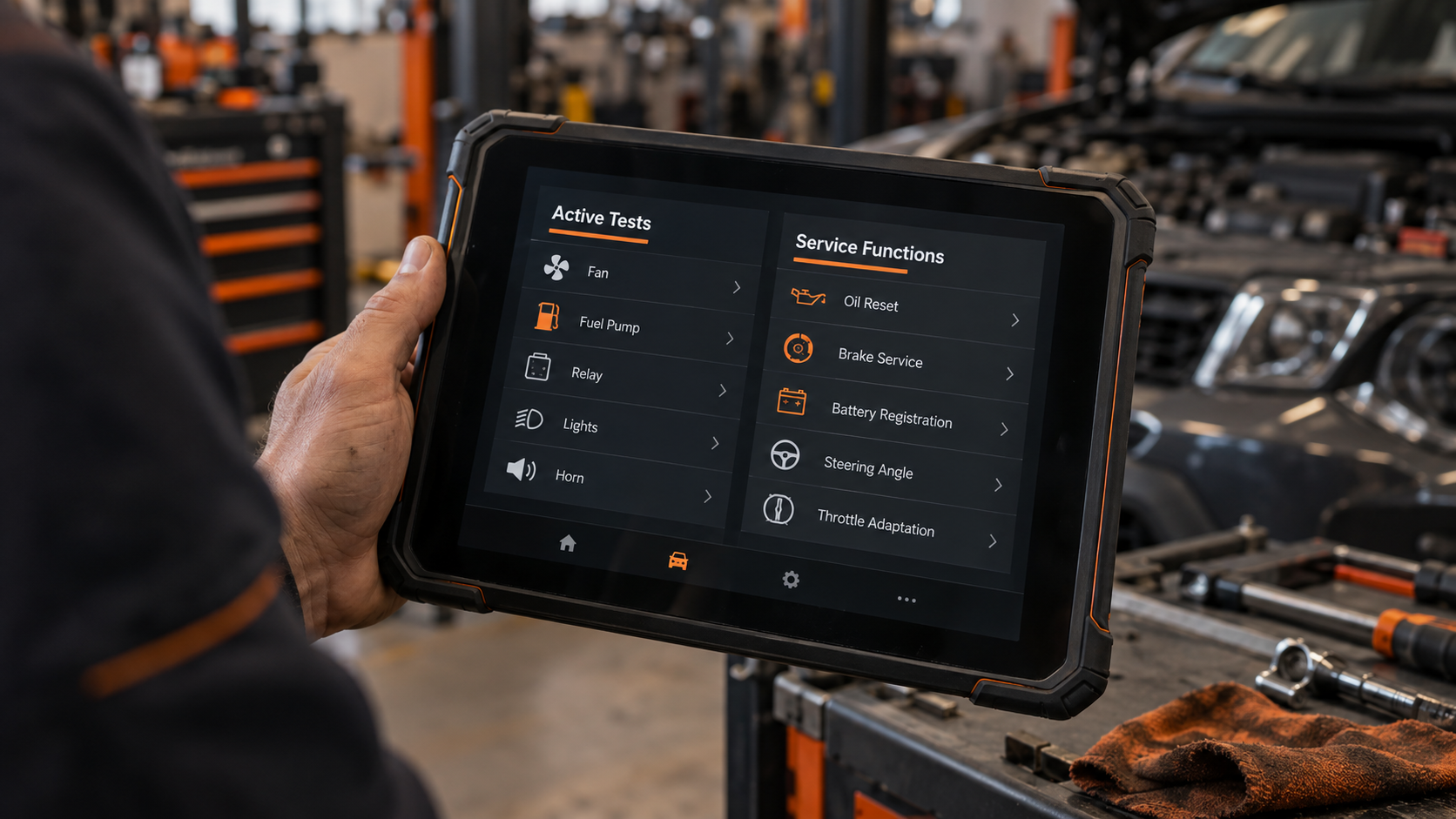
Another common source of confusion is the difference between an active test and a service function.
They can both involve two-way communication, but they are not useful as interchangeable shopping labels.
An active test usually commands an output or component so you can observe its response: examples can include turning a fan on/off, commanding a fuel pump, actuating a valve, operating a relay, or commanding a window or lock.
A service function is a defined procedure or routine used during maintenance or repair. Examples can include, where supported, an oil-service reset, electronic parking-brake service, battery registration/reset, steering-angle calibration, throttle relearn, ABS bleeding, DPF regeneration, or other resets, adaptations or relearns.
A scanner can have useful service functions without offering deep active-test coverage across every module. And a scanner advertised as bidirectional may still lack a particular service routine you need.
Therefore, never buy a scanner based only on a total number such as “30+ service functions.” Verify the exact function.
Is Bidirectional Control Part of Standard OBD2?
There is an important nuance.
SAE J1979 historically includes Mode $08, Request Control of On-Board System, Test, or Component. So the concept of control requests is not foreign to standardized OBD diagnostics.
But that does not mean a basic generic OBD2 code reader has the same capability as a modern enhanced bidirectional scan tool.
Legislated generic OBD is primarily centered on standardized emissions-related diagnostic access. Modern scanner marketing commonly uses “bidirectional control” for much broader manufacturer-specific active testing across engine, transmission, ABS, body and other modules.
So do not reason: “My car has OBD2, therefore every bidirectional test should work.” That conclusion is wrong.
Why Vehicle Coverage Matters More Than the Marketing Label
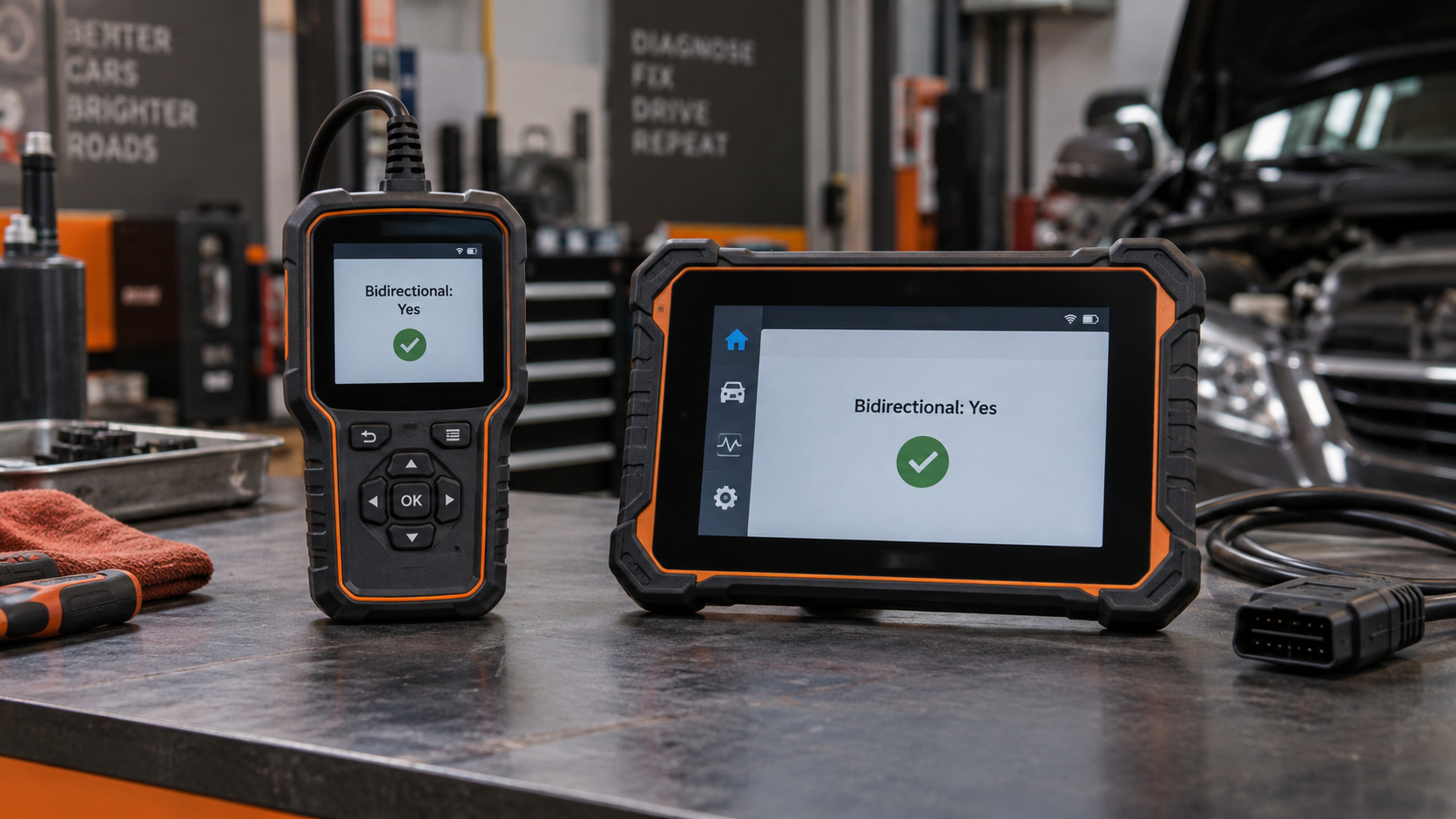
Suppose two scanners both advertise: Bidirectional Control: Yes.
They can still be dramatically different for your vehicle. Scanner A may command the function you need on your exact Ford. Scanner B may communicate with the same module but lack that active test for that model year. Or the reverse may be true on a Toyota.
Even within one scanner, support can vary by make, model, model year, engine, trim/configuration, module, software version and market/region.
Official manufacturers themselves acknowledge this variability: feature-availability checkers exist precisely because exact scanner features vary by model and year.
The correct buying question is therefore not “Is this scanner bidirectional?” It is “Does this scanner perform the exact active test I need on my exact vehicle?” That is a much better question.
Do You Need a Bidirectional Scan Tool?
Not everyone does.
You may not need bidirectional control if you mainly want to read a Check Engine light, retrieve generic DTCs, clear supported emissions-related diagnostic information, check readiness monitors, view basic live data, or perform occasional basic DIY diagnosis. A simpler scanner may be enough.
Bidirectional control becomes more useful if you perform deeper DIY repairs, diagnose electrical or actuator problems, work on multiple vehicle systems, want to test components without waiting for the vehicle to activate them naturally, frequently need to distinguish between a control problem and a component/circuit response problem, or are an advanced DIYer, mobile technician or professional mechanic.
But even then, buy for the specific tests and vehicles, not for the label.
How to Use Active Tests Safely
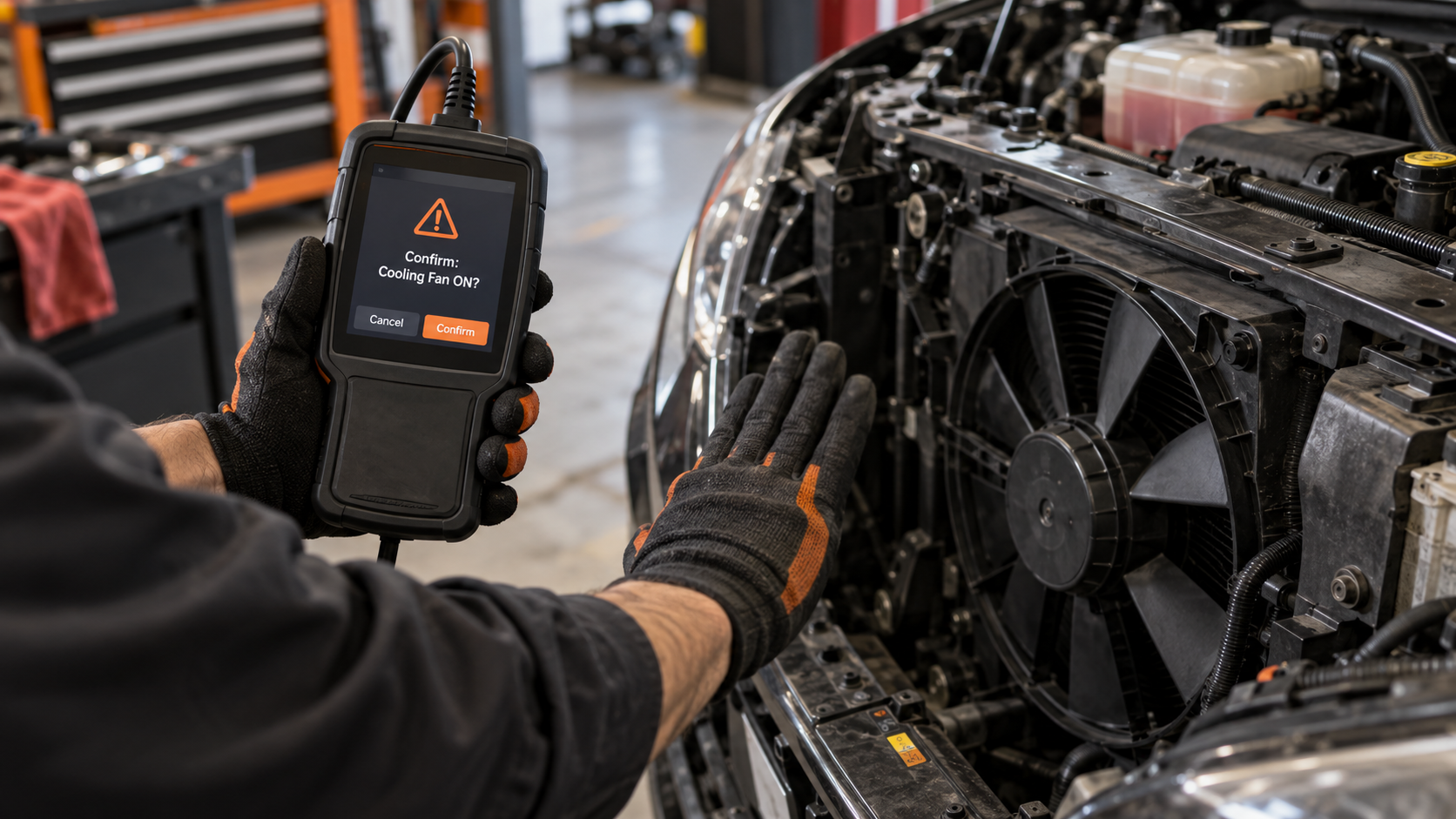
Bidirectional control can physically operate vehicle components. That deserves respect.
An active test may start a fan, run a pump, move a throttle, operate a window, cycle a solenoid, move a parking-brake mechanism, or affect another powered component.
Before commanding anything: read the scanner instructions; follow manufacturer service information where appropriate; understand what the test will command; keep hands, tools, clothing and cables away from moving parts; make sure vehicle position and surroundings are safe; use the required ignition/engine state; do not run unfamiliar tests simply to see what happens; and stop if the vehicle or scanner behaves unexpectedly.
For safety-critical systems, advanced procedures or any test you do not understand, use appropriate professional service information or qualified help.
A bidirectional scanner gives you control. It does not give you permission to use that control blindly.
Bidirectional Control FAQ
Is bidirectional control the same as an active test?
In everyday scanner terminology, they are closely linked. Active tests, actuator tests and output controls are common names for functions enabled by bidirectional command capability.
Is a bidirectional scanner the same as a full-system scanner?
No. Full-system describes module-access breadth. Bidirectional describes command capability. A scanner can access a module without necessarily supporting every active test for that module.
Is bidirectional control the same as ECU coding?
No. Active testing commands supported operations for diagnosis. ECU coding/configuration changes supported configuration or coding parameters. Programming/flashing is another distinct capability. Do not assume one because a scanner supports the other.
Is ABS bleeding a bidirectional function?
ABS bleeding is normally presented as a service procedure/routine on scan tools and can require commanding ABS hydraulic components. But do not use “ABS bleeding” as proof that a scanner has broad active-test coverage across the vehicle. Check each capability separately.
Can a bidirectional scanner turn on a fuel pump?
Some can on supported vehicles, and manufacturers officially list fuel-pump commands among active-test examples on applicable models. Availability still depends on the exact vehicle.
Can a bidirectional scanner test injectors?
Some scanner/vehicle combinations support injector-related active tests. The exact test may differ: enable/disable, balance-related routines or other commands, so verify the exact function instead of assuming generic “injector test” support.
Can a bidirectional scanner test a cooling fan?
Yes, on supported vehicles and scanners. Cooling-fan activation is a common official example of an active test.
Does a failed active test prove the actuator is bad?
No. Failure to respond can involve the actuator, power, ground, wiring, relay, module output, test conditions or other parts of the system. Use further testing to identify the cause.
Does every bidirectional scanner work on every OBD2 car?
No. Basic OBD2 compatibility and enhanced active-test coverage are different questions. Verify exact vehicle and function coverage.
Are more active tests always better?
Only if they apply to the vehicles and jobs you actually perform. A marketing claim of thousands of tests is less useful than confirmed support for the one test you need on your exact vehicle.
The Bottom Line
Bidirectional control lets a scan tool move beyond simply reading information. It can send supported commands to vehicle modules so you can deliberately operate a component or function and observe the response.
That makes active tests extremely useful for diagnosis. But remember four rules: bidirectional does not mean universal; full-system access does not automatically mean active control; active tests and service functions should be verified separately; and a component response is evidence, not automatic proof of root cause.
If you only need basic codes and live data, you may not need bidirectional control. If you perform deeper diagnostics, it can be one of the most valuable scanner capabilities you can buy.
For the module-access side of this distinction, read What Does Full-System Diagnostics Mean on a Scan Tool?
Ready to compare products with verified bidirectional coverage? See 7 Bidirectional Scan Tools Compared in 2026 or the Best Bidirectional Scan Tools buying guide.