Knowledge Hub
Can an OBD2 Scanner Tell You Exactly What’s Wrong With Your Car?

Usually, no.
An OBD2 scanner can tell you what the vehicle’s diagnostic system detected.
That can be extremely useful. It may retrieve diagnostic trouble codes (DTCs), freeze-frame data, live sensor data, readiness information, monitor results, and manufacturer-specific module information on supported tools.
But a trouble code does not automatically tell you which physical part to replace.
The safest way to think about a scanner is: it narrows the investigation. It does not universally finish the diagnosis.
A Trouble Code Is Not a Parts-Replacement Instruction
Suppose your scanner retrieves a code related to an oxygen-sensor circuit. It is tempting to conclude: “Bad oxygen sensor. Replace it.”
But a circuit-related fault can potentially involve more than the sensor itself. Depending on the exact code and vehicle, possibilities can include the sensor, damaged wiring, a loose or corroded connector, power or ground problems, a fuse, another condition affecting the signal, or a control-module issue.
The code tells you where the vehicle detected an abnormal condition. Diagnosis determines why that condition exists. Those are not the same step.
What Does the Car Actually Know?
Modern control modules constantly monitor many signals and operating conditions. They can compare those signals against expected ranges, relationships and diagnostic criteria.
When the conditions for a diagnostic fault are met, the vehicle can store a DTC. The control module therefore knows that its diagnostic logic detected a problem.
It does not have a mechanic physically inspecting every wire, hose, connector and mechanical component. That distinction explains why a DTC can be precise about the detected condition without uniquely identifying the root cause.
What Does the Scanner Actually Do?
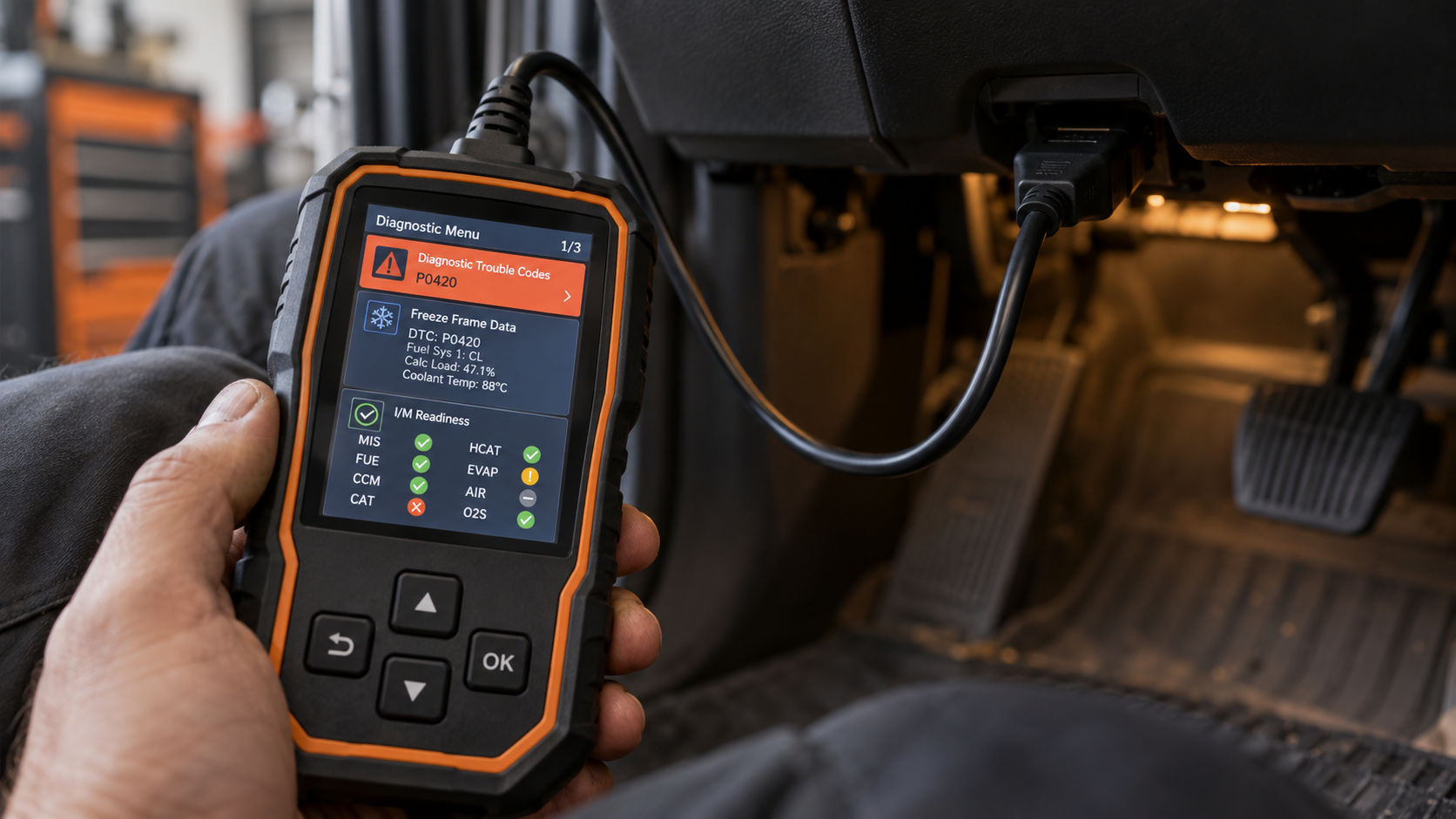
At its simplest, the scanner is an interface between you and diagnostic information available from the vehicle.
Standardized emissions-related OBD communication between vehicles and generic external test equipment supports information such as current diagnostic data, freeze-frame information, emissions-related trouble codes, monitor/test results, and vehicle information.
The scanner can retrieve and display that information. More capable tools may also access manufacturer-specific modules and data, perform active tests or provide repair databases.
But the scanner still needs evidence to distinguish one possible cause from another.
Why Can One Code Have Several Causes?
Because the control module often monitors a result or electrical condition rather than directly observing the physical failure.
Consider a simplified example. The ECU expects a sensor signal within a particular range. The signal is wrong. Possible explanations might include the sensor being defective, an open wire, a signal wire shorted, a connector with poor contact, missing power or ground, or another system condition driving the reading outside the expected range.
From the ECU’s perspective, the abnormal signal is real. But several physical faults can create that same abnormal signal.
That is why replacing the component whose name appears in a code definition can waste money.
A Real Example: P0406
Repair-database evidence for a real code such as P0406: an EGR sensor circuit-high code, illustrates the point well. Sample repair reports for this code do not give one guaranteed failed component. They list multiple possible causes, including connector damage, sensor failure, an open return circuit, a signal shorted to voltage, and PCM failure.
They also list reported fixes from repair history. Most importantly, this kind of report explicitly warns that the possible causes may or may not be the actual cause and that reported fixes are not guaranteed repairs.
That is exactly how diagnostic information should be interpreted. A likely fix is evidence. It is not proof.
Then Why Are OBD2 Scanners So Useful?
Because diagnosis without information is much harder.
A scanner can reduce a huge question (“Why is my car running badly?”) into a much narrower one: “Why did the ECU detect this specific fault under these conditions?”
That is a major advantage. A good scan can help you identify the affected system, see which codes are stored, distinguish current and pending information where supported, capture the operating conditions when a fault was recorded, examine live sensor behavior, inspect monitor results, access other modules with an enhanced scanner, and decide what test should come next.
The scanner does not have to give you the final answer to save substantial diagnostic time.
Freeze Frame Adds Context
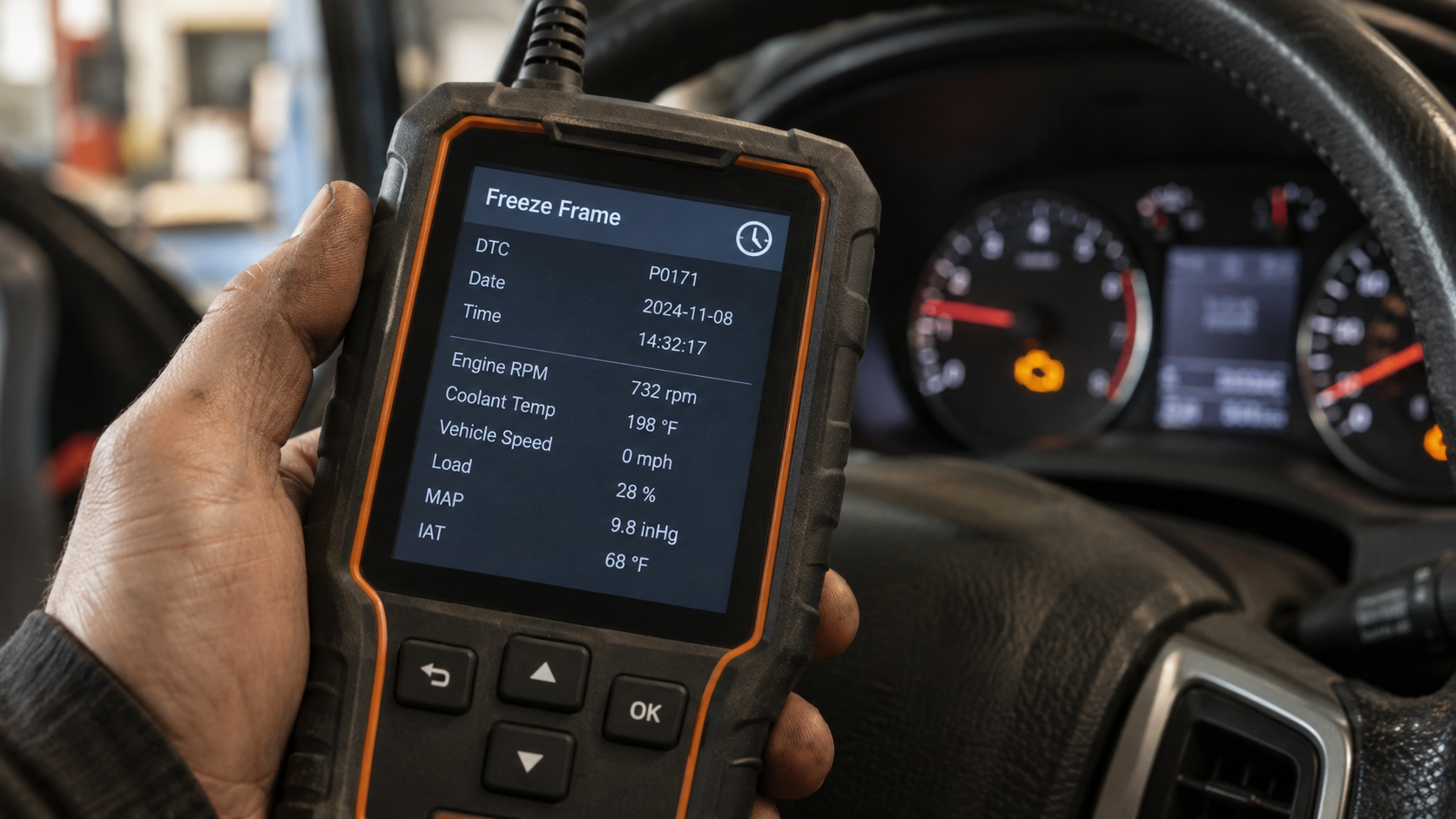
A DTC tells you what diagnostic fault was recorded. Freeze-frame data can tell you something about when it happened.
Depending on the vehicle and supported data, that snapshot may include parameters such as engine speed, vehicle speed, coolant temperature, calculated load, fuel trims and other relevant PIDs.
Imagine a fault that occurs only during a cold start, under heavy load, at highway speed, or at idle. That context can change the diagnostic direction.
Freeze frame is best understood as a snapshot of the vehicle when the code was stored: evidence surrounding the fault, not automatic proof of the failed part.
Live Data Helps You Test a Hypothesis
Live data lets you observe supported values while the vehicle is operating. This can help answer questions such as: is a sensor responding? Does a reading change when conditions change? Are fuel trims abnormal? Does temperature data make sense? Is the symptom visible in a monitored parameter?
But live data must be interpreted. A number on a screen is not useful merely because it is available. You need to know what the PID represents, what conditions the vehicle is operating under, what behavior is plausible, and how related parameters interact.
For a deeper guide, continue to How to Read OBD2 Live Data.
Mode 6 and Monitor Results Can Add More Evidence
Supported OBD monitor-test information can provide another layer of diagnostic evidence. For example, some tools expose Mode 6 results related to on-board monitors, including examples such as misfire counts.
This can help narrow a problem. But once again: more data is not the same as an automatically confirmed diagnosis. The quality of the conclusion depends on the data available and how it is interpreted.
What Does a More Expensive Scanner Add?
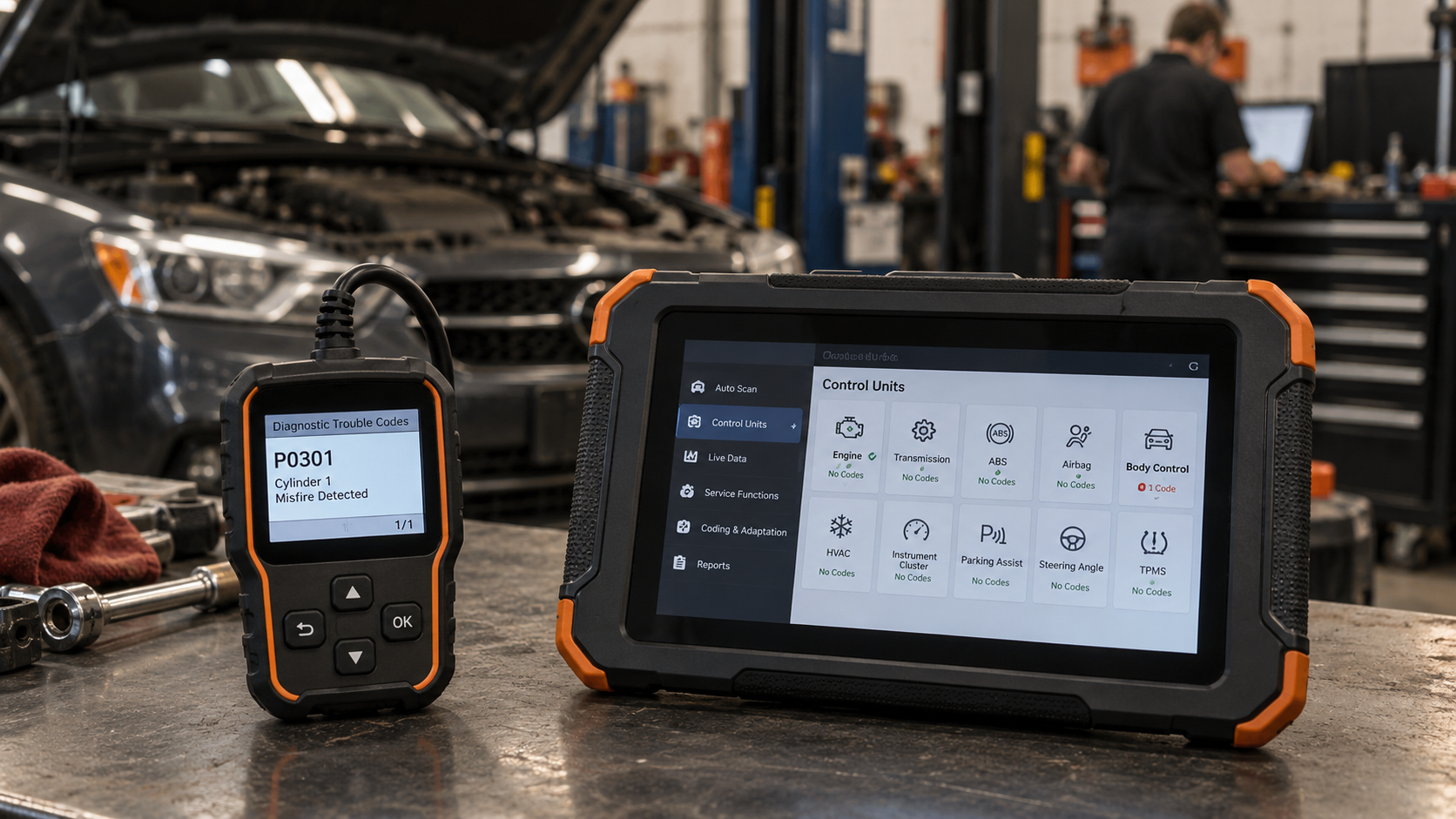
A more capable scanner can provide more diagnostic evidence. Depending on the exact tool and vehicle, that can include more control modules, manufacturer-specific codes, enhanced live data, full-system scanning, bidirectional controls, service functions, repair information, topology or module views, and coding/adaptation functions.
These capabilities can dramatically improve diagnosis. For example, an active test can help determine whether a component responds when commanded.
But even bidirectional control is not a magic “find broken part” button. A failed response can still require investigation of power, ground, wiring, communication, mechanical condition, or the actuator itself.
For more detail, read What Is Bidirectional Control on a Scan Tool? Active Tests Explained.
What About Apps That Give a “Verified Fix”?
Repair databases can be extremely useful. Products that combine the retrieved code with vehicle-specific repair information, possible causes and previously reported fixes are much more useful than a bare code number.
But distinguish common/verified historical repair information from physical confirmation on your particular vehicle.
If thousands of similar vehicles with the same code were fixed by replacing one component, that can make the component a strong suspect. It still does not prove that your vehicle has the same failure.
Use repair data to prioritize testing, not to eliminate testing when the cause is uncertain.
Can a Scanner Detect Mechanical Problems?
Only indirectly in many cases. A scanner sees diagnostic information made available by vehicle systems. A mechanical problem may affect monitored data and trigger a code. But some faults may not produce a useful DTC at all: examples can include certain noises, leaks, worn mechanical parts, intermittent faults, physical damage, and problems outside monitored systems.
A scan that reports no DTC does not prove the entire vehicle is mechanically healthy. That is another reason a scanner complements inspection and testing rather than replacing them.
Can a Scanner Diagnose ABS, Airbag or Transmission Problems?
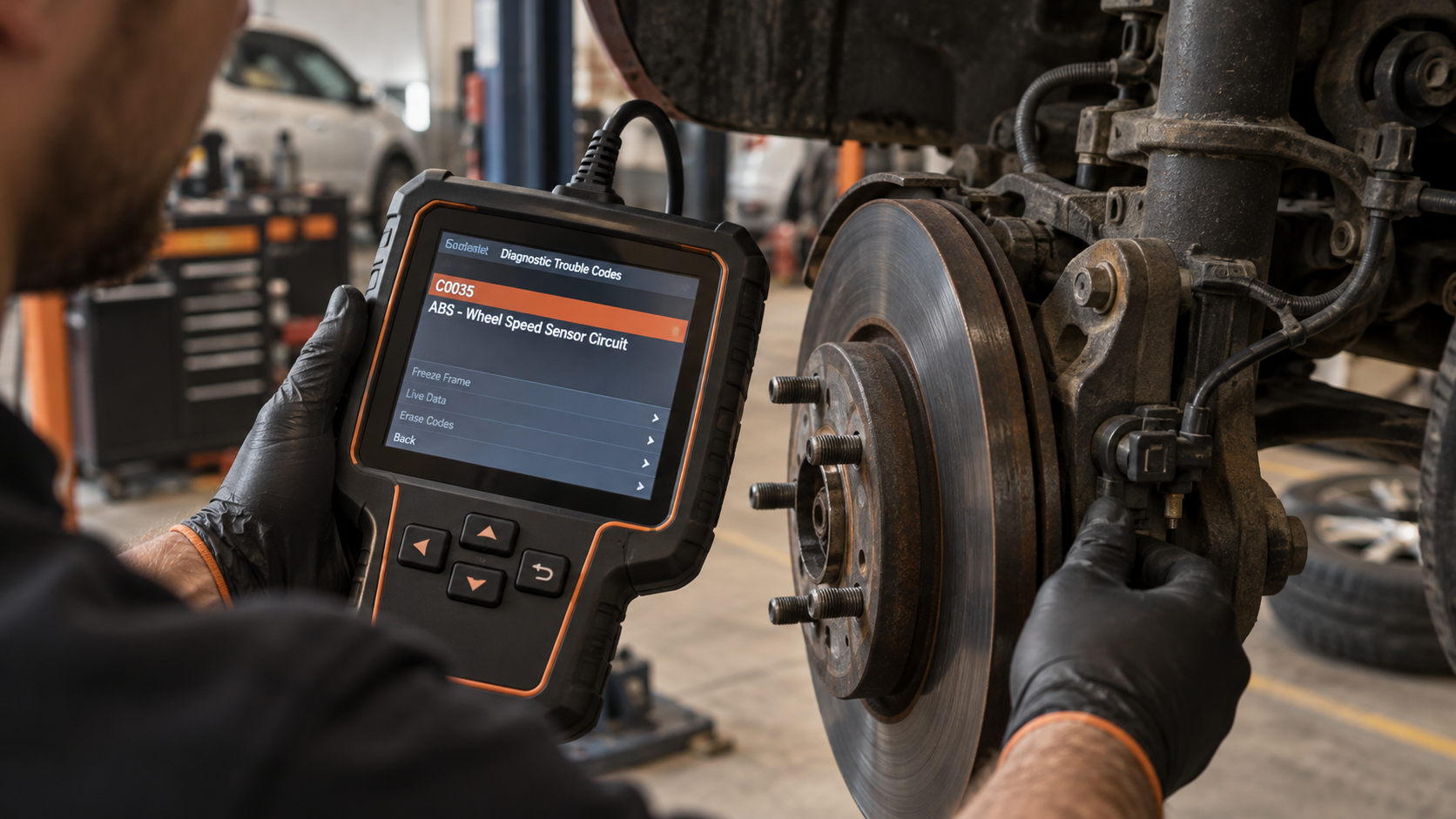
A generic OBD2 reader may not access those systems. An enhanced/full-system scanner can access additional modules where supported.
But the same diagnostic principle remains: module code does not automatically equal confirmed failed part.
For example, an ABS code may direct attention to a wheel-speed-sensor circuit. Diagnosis may still require checking live wheel-speed data, wiring, connectors, sensor condition, tone ring/bearing-related conditions where applicable, and module communication.
First make sure the scanner can access the system. See What Does Full-System Diagnostics Mean on a Scan Tool?
The Code-to-Diagnosis Workflow
Step 1: Read all relevant codes. Do not immediately clear them. Record code number, code status where available, affected module, and accompanying codes. Multiple codes can provide context.
Step 2: Save freeze-frame information. If available, record the conditions when the fault was stored.
Step 3: Research the exact code for the exact vehicle. Distinguish generic code definition, manufacturer-specific information, service information, and known failure patterns.
Step 4: Consider symptoms. What is the vehicle actually doing? When does it happen? Is there a warning light? Is drivability affected?
Step 5: Examine relevant live data. Use the scanner to test the diagnostic hypothesis where appropriate.
Step 6: Inspect and test. Depending on the fault, this may involve visual inspection, connector checks, wiring tests, voltage/resistance measurements, vacuum/smoke testing, mechanical tests, active tests, and service-information procedures.
Step 7: Replace a part when evidence supports it. Do not replace parts simply because their name appears in a code definition.
Step 8: Verify the repair. After the repair: clear codes when appropriate, operate the vehicle under relevant conditions, rescan, confirm the fault does not return, and verify the symptom is resolved.
The complete post-scan workflow is covered in more depth in What to Do After Your OBD2 Scanner Finds a Trouble Code.
The “Parts Cannon” Mistake
“Parts cannon” is informal workshop language for replacing likely parts one after another without properly confirming the cause. It can become expensive quickly.
Example: a code points toward an oxygen-sensor-related condition. You replace the oxygen sensor. The code returns. You replace another sensor. The code returns. The real problem was a wiring fault.
A scanner should reduce guessing. Using the scanner as a parts-replacement menu creates a new form of guessing.
When Can a Scanner Get Very Close to the Answer?
Sometimes the evidence becomes very strong. Suppose you have a specific DTC, matching symptoms, freeze-frame context, abnormal live data, a failed targeted test, and physical inspection confirming the fault.
At that point, the scanner may have been central to a highly confident diagnosis. But notice what happened: the conclusion came from multiple pieces of evidence. Not merely from reading one code.
When Should You Stop DIY Diagnosis?
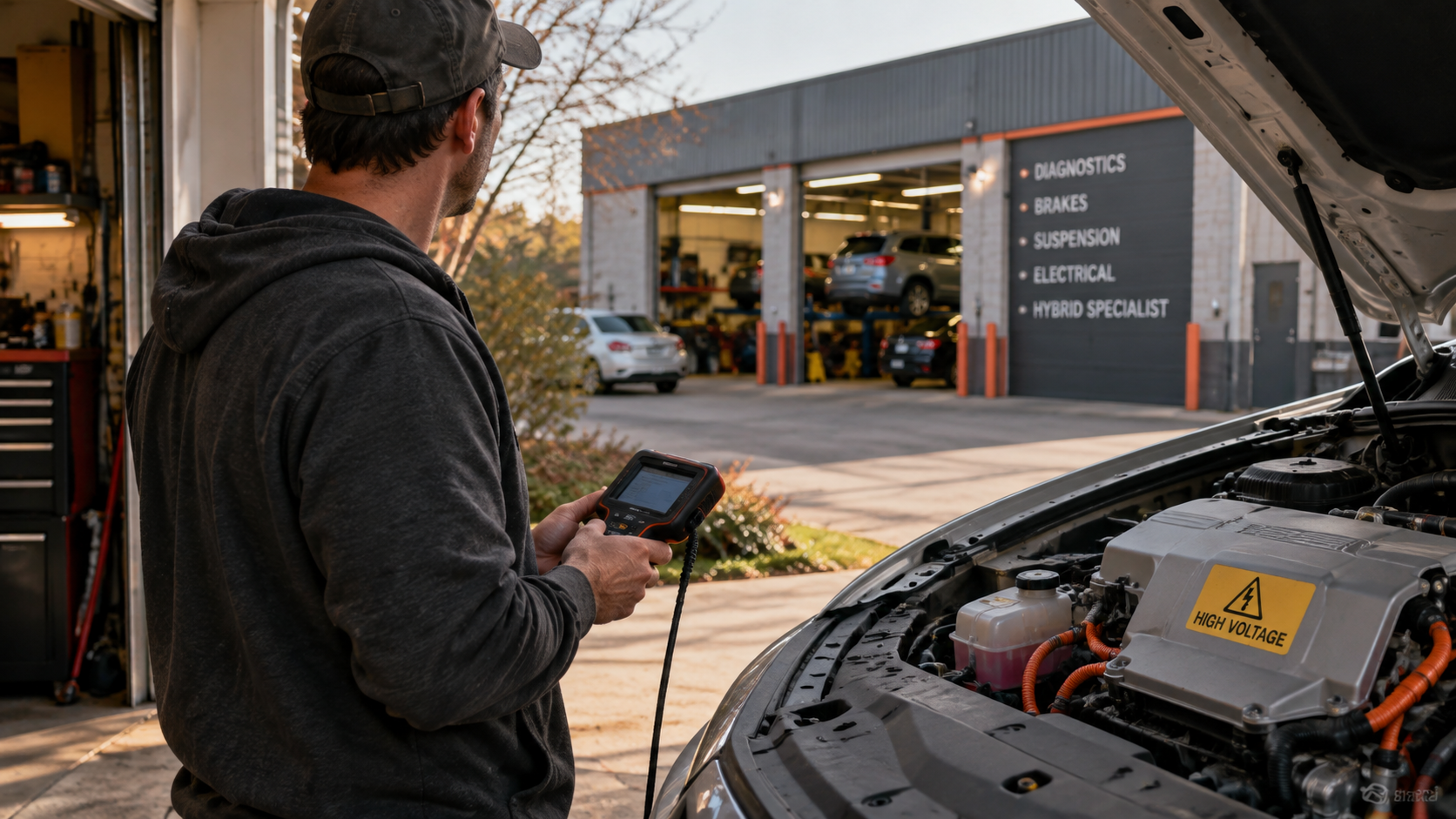
Consider professional diagnosis when the fault involves safety-critical systems, you do not have the required test equipment, the procedure requires advanced electrical knowledge, programming/coding is involved, high-voltage hybrid/EV systems are involved, the vehicle has severe drivability symptoms, the repair could cause major damage if performed incorrectly, evidence remains contradictory, or you are about to replace an expensive part without confirmation.
A scanner can also make a professional visit more productive because you can describe the code, symptoms and conditions clearly.
Common Diagnostic Mistakes
Mistake 1: Replacing the part named in the code. A code identifies a detected condition, not necessarily the failed component.
Mistake 2: Clearing the code before saving data. You may erase useful diagnostic context.
Mistake 3: Looking at only one code. Related codes can help reveal the bigger picture.
Mistake 4: Ignoring freeze frame. The conditions when the fault occurred may matter.
Mistake 5: Treating a common fix as a guaranteed fix. Repair databases show useful patterns, not physical proof.
Mistake 6: Assuming no codes means no problem. Not every mechanical fault creates a DTC.
Mistake 7: Buying a more expensive scanner instead of learning the diagnostic process. More capability provides more evidence. It does not remove the need to interpret evidence.
FAQ
Does an OBD2 code tell you what part is bad?
Not necessarily. It identifies a diagnostic fault/condition. Several different physical causes can sometimes produce the same code.
Can an OBD2 scanner diagnose a Check Engine light?
It can retrieve the diagnostic information behind the warning and provide important evidence. Confirming the root cause may require additional interpretation and testing.
Can a scanner tell me exactly which sensor is bad?
Sometimes the combined evidence may strongly identify a sensor, but the code alone may not prove the sensor itself has failed. Wiring, connectors, power/ground and other conditions can produce sensor-related faults.
What is the difference between a code and a diagnosis?
A code is information stored by the vehicle after a diagnostic condition is detected. A diagnosis is the evidence-based conclusion about the actual cause.
Are “most likely fixes” reliable?
They can be valuable diagnostic clues, especially when based on vehicle-specific repair history, but they should not automatically be treated as guaranteed repairs.
Does live data tell you exactly what is wrong?
Live data can reveal abnormal behavior and help test hypotheses. It still requires interpretation.
Can a professional scan tool diagnose everything automatically?
No. Advanced tools can provide much more information and testing capability, but mechanical/electrical diagnosis can still require inspection, measurements and technician reasoning.
If there are no codes, is the car fine?
Not necessarily. Some problems do not set a DTC or may be intermittent/not currently meeting code-setting criteria.
Should I clear a code as soon as I read it?
Usually record the code and useful supporting information first. Clearing diagnostic information too early can remove evidence needed for troubleshooting.
What should I do immediately after finding a code?
Save the code and supporting data, understand what the code actually means, investigate likely causes, test before replacing parts, repair the confirmed cause and verify the result. See What to Do After Your OBD2 Scanner Finds a Trouble Code for the complete workflow.
The Bottom Line
An OBD2 scanner can tell you a great deal about what your vehicle’s computers detected. But the most important distinction is: code does not equal automatic diagnosis.
Use this model: detection → storage → retrieval → interpretation → confirmation. The scanner handles the retrieval and can provide powerful evidence for the remaining steps.
A basic scanner may point you toward the affected system. A more advanced scanner may add freeze frame, enhanced live data, additional modules, active tests and repair information. But no scanner should be treated as a universal parts-replacement machine.
The best diagnostic habit is simple: use the code to decide what to test next, not what to replace next.
If you need a deeper explanation of DTCs, continue to OBD2 Codes Explained: How to Read Diagnostic Trouble Codes.
If you already have a code and want the complete next-step process, continue to What to Do After Your OBD2 Scanner Finds a Trouble Code.
To see what scanners can do beyond reading codes, compare the Best Full-System Automotive Scanners.