Knowledge Hub
DoIP Explained: Why Modern Scan Tools Use Ethernet
A modern scan tool specification may list DoIP next to CAN FD, J2534, ECU Coding and Bidirectional Control.
It is easy to read that list as if all five terms describe diagnostic features. They do not.
DoIP is a communication technology for carrying vehicle diagnostic traffic over Internet Protocol networks. In practical automotive diagnostics, that commonly means using Ethernet/IP communication between diagnostic equipment and a supported vehicle.
DoIP does not automatically give a scanner full-system diagnostics, active tests, ECU coding, ECU programming, secure-gateway access, or universal vehicle coverage.
It provides a communication path. The scanner still needs the right software, vehicle coverage, module support and authorization to perform the job.
What Does DoIP Stand For?
DoIP means Diagnostic Communication over Internet Protocol. It is standardized in the ISO 13400 series.
The current ISO 13400-2 standard defines transport protocol and network-layer services for diagnostic communication between a client DoIP entity, such as diagnostic equipment, and server entities in the vehicle using IP, TCP and UDP.
In plain English: DoIP lets diagnostic equipment communicate with supported vehicle systems using computer-network technology.
Does DoIP Mean the Car Uses the Public Internet?
No. This is probably the most important beginner misconception.
The word “Internet” appears because DoIP uses Internet Protocol (IP). IP is a networking technology. A diagnostic tool and vehicle can communicate over a local IP network without either device browsing the web or connecting the diagnostic session through the public Internet.
Think of your home network. Your laptop can communicate with another device on the same local network even if the internet connection outside your house is unavailable. The same general distinction applies here: IP communication does not equal a public Internet connection.
Is DoIP the Same as Automotive Ethernet?
Not exactly. A useful simplified model: Ethernet is the network technology/path; IP/TCP/UDP are the networking/transport technologies; and DoIP is the standardized vehicle-diagnostic communication built on top of that IP environment.
DoIP is therefore strongly associated with automotive Ethernet, but the terms should not be treated as identical definitions.
Why Did Automotive Diagnostics Move Toward Ethernet/IP?
Modern vehicles contain more electronic control units, larger software/calibration packages, centralized/domain/zonal architectures, advanced driver-assistance systems, and increasingly software-dependent functions.
Diagnostic work can involve much more data than simply retrieving one five-character trouble code: examples include large software transfers, module programming, complex diagnostic sessions, high-volume data exchange, and communication through central gateways.
DoIP provides a standardized diagnostic interface for that IP-based environment.
How Does DoIP Work?
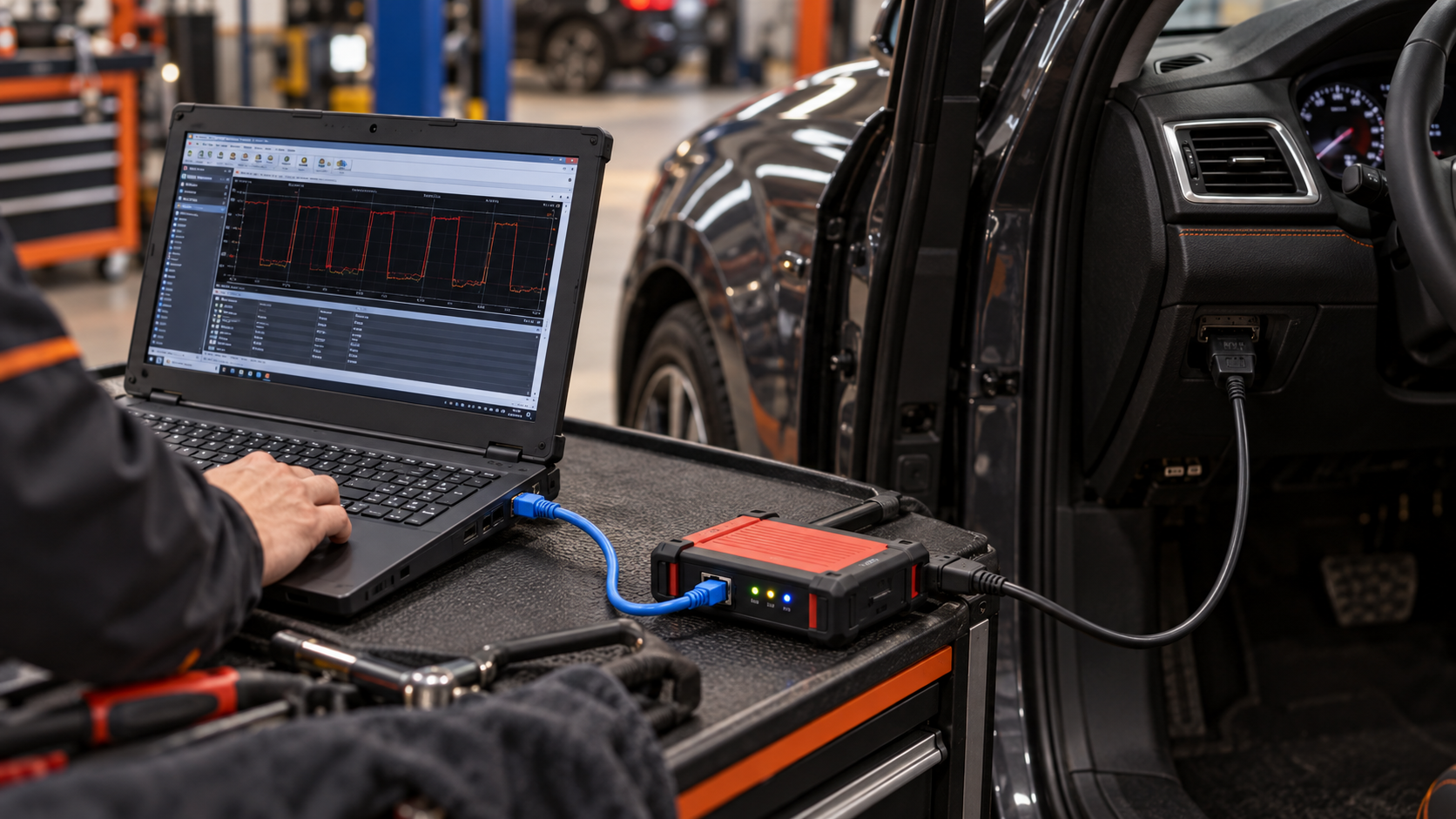
You do not need to become a network engineer to understand the basic flow. A simplified DoIP session looks like this: diagnostic tool → IP/Ethernet connection → DoIP vehicle interface/gateway → target vehicle system.
The current ISO 13400-2 standard includes functions for network integration/IP addressing, vehicle announcement and discovery, retrieving basic vehicle status information, establishing and maintaining connections, controlling/routing through the vehicle gateway, routing data to vehicle subcomponents, and handling communication errors.
So DoIP is more than simply putting a diagnostic message into “an Ethernet cable.” It defines how the diagnostic client finds, connects to and communicates through the vehicle’s DoIP environment.
What Are TCP and UDP Doing in DoIP?
ISO 13400-2 specifies DoIP communication using IP together with TCP and UDP.
UDP can be used for connectionless network functions such as vehicle discovery/announcement and related information exchange.
TCP provides connection-oriented communication used for established diagnostic communication.
The practical takeaway is not that scanner buyers need to configure TCP packets. It is that DoIP behaves like an IP-network diagnostic system, not like a traditional CAN-only diagnostic link.
What Is UDS, and Is It the Same as DoIP?
No. This is another major distinction.
UDS (Unified Diagnostic Services) is the diagnostic service framework standardized in ISO 14229. It describes diagnostic services/requests. DoIP describes how supported diagnostic traffic can be transported over an IP network.
A useful mental model: UDS is what diagnostic conversation is taking place; DoIP is how that diagnostic traffic travels through the IP network.
DoIP does not replace the diagnostic meaning of UDS. It provides a transport path for supported diagnostic communication.
Is DoIP the Same as OBD2?
No. OBD2 and DoIP exist at different conceptual levels.
OBD2 refers to the standardized/regulatory on-board diagnostic framework familiar to consumers through functions such as emissions-related trouble codes, readiness and standardized data.
DoIP is a communication technology for diagnostic traffic over IP networks. A modern vehicle can support legislated OBD diagnostics while also using enhanced manufacturer diagnostics over modern network technologies.
Do not assume DoIP is simply a new version of the Check Engine light code reader. It is broader, as a communication architecture concept.
DoIP vs CAN
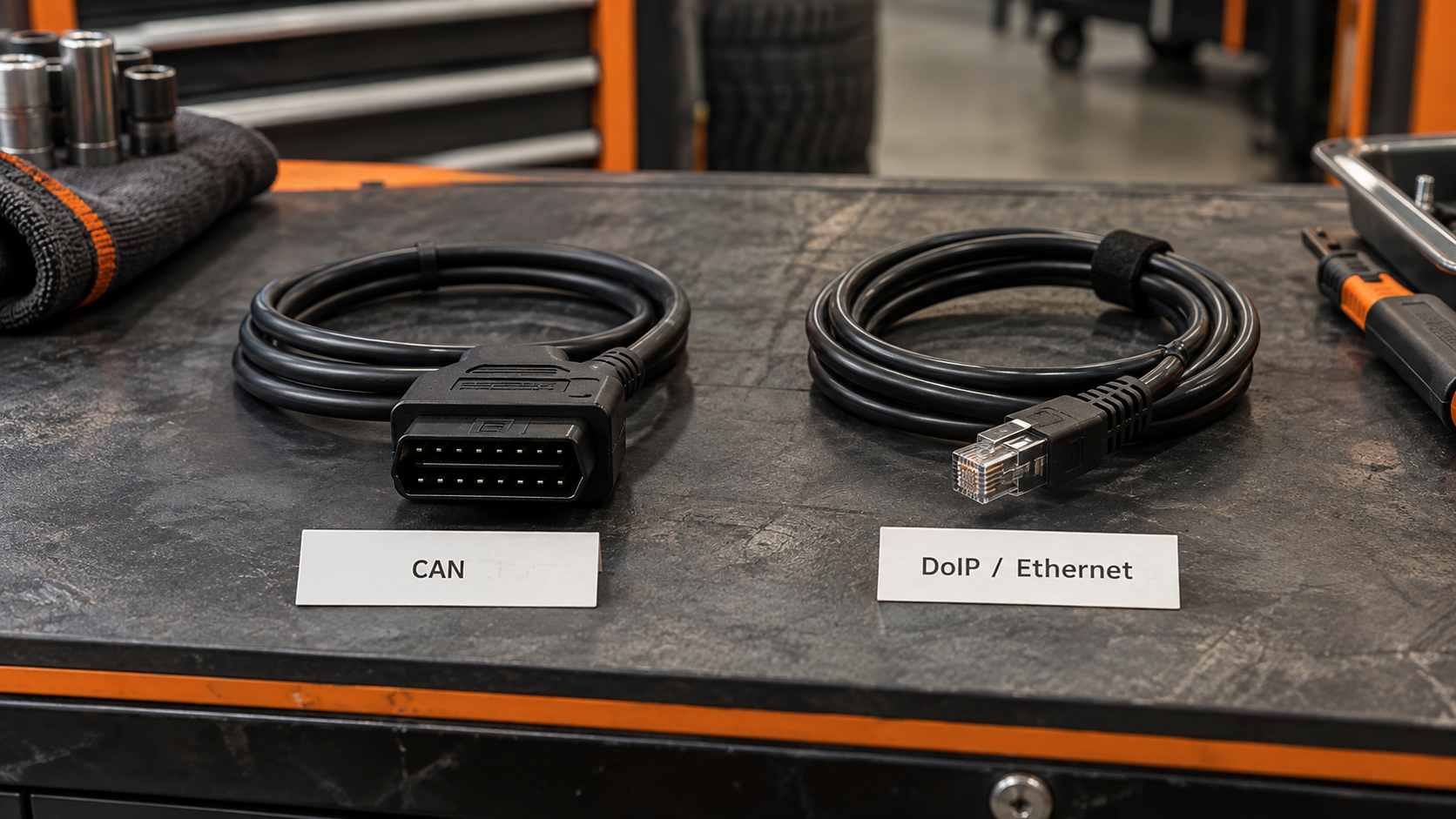
Traditional vehicle diagnostics have long used CAN-based communication. DoIP takes a different network approach.
CAN-based diagnostics. Diagnostic traffic is carried over a CAN network.
DoIP. Diagnostic traffic is carried using IP networking, commonly over Ethernet.
Ethernet/IP can provide substantially more bandwidth than traditional CAN-based diagnostic communication, which is valuable for data-heavy workflows. But CAN has not simply disappeared. Modern vehicles can contain multiple network technologies at the same time, with gateways routing communication between them.
DoIP vs CAN FD
This distinction is especially important because modern scanner boxes often list both.
CAN FD is CAN with Flexible Data-rate, an evolution of CAN that increases the maximum data field and supports a faster data phase.
DoIP is diagnostic communication over IP networks, commonly Ethernet.
So CAN FD does not equal DoIP. A professional scanner may need both because different vehicles/modules use different communication architectures: modern professional interfaces increasingly bundle DoIP and CAN FD support together.
For the CAN side, read CAN FD Explained: Why It Matters for Modern OBD2 Scanners.
Does DoIP Make Diagnostics Faster?
It can enable much higher-bandwidth diagnostic communication than older CAN-based paths. That matters particularly when a diagnostic workflow transfers substantial amounts of data. Programming/reflashing is an obvious example: a large software/calibration transfer benefits much more from high-bandwidth communication than reading one small DTC response.
But avoid the simplistic claim “every DoIP scan is X times faster.” Actual performance depends on vehicle architecture, diagnostic software, gateway, target ECU, interface, network implementation, and diagnostic operation.
The safe claim is: DoIP provides an IP/Ethernet-based path capable of supporting high-bandwidth diagnostic communication.
Is DoIP Only for ECU Programming?
No. Programming is an important high-data use case, but DoIP is not “the programming protocol.” DoIP is the communication transport. Supported diagnostic traffic can include many operations.
Programming itself still depends on diagnostic/programming services, OEM procedure, module support, security/access, software/calibration, appropriate interface, and stable vehicle power. For that distinction, read ECU Coding vs Programming vs Adaptation: What’s the Difference?
Is DoIP the Same as J2534?
No.
DoIP is a diagnostic communication technology over IP. J2534 is a standardized pass-thru interface framework used in vehicle reprogramming workflows.
They can exist in the same interface: a single vehicle communication interface can be J2534-compliant while separately supporting DoIP and CAN FD. That tells us these terms describe different aspects of the diagnostic system.
Does DoIP Mean Full-System Diagnostics?
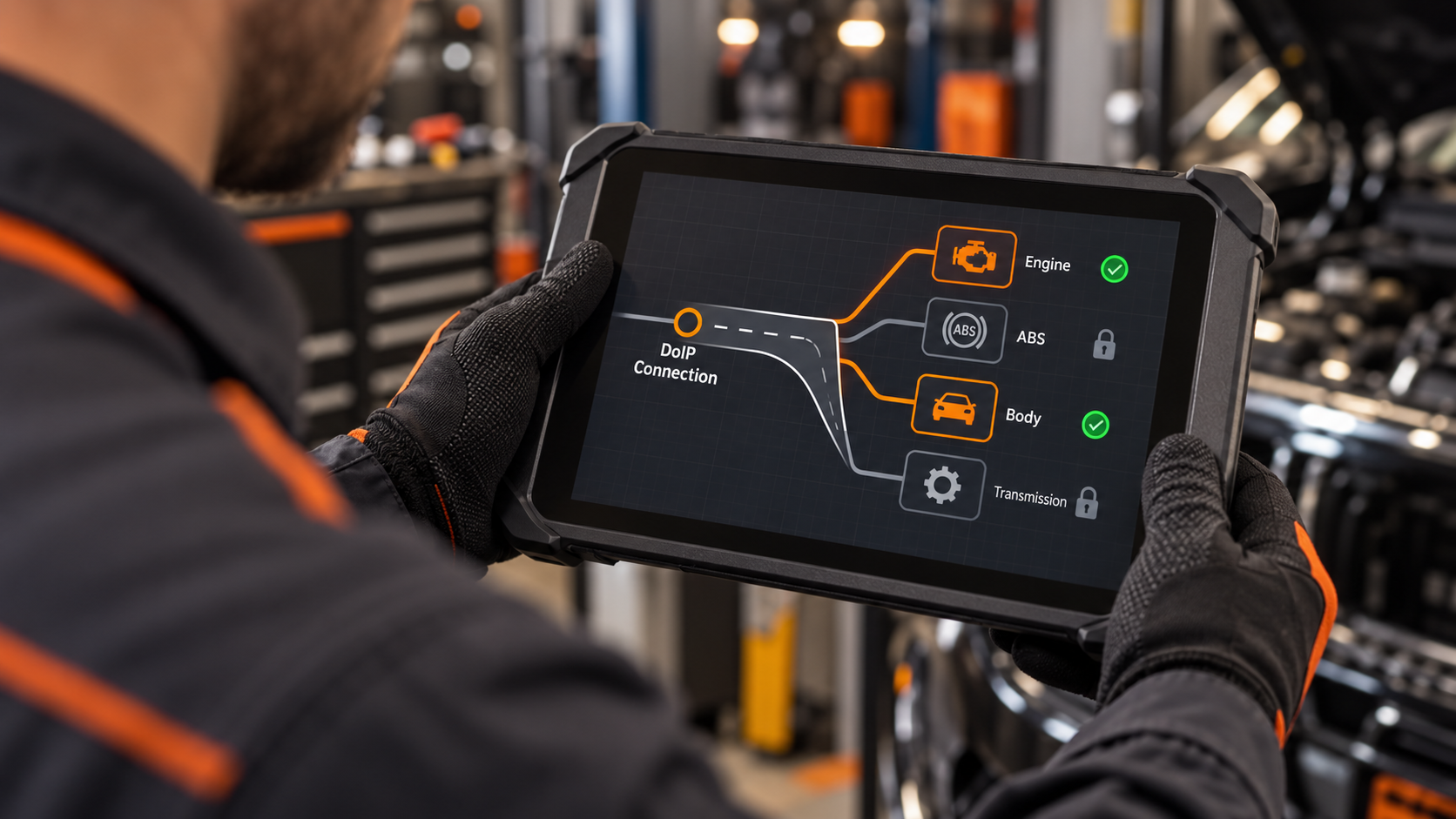
No. A scanner can have the hardware/network capability to communicate using DoIP while its software lacks coverage for the module or function you need.
Think of it as: DoIP is the communication road, and diagnostic coverage is the destinations the tool knows how to reach and work with. You need both.
For the module-access side, read What Does Full-System Diagnostics Mean on a Scan Tool?
Does DoIP Mean Bidirectional Control?
No. Bidirectional control is a diagnostic function. DoIP is a communication technology.
A scanner may perform an active test over a DoIP communication path on a supported vehicle. But DoIP support does not itself prove that the scanner has that active test. Read What Is Bidirectional Control on a Scan Tool? Active Tests Explained for the functional distinction.
Does DoIP Mean ECU Coding?
No. The same rule applies. A tool may communicate with a module using DoIP and support coding. Another tool may communicate over DoIP but not offer the coding function you need. Protocol support is necessary only when the vehicle/function requires that protocol. It is not proof of every function above the transport layer.
Does DoIP Automatically Mean Remote Diagnostics?
No. DoIP uses Internet Protocol and its architecture can support networked diagnostic scenarios. But IP-based diagnostics does not mean any scanner can automatically diagnose the car from anywhere on the public internet.
Remote diagnostics requires an appropriate end-to-end architecture, including connectivity, routing, authentication, security, software, permissions, and OEM/tool support. Do not buy a DoIP scanner because you assume the acronym automatically creates remote workshop access.
Is DoIP Secure?
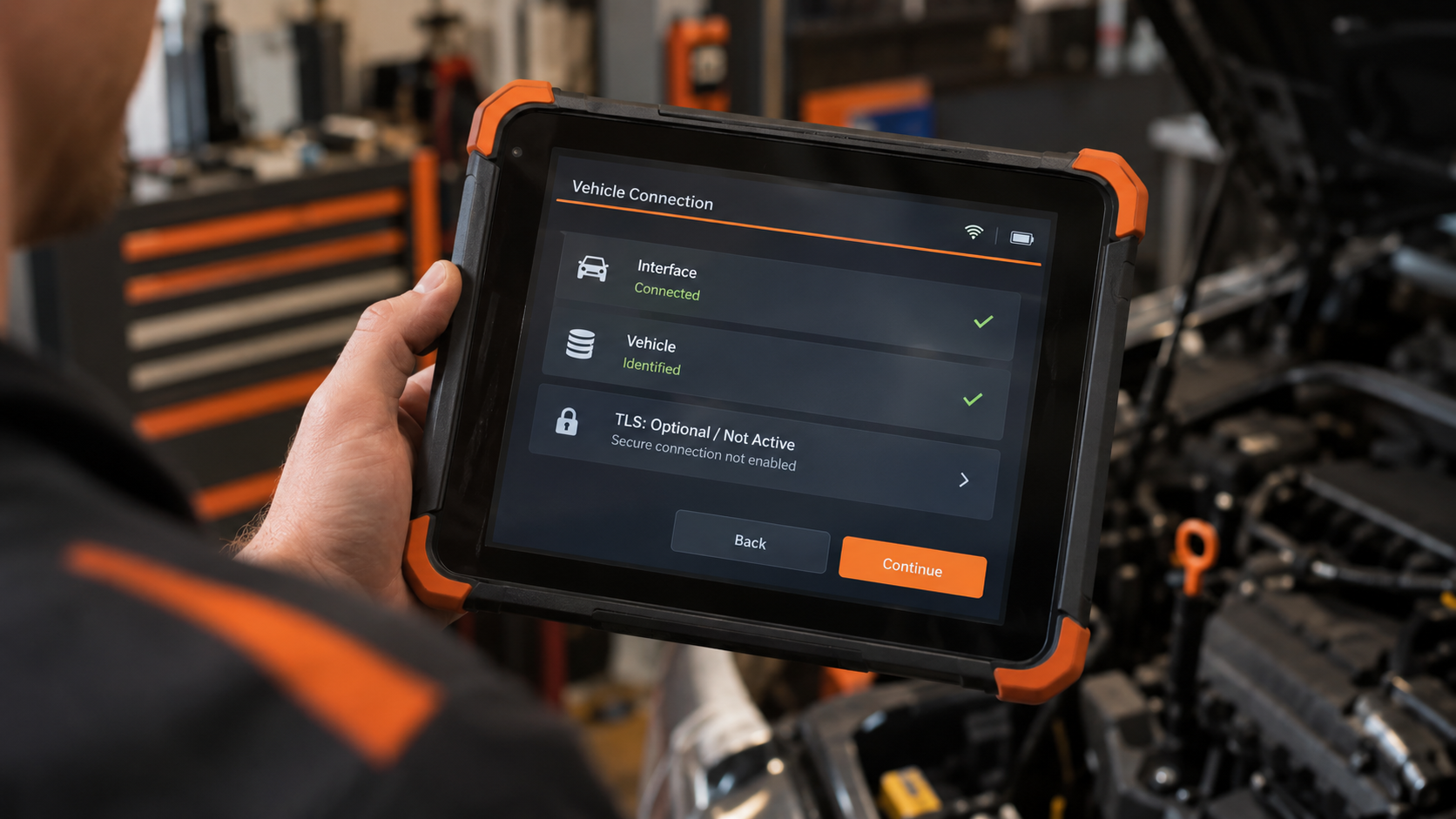
Do not assume security merely because the traffic uses modern IP networking.
The current ISO 13400-2 standard explicitly covers both secured and unsecured diagnostic communication. It lists TLS as an optional feature. DoIP should not be treated as inherently authenticated/encrypted by itself.
In practice, vehicle security can involve additional layers such as authentication, secure gateways, OEM authorization, diagnostic security services, and network security controls.
The safe SCG rule is: DoIP provides diagnostic transport. Security must be evaluated separately.
DoIP vs Secure Gateway
These are different. DoIP provides a communication path over IP. A secure gateway controls authorized access to supported vehicle diagnostic functions/networks.
A scanner can support DoIP and still require separate authorization to perform a protected operation. Likewise, having secure-gateway credentials does not give a CAN-only interface missing DoIP capability. Modern diagnostic compatibility can require both.
Does Every New Vehicle Use DoIP?
No. Do not use a universal rule such as “every vehicle after 2020 uses DoIP.” Vehicle network architectures vary by manufacturer, model, year, platform, module and market.
Some vehicles use DoIP extensively. Others may rely on CAN/CAN FD for many diagnostic functions. Others use mixed architectures. Verify the exact vehicle and task.
For the full process, read Will Any OBD2 Scanner Work With My Car? OBD2 Compatibility Explained.
Can an Older Scanner Work on a DoIP Vehicle?
Possibly for some functions. A vehicle that supports DoIP may also expose other diagnostics through CAN or another supported path.
An older scanner could therefore read generic OBD information, access some modules, or perform some supported functions, while lacking DoIP access needed for another module or operation.
So: “the scanner connects” does not prove complete coverage. And “the vehicle supports DoIP” does not prove every diagnostic task requires DoIP. Check the exact function.
What Happens If My Scanner Does Not Support DoIP?
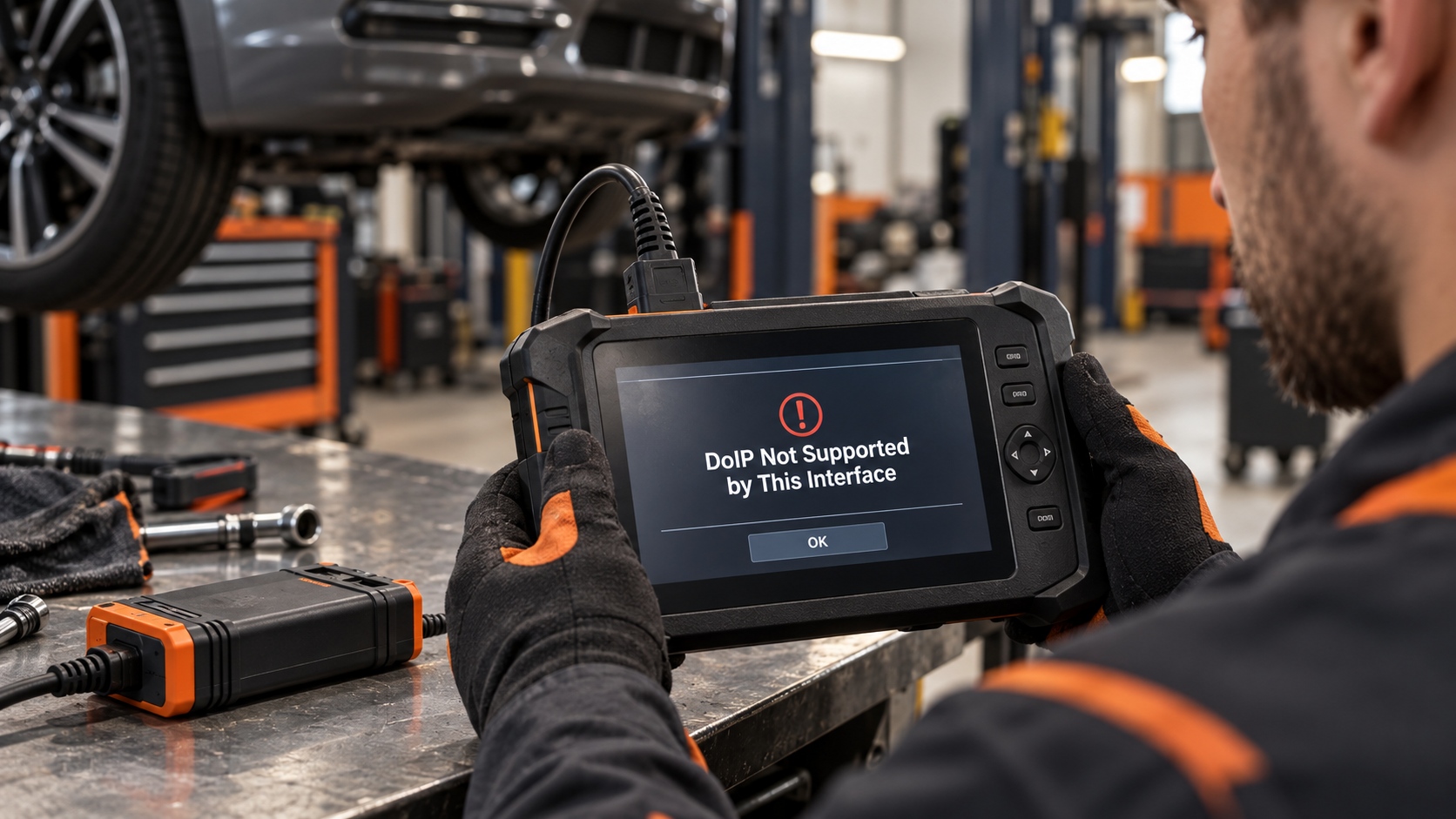
First determine whether the job actually requires DoIP. If it does, possible solutions can include a newer compatible VCI, an Ethernet/DoIP-capable interface, a manufacturer-supported adapter, or a different diagnostic platform.
But do not purchase hardware before checking exact coverage. If the problem is simply that your scanner will not communicate, first work through Why Won’t My OBD2 Scanner Connect to My Car? A communication failure can have many causes besides missing DoIP.
How to Tell Whether You Need DoIP
Step 1: Identify the exact vehicle. Make, model, year, engine/powertrain where relevant.
Step 2: Identify the exact job. Do you need generic OBD? Full-system scan? One specific module? Active tests? Coding? Programming? An ADAS-related diagnostic/calibration workflow?
Step 3: Check the scanner manufacturer’s exact coverage. Do not stop at “Supports DoIP.” Verify vehicle, module, function and software package.
Step 4: Check the interface. Does the scanner’s included VCI support DoIP, or is another VCI, cable, adapter or accessory required? Do not assume the base scanner has the capability merely because an accessory exists.
Step 5: Check software/subscriptions. Hardware protocol support does not create missing diagnostic software.
Step 6: Check access/security requirements. The vehicle may also require secure gateway authorization, an OEM account, online access, or security credentials.
Step 7: Check the complete workflow. For programming especially, also verify OEM software, J2534 or other required interface support, stable power requirements, and post-programming procedures.
Should You Pay More for a Scanner With DoIP?
That depends on your vehicles and expected use.
If you work only on older vehicles and your required diagnostic functions do not use DoIP, the feature may provide little immediate value. If you work on applicable newer vehicles, European platforms, software-heavy vehicles, EVs or professional late-model diagnostics, DoIP capability can become much more important.
But never buy from the acronym alone. Buy the vehicle/function coverage, not the protocol logo. The protocol matters because it enables access. The actual value comes from whether the tool can perform your required job.
Common Mistakes
Mistake 1: Thinking DoIP means the car must be online. IP can operate on a local network.
Mistake 2: Treating DoIP and UDS as the same thing. UDS defines diagnostic services; DoIP transports supported diagnostic traffic over IP.
Mistake 3: Treating DoIP and CAN FD as synonyms. They are different communication technologies.
Mistake 4: Treating a DoIP interface as a coverage guarantee. A DoIP connection only proves the tool can reach the vehicle’s gateway over Ethernet; which modules and functions it can actually work with still depends entirely on the diagnostic software running behind that connection.
Mistake 5: Expecting DoIP support to unlock programming on its own. Even over a DoIP-connected gateway, writing new software to a module still requires the manufacturer’s own licensed programming workflow, not just an Ethernet-capable interface.
Mistake 6: Assuming DoIP automatically means remote diagnostics. Remote access requires additional infrastructure, security and support.
Mistake 7: Assuming DoIP is automatically secure. Current ISO 13400-2 covers secured and unsecured communication; TLS is optional.
Mistake 8: Assuming every new car requires DoIP. Verify the exact vehicle/module/function.
Mistake 9: Buying a scanner because “DoIP” appears on the box. Verify the included interface and exact coverage.
FAQ
What does DoIP stand for?
Diagnostic Communication over Internet Protocol.
What standard defines DoIP?
The ISO 13400 series. The current ISO 13400-2 specifies transport protocol and network-layer services for DoIP communication.
Does DoIP require the public internet?
No. Internet Protocol can be used on a local network between diagnostic equipment and the vehicle.
Does DoIP use Ethernet?
DoIP is IP-based and is commonly implemented over Ethernet for automotive diagnostics.
Does DoIP use TCP and UDP?
Yes. ISO 13400-2 specifies DoIP communication using IP together with TCP and UDP.
Is DoIP the same as UDS?
No. UDS defines diagnostic services; DoIP provides an IP-based transport path for supported diagnostic messages.
Is DoIP the same as CAN FD?
No. CAN FD is an evolution of CAN. DoIP is diagnostic communication over IP networks.
Is DoIP the same as J2534?
No. J2534 is a pass-thru interface framework used in reprogramming workflows. A device can support both J2534 and DoIP.
Is DoIP faster than CAN?
Ethernet/IP-based DoIP can provide substantially higher communication bandwidth than traditional CAN diagnostic paths. Actual diagnostic speed depends on the complete vehicle/tool/software implementation.
Does DoIP mean a scanner supports ECU programming?
No. Programming capability, OEM software, module coverage and required access must be verified separately.
Does DoIP mean full-system diagnostics?
No. DoIP transport support does not prove diagnostic software coverage for every module.
Is DoIP secure?
Do not assume so automatically. ISO 13400-2 covers secured and unsecured communication and lists TLS as optional. Vehicle/tool security requirements must be checked separately.
Do I need a DoIP scanner?
You need DoIP capability when the exact vehicle/module/function you want to service requires it. Verify exact coverage before buying.
The Bottom Line
DoIP is easier to understand when you stop treating it as a scanner feature like “ABS Bleed” or “ECU Coding.” It is part of the communication architecture.
Use this model: UDS/diagnostic service → DoIP/IP transport → Ethernet/network → vehicle gateway → target module.
Then add the scanner-buyer reality: DoIP support plus exact vehicle coverage plus module/function support plus required software/authorization equals useful diagnostic capability.
DoIP provides the road. It does not guarantee every destination or every job.
If you want to understand the other major modern protocol advertised beside DoIP, read CAN FD Explained: Why It Matters for Modern OBD2 Scanners.
If you are checking whether a scanner will work with your exact vehicle, continue to Will Any OBD2 Scanner Work With My Car? OBD2 Compatibility Explained.
If you want to see which scanners support DoIP in practice, compare the Best Professional Automotive Scan Tools.