Knowledge Hub
OBD2 Scanner Subscriptions Explained: Updates, Renewals and the Real Cost of Ownership

An OBD2 scanner can cost $50, $500 or several thousand dollars.
But the price on the box may not be the full cost of owning it.
Some diagnostic tools include free software updates for years or even advertise lifetime updates. Others include a limited update period and then offer paid renewals. Some keep basic functions available but require a subscription for advanced features or online services.
That creates an important buying question: what will this scanner still do if I never pay another dollar after buying it?
Do not assume. Subscription and update policies vary by exact product, software package, region and time, even within the same brand.
Why Do Diagnostic Scanners Need Updates?
Modern scan tools depend heavily on software.
New vehicles introduce new model years, new control modules, new diagnostic functions, revised procedures, new protocols, security changes, and software bugs that need correction.
A scanner’s hardware can remain physically fine while its vehicle database becomes increasingly outdated.
Software updates can add or improve vehicle coverage, module coverage, diagnostic functions, service procedures, protocol support, bug fixes and user-interface features.
That is why update policy matters much more on an advanced diagnostic tool than on a very simple generic code reader.
Subscription and Software Update Are Not Always the Same Thing
This distinction is critical.
A software update plan may determine whether you receive newer diagnostic software and vehicle coverage.
A feature subscription may determine whether particular advanced functions remain available.
An online-service subscription may pay for cloud information, repair databases, AI tools or other connected services.
A support/warranty plan may extend technical support or hardware coverage.
These can be bundled together. Or they can be completely separate.
So when a seller says “One-year subscription included,” you still need to ask: one year of what?
The Six Costs You Should Check
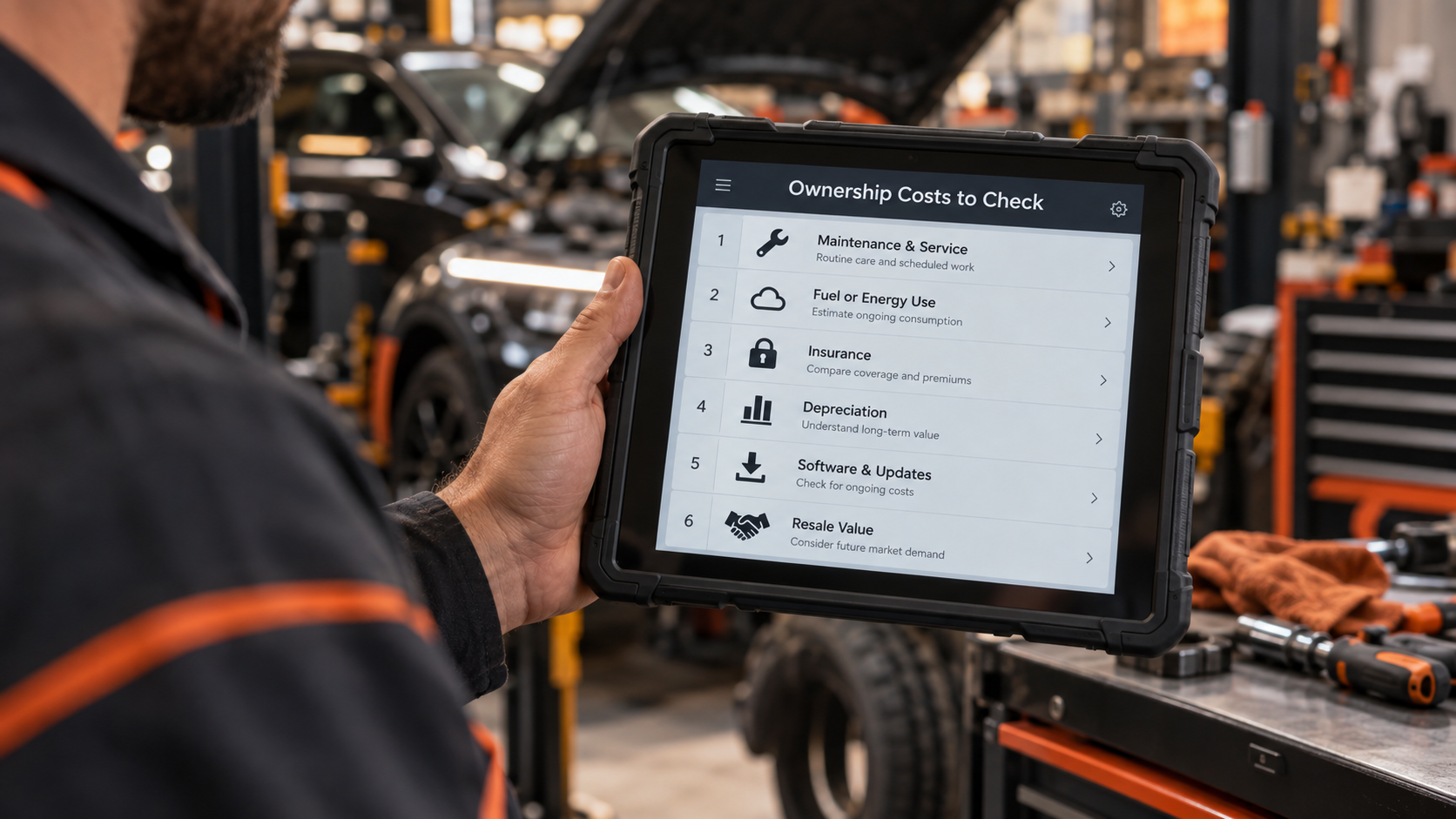
SCG recommends checking six separate layers.
1. Core tool ownership
Start with the simplest question: what functionality belongs to the tool permanently after purchase? Examples might include generic OBD2 functions, code reading, certain vehicle diagnostics, and functions installed during the active period. But never assume the answer. Check the exact product policy.
2. Software and vehicle-coverage updates
Ask: how long are updates included? What does renewal cost? Is renewal optional or required? If I stop renewing, can I keep the last installed software? Can I renew later? Is there a penalty for skipping years? Are new vehicle models added only while the plan is active? This category affects how current the tool remains.
3. Feature entitlements
Some tools separate always-available features from subscription-required advanced functions. One current example in the market lists certain functions as always free while placing other advanced functions, including bidirectional control and some full-system capabilities, behind a software subscription, depending on the product tier.
That is very different from a simple “updates cost money” model. It means you need to ask: what actually becomes unavailable when the subscription ends?
4. Online and data services
A scanner can also include connected services such as repair information, AI diagnostic assistance, cloud reports, guided diagnostics, remote services and databases. These may have their own commercial terms. Do not automatically treat an online-information subscription as the same thing as the scanner’s core diagnostic license.
5. Third-party or OEM access
Some advanced work can involve services outside the scanner manufacturer’s basic software package, such as manufacturer security access, OEM programming subscriptions, secure-gateway services, or third-party repair information. A scanner supporting a capability does not necessarily mean every external service needed to use that capability is included forever in the purchase price. For professional tools, investigate this before buying.
6. Support and warranty programs
Some renewal programs combine software access with support or warranty benefits: extending software updates and warranty/support coverage for an additional period on applicable products. So a renewal price cannot always be compared directly with another brand’s software-only update price. First compare what the renewal actually includes.
What Happens When a Scanner Subscription Expires?
There is no universal answer.
Depending on the product, expiration may mean you stop receiving new software updates, you keep the software already installed, some advanced features stop working, online services stop, newer vehicle coverage is unavailable, support/warranty benefits end, the tool prompts you to renew, or some basic functions remain available.
This is why statements such as “the scanner becomes useless after one year” or “everything keeps working forever” should not be made without checking the exact product.
Does Every Professional Scanner Require a Subscription?
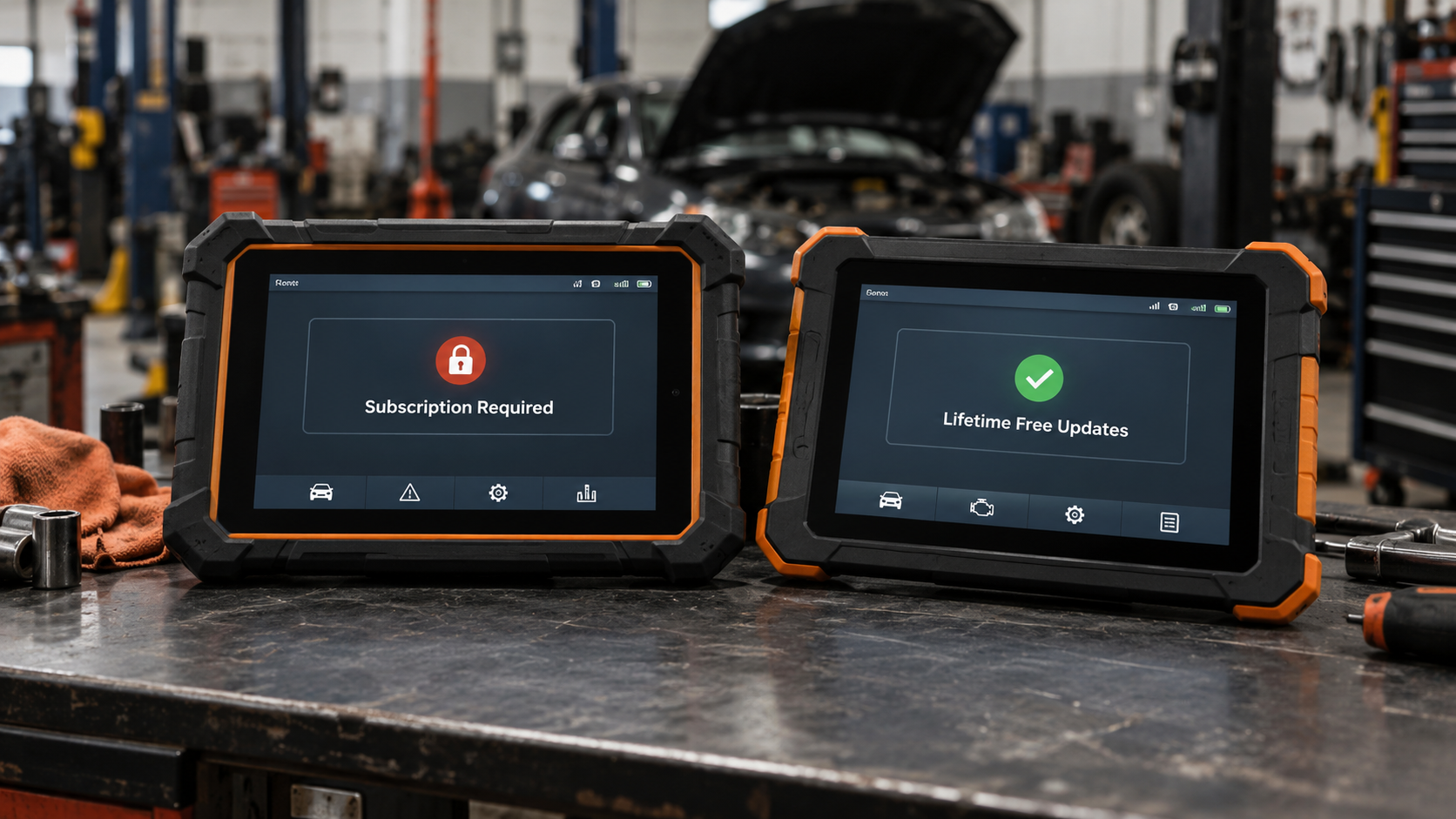
No.
Current official product information shows several different business models. Some professional tool lines sell defined software-subscription periods. Others use renewal programs on applicable professional platforms. But other manufacturers currently sell advanced tools with lifetime free updates, and some brands have moved specific product lines to free lifetime software updates after initially charging for renewals.
So: professional capability does not automatically mean annual update fees. And one brand does not necessarily use one policy across every product forever.
“Lifetime Free Updates”: What Should You Verify?
“Lifetime free updates” sounds simple. Still, verify what the manufacturer means.
Ask: does “lifetime” refer to the life of the product? Are all diagnostic software packages included? Are new vehicle models included? Are new functions included? Are online services included? Are third-party services included? Is registration required? Is there a region limitation? Can the policy change for future services? Does it cover only software updates, not subscriptions to separate services?
A manufacturer may genuinely provide free lifetime diagnostic updates while separately charging for another service. Those statements are not necessarily contradictory. Read the terms at the function/service level.
Why Brand-Level Assumptions Are Dangerous
Suppose you learn that one scanner in a brand’s lineup has paid renewal. You should not conclude that every scanner from that brand requires annual subscriptions.
Manufacturers have publicly moved specific product lines to free lifetime software updates while other product lines from the same brand continue to use their own subscription structure for advanced features.
Same brand. Different products. Different ownership models.
The correct unit of research is: exact product + exact feature + current policy.
Calculate Total Cost of Ownership, Not Purchase Price
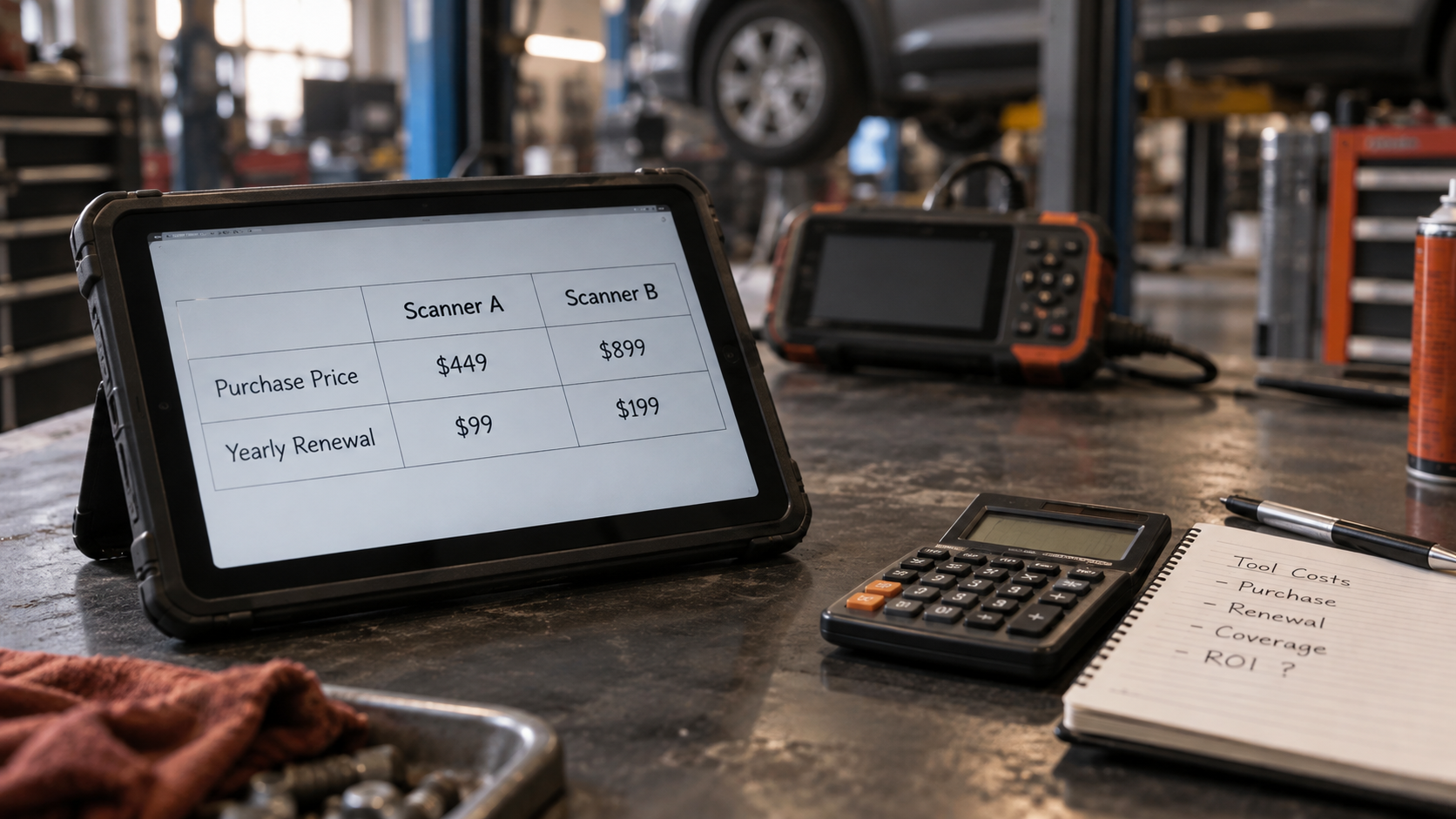
Imagine two scanners.
Scanner A costs $400 and includes the software you need without recurring fees.
Scanner B costs $300 and requires paid renewals of $100 per year after the included period to maintain the advanced capability you depend on.
Scanner B looks cheaper on day one. But if you need current software and renew for several years, the cost relationship can reverse.
A simple ownership calculation is: purchase price + required renewals + paid feature packages + required external services = realistic ownership cost.
For a DIY user, calculate three to five years. For a professional shop, consider the expected service life and whether current vehicle coverage is revenue-critical.
Should a DIY User Pay for Annual Updates?
Maybe, but not automatically.
Suppose you own one older vehicle and the scanner already supports every function you need. New model-year coverage may have little value to you. If the tool keeps existing functions after expiration, you might decide not to renew.
But suppose you replace vehicles frequently, work on friends’ and family vehicles, buy newer cars, or need new service functions. Then updates may be more valuable.
The decision depends on your use case and the manufacturer’s expiration policy.
Should a Professional Shop Pay for Updates?
For a working shop, current coverage can have direct economic value.
A technician may encounter new model years, updated modules, new security architectures, revised service procedures, and new diagnostic functions.
If outdated software causes the shop to turn away jobs or spend more diagnostic time, renewal can be economically rational.
But professionals should still compare annual cost, vehicle coverage, feature depth, support, repair information, security access, programming requirements, and alternative tools. “Professional” does not mean “ignore the renewal bill.”
Free Updates Are Not Automatically the Best Deal
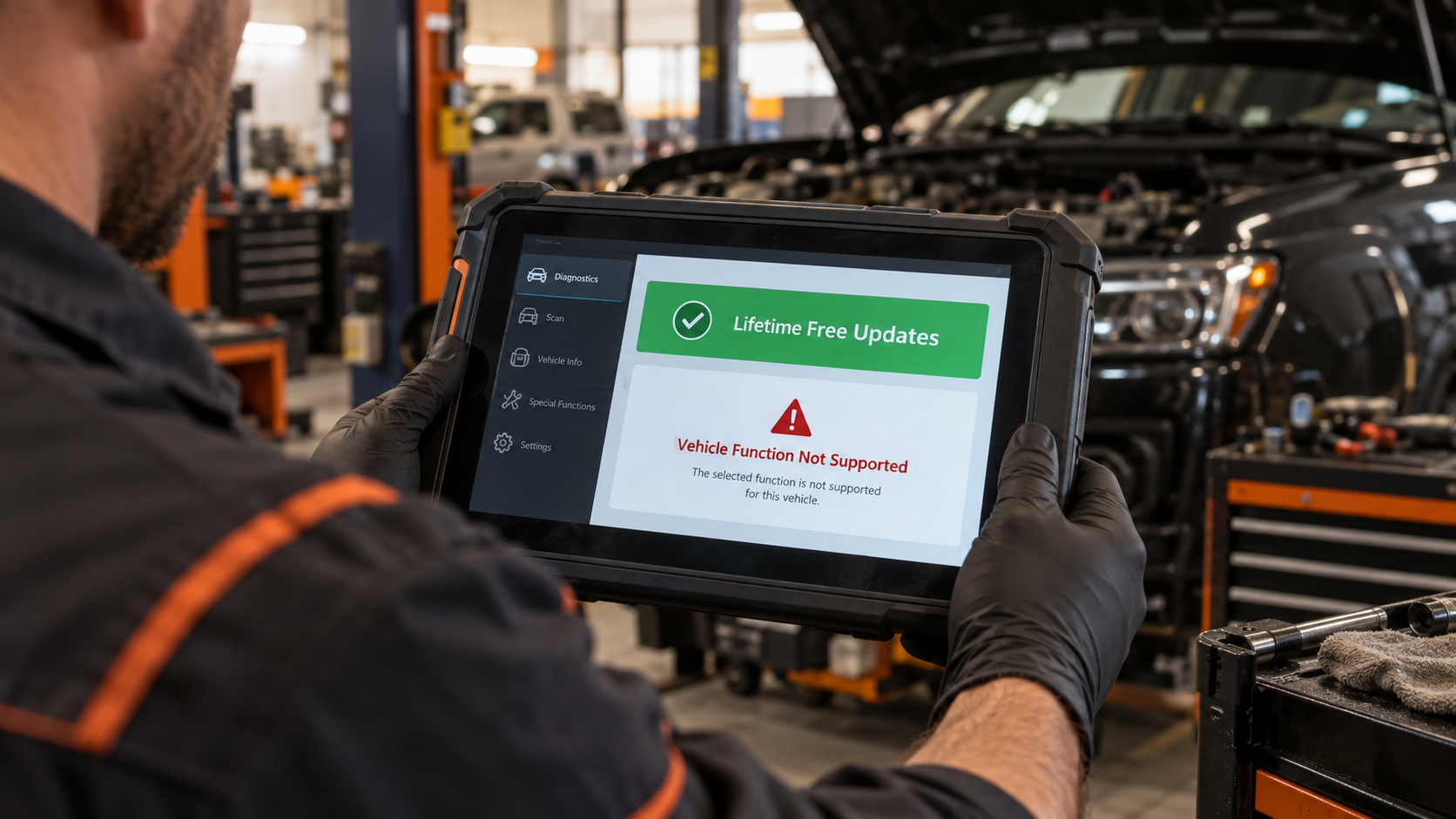
A scanner with lifetime free updates can offer excellent long-term value. But update policy is only one decision factor.
A no-subscription scanner is a poor purchase if it does not support your vehicle, your module, or your required function.
Likewise, a paid-renewal tool may be worth the cost if its coverage and capabilities generate real value for your work.
Choose in this order: required job → exact coverage → diagnostic capability → ownership model → total cost. Not: free updates → hope it does the job.
Paid Updates Are Not Automatically a Bad Deal
Paid updates fund an ongoing software ecosystem. The useful question is not whether a fee exists. It is: what value do I receive for that fee?
A renewal may provide new vehicle coverage, new functions, updated procedures, bug fixes, repair information, technical support, warranty benefits, or other services. Compare the value against your actual use.
How to Check Subscription Costs Before Buying
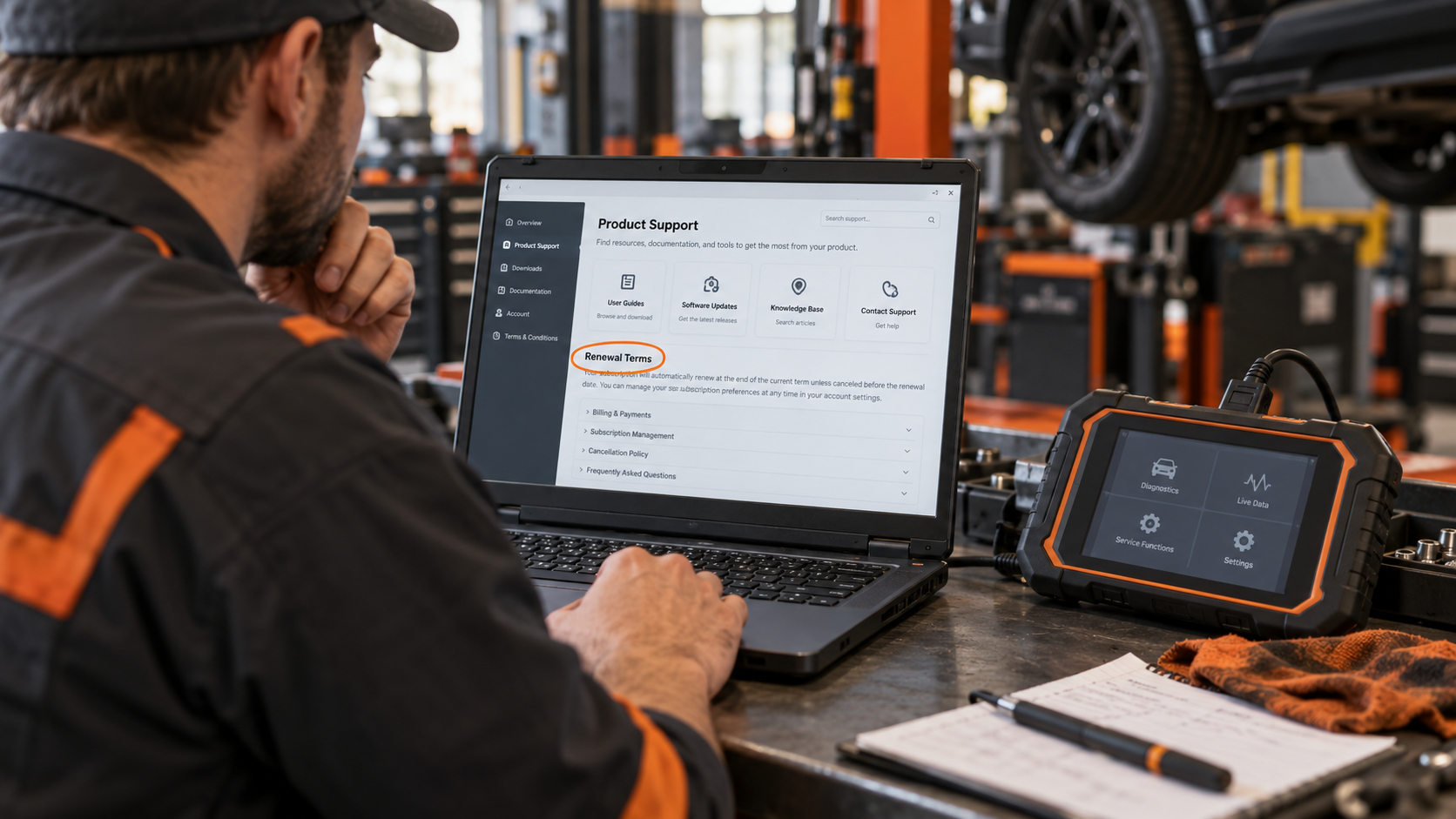
Step 1: Identify the exact scanner model. Do not research only the brand.
Step 2: Find the official product page. Look for included update period, subscription wording, lifetime-update claims and renewal terms.
Step 3: Find the official renewal/update page or manual. Product marketing pages sometimes simplify the ownership model. Manuals and renewal pages can reveal what happens when the plan expires.
Step 4: Separate diagnostic updates from advanced-feature subscriptions. Ask whether expiration affects new updates only, active tests, service functions, full-system functions, coding, online information, or AI features.
Step 5: Identify external costs. Check whether your intended workflow also needs secure-gateway access, OEM subscriptions, programming services, or repair databases.
Step 6: Calculate at least a three-year cost. For expensive professional tools, also calculate five years.
Step 7: Save current evidence. Subscription policies can change. Save the manufacturer’s current page, screenshot or written confirmation if the policy materially affects your purchase.
Seven Subscription Mistakes to Avoid
Mistake 1: Assuming every scanner with updates has a subscription. Updates can be free.
Mistake 2: Assuming “no subscription” means every service is free. Separate online or third-party services can still cost money.
Mistake 3: Assuming the scanner stops working when updates expire. That depends on the exact product. Verify what remains.
Mistake 4: Assuming one brand uses one renewal policy. Different models can have different terms.
Mistake 5: Comparing only annual renewal prices. One renewal may include support/warranty/services that another does not.
Mistake 6: Buying “lifetime updates” without checking vehicle coverage. Free updates cannot compensate for missing required functionality.
Mistake 7: Using an old review to determine today’s subscription policy. Policies change. Verify the current official source before purchase.
OBD2 Scanner Subscription FAQ
Do all OBD2 scanners require a subscription?
No. Many basic scanners and some advanced scanners operate without mandatory annual subscriptions. Others use paid update or feature-renewal models.
Do Bluetooth OBD2 scanners require subscriptions?
Not automatically. Subscription policy belongs to the exact product/app ecosystem, not Bluetooth itself.
Do standalone scanners require subscriptions?
Some do and some do not. Form factor does not determine software policy.
What happens if I don’t renew my scan tool?
It depends on the product. You may lose new updates, online services or subscription-gated features while retaining some or all previously available functionality. Check the manufacturer’s exact policy.
Can a scanner still read codes after its subscription expires?
On some products, yes. But do not generalize. Verify what functions remain on the exact model.
Are software updates necessary?
They become more important when you need coverage for newer vehicles, updated modules, new functions or software fixes. A user working only on an older supported vehicle may value them differently from a professional shop.
Are lifetime free updates really free?
Some manufacturers currently explicitly advertise lifetime free software updates on particular products. Still verify what “updates” includes and whether separate online/third-party services exist.
Is a scanner with no subscription always cheaper?
Not necessarily. Compare purchase price, functionality, update policy and all required services over your expected ownership period.
Can subscription policies change?
Yes. Manufacturers have publicly changed specific product lines to free lifetime software updates after previously charging for renewal: a reminder that policies are time-sensitive.
Should I avoid scanners with annual subscriptions?
Not automatically. Avoid paying for capability you do not need, but a paid software ecosystem can make sense if its current coverage and services create enough value for your use.
The Bottom Line
The sticker price is only the beginning of an OBD2 scanner buying decision.
Before purchasing, separate six things: what functions do I permanently own? How long are software/vehicle updates included? Which advanced features require an active subscription? Which online services cost extra? Which OEM or third-party services cost extra? Does renewal include support or warranty benefits?
Then calculate the realistic cost over the years you expect to own the tool.
Most importantly, never apply one subscription rule to an entire scanner brand. Policies can differ by product and can change over time.
The safest buying question is: “What will this exact scanner still do on my exact vehicle if I never renew, and what will I have to pay to keep the functions I actually need?”
If you are still deciding between phone-based and dedicated hardware, continue to Bluetooth vs Standalone OBD2 Scanners: Which Type Is Right for You?
If you need to verify whether a scanner supports your exact vehicle and function, read Will Any OBD2 Scanner Work With My Car? OBD2 Compatibility Explained.
Once your requirements and ownership costs are clear, continue to How Much Should You Spend on an OBD2 Scanner?
If you want to avoid annual fees, see the Best OBD2 Scanners With No Subscription.