Knowledge Hub
What Does Full-System Diagnostics Mean on a Scan Tool?

A basic OBD2 scanner may tell you why the Check Engine light is on.
But what if the warning light is for ABS, airbags, electronic parking brake, transmission, steering, TPMS, or another electronic system?
That is where full-system diagnostics becomes important.
A full-system scan tool is designed to communicate with many of the electronic control modules installed throughout a supported vehicle, not just the standardized engine/emissions OBD system.
Depending on the scanner and vehicle, that can let you read module-specific trouble codes, view data and retrieve ECU information from systems across the vehicle.
But the phrase creates one dangerous assumption: “full-system” does not automatically mean every module and every diagnostic function on every vehicle. Coverage still has to be verified.
What Is Full-System Diagnostics?
Full-system diagnostics describes broad diagnostic access across the electronic systems or control modules of a vehicle.
You may also see terms such as all-system diagnostics, all-module diagnostics, full vehicle scan, network scan, Auto Scan, or health report. The exact terminology varies by scanner manufacturer.
The key idea is breadth. Instead of communicating only with standardized emissions-related OBD, the scanner can communicate with additional manufacturer-specific vehicle modules where supported.
In simple terms: basic OBD2 asks the regulated diagnostic system about emissions-related engine/powertrain information. Full-system diagnostics asks many of the vehicle’s electronic modules what they know.
Basic OBD2 vs Full-System Diagnostics
This distinction is fundamental.
Current SAE J1979 describes communication between the vehicle’s OBD systems and external test equipment within the scope of legislated emissions-related OBD. That standardized layer is extremely useful: it gives generic test equipment access to regulated diagnostic information.
But modern vehicles contain many electronic systems whose diagnostics extend beyond that generic emissions framework.
For example, a basic OBD2 code reader may successfully retrieve a P-code from the engine control system while providing no meaningful access to an airbag or body-control fault. A full-system tool is designed to go deeper into those enhanced vehicle-specific systems.
So: OBD2 compatibility is not the same as full-system coverage. And full-system coverage is not the same as support for every advanced function.
What Is a Vehicle Control Module?
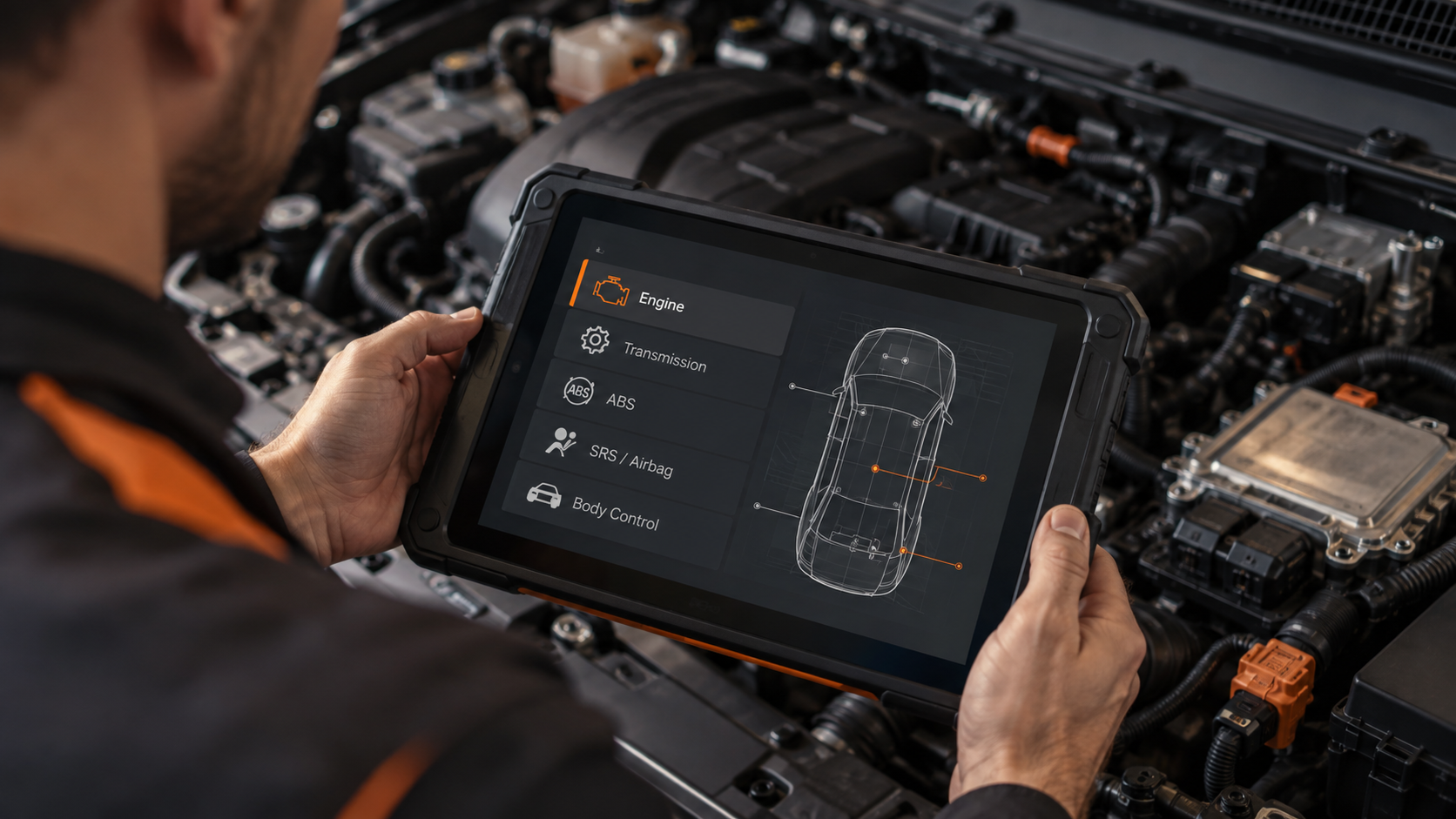
Modern vehicles use electronic control units or modules to manage different systems. The exact architecture varies by vehicle.
Examples can include the Engine Control Module/Powertrain Control Module, Transmission Control Module, ABS/ESC module, SRS/airbag module, Body Control Module, HVAC/climate-control module, electronic power-steering module, electronic parking-brake module, TPMS-related module, instrument cluster, door modules, seat modules, gateway modules, and other vehicle-specific controllers.
These modules communicate over one or more vehicle networks. A full-system scanner attempts to communicate with the supported modules using the diagnostic functions available for that vehicle.
Which Systems Can a Full-System Scanner Access?
Depending on the vehicle and tool, full-system diagnostic coverage can include engine, transmission, ABS, stability control, SRS/airbag, body control, electronic parking brake, steering, HVAC, TPMS, instrument cluster, doors, seats, lighting, immobilizer-related systems, gateway modules, and other manufacturer-specific ECUs.
But treat that list as examples, not a guarantee. The exact module list varies by vehicle. The exact scanner coverage varies too. A 2026 vehicle can contain modules that did not exist on an older vehicle, while different trims of the same model can have different electronic equipment.
That is why “supports 100+ vehicle brands” tells you much less than: “Does this tool access the module I need on this exact vehicle?”
Engine-Only vs Four-System vs Full-System Scanners
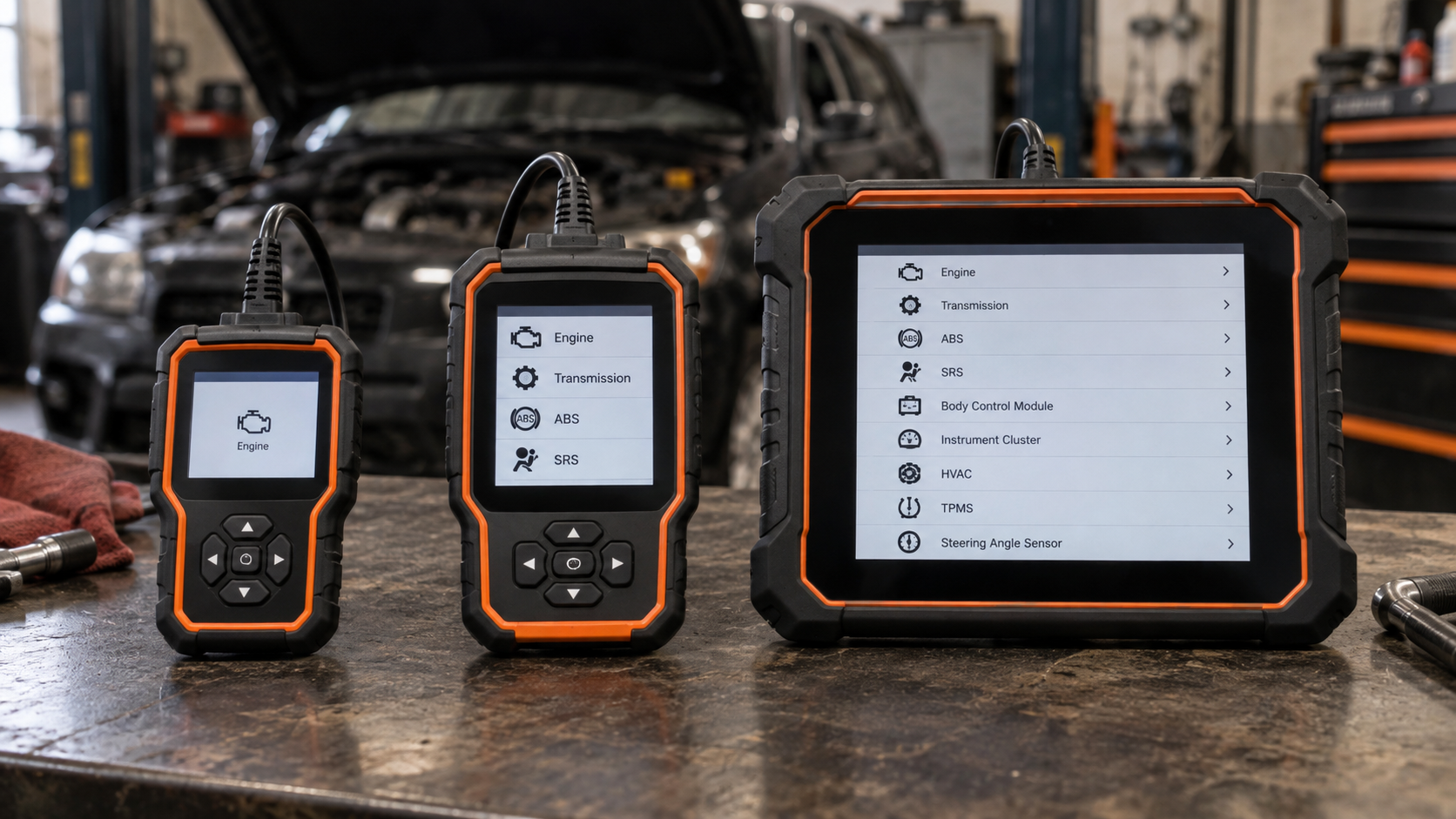
Scanner capability is easier to understand as a ladder.
Engine / basic OBD2 scanner. Typically focused on standardized OBD2 engine/emissions diagnostics. Useful for Check Engine DTCs, readiness, freeze frame, supported generic live data, and other regulated OBD information.
Four-system scanner. A common product category adds diagnostic access to four major systems, often engine, transmission, ABS, and SRS/airbag. That can be a major upgrade over a basic code reader. But it still is not necessarily a full-system tool.
Full-system scanner. A full-system scanner aims to access the wider network of supported control modules across the vehicle. That can provide a much more complete picture when the fault is outside the engine system or when several modules are involved. The important word remains: supported.
What Can You Usually Do After Entering a Module?
Accessing a module is only the first question. The next question is: what functions does the scanner support inside that module?
Depending on scanner and vehicle coverage, diagnostic functions can include reading DTCs, erasing DTCs, viewing live data, viewing freeze-frame or related fault data, reading ECU/module information, performing a module scan, or creating a diagnostic report.
More capable tools may additionally support active tests, resets, relearns, calibrations, adaptations, coding, or other manufacturer-specific procedures.
But do not bundle all of these into the phrase “full-system.” Manufacturers commonly separate their own feature matrices into distinct categories: Read Codes, Erase Codes, Live Data, ECU Information, Active Test and Service Functions are frequently listed as separate capabilities, not one bundle.
That separation is important. Module access tells you where the scanner can go. Feature coverage tells you what it can do once it gets there.
What Is a Full Vehicle or Network Scan?
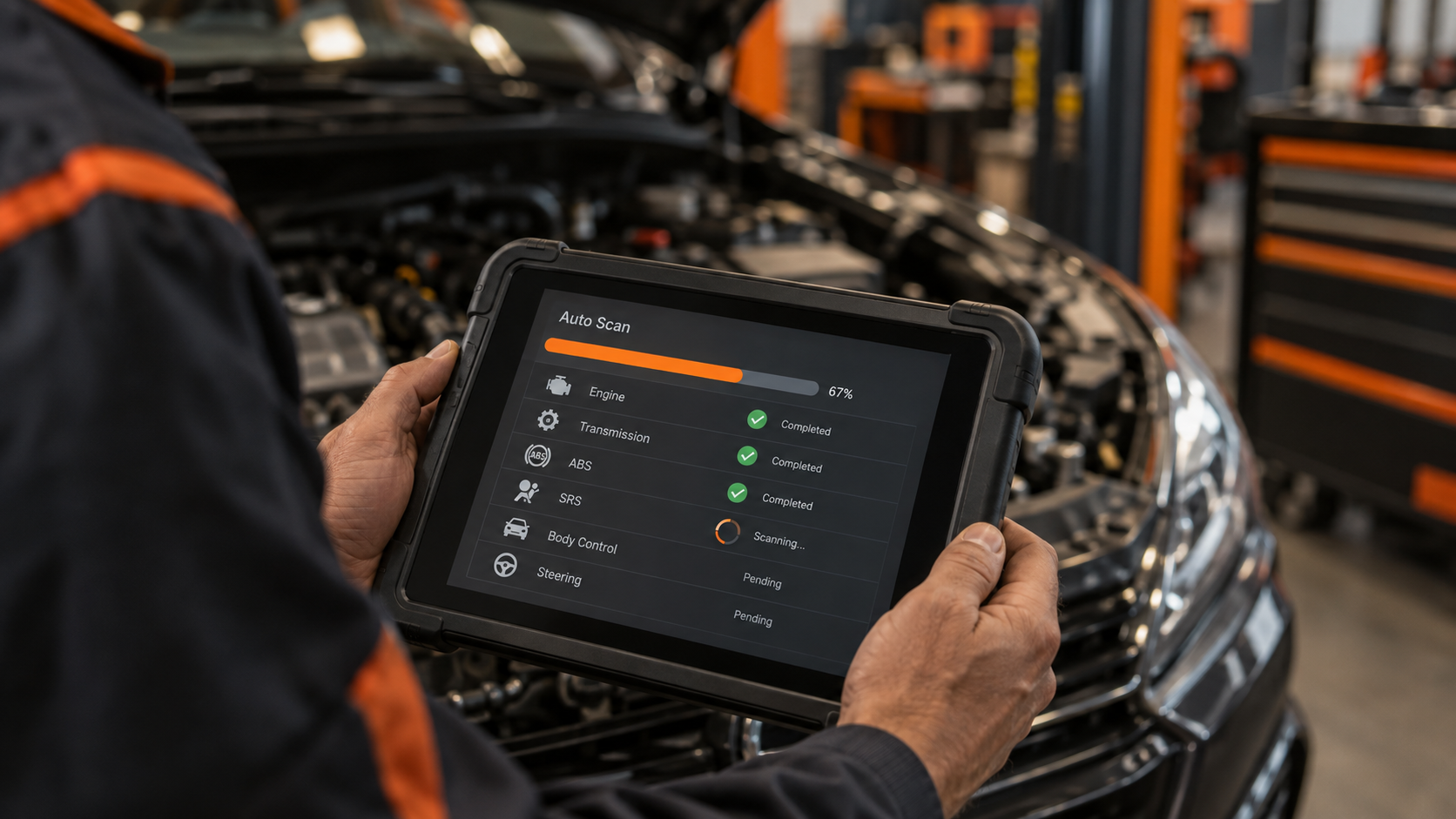
Many full-system tools provide an automatic scan of the vehicle’s supported modules. Manufacturers may call it Auto Scan, All System Network Scan, full vehicle scan, health scan, vehicle health report, or pre-scan/post-scan.
The scanner queries supported modules and builds an overview of their diagnostic status. That can help you quickly see which modules are present, which modules respond, which modules report DTCs, how many faults are reported, and whether problems appear across multiple systems.
This is especially useful on modern vehicles because one customer complaint can involve more than one module.
But an automatic scan is a starting map, not the final diagnosis.
Why Multiple Modules Can Store Codes for One Problem
Suppose a full vehicle scan returns faults in several modules. That does not necessarily mean several components failed independently.
Modern vehicle modules exchange information. One underlying problem can sometimes cause secondary faults elsewhere. Examples can include low system voltage, network communication failure, a missing shared signal, a module going offline, power or ground problems, or a primary fault that causes other modules to record related information.
This is why reading a full network scan requires context. Do not count five codes and assume you have five unrelated repairs.
Look at which codes are current or history, which modules reported them, whether several codes share a communication or voltage theme, timestamps or fault context where available, symptoms, and vehicle-specific service information.
A full-system scan gives you a broader map. You still have to interpret the map.
Does “Full-System” Really Mean Every Module?
This is one of the most important buying questions.
In marketing language, “full-system” or “all-system” generally means broad access across vehicle systems. It should not be interpreted as a mathematical guarantee that the scanner can access every possible ECU and every function on every vehicle it claims to support.
Coverage can vary by make, model, model year, trim/configuration, engine/powertrain, ECU, market/region, software version, security architecture, communication protocol, and scanner software package.
Manufacturers themselves acknowledge vehicle-dependent coverage, explicitly warning that specific diagnostic/service functions vary by vehicle brand, model, production year and ECU configuration.
Therefore, the safe rule is: never buy a scanner because the product page says “full-system” alone. Verify the exact vehicle, module and function you need.
Full-System Diagnostics vs Bidirectional Control
These are not synonyms.
Full-system diagnostics means breadth of module access. Bidirectional control means the ability to send supported commands to modules/components.
A scanner may enter an ABS module, read its DTCs and display its data without providing the active test you need. Conversely, a scanner marketed with active tests still needs the appropriate module and vehicle coverage for the command to work.
Full-system access lets a scanner communicate with many modules and read/clear faults, while bidirectional control goes further by sending commands to components.
SCG covers that command capability in What Is Bidirectional Control on a Scan Tool? Active Tests Explained.
Full-System Diagnostics vs Service Functions
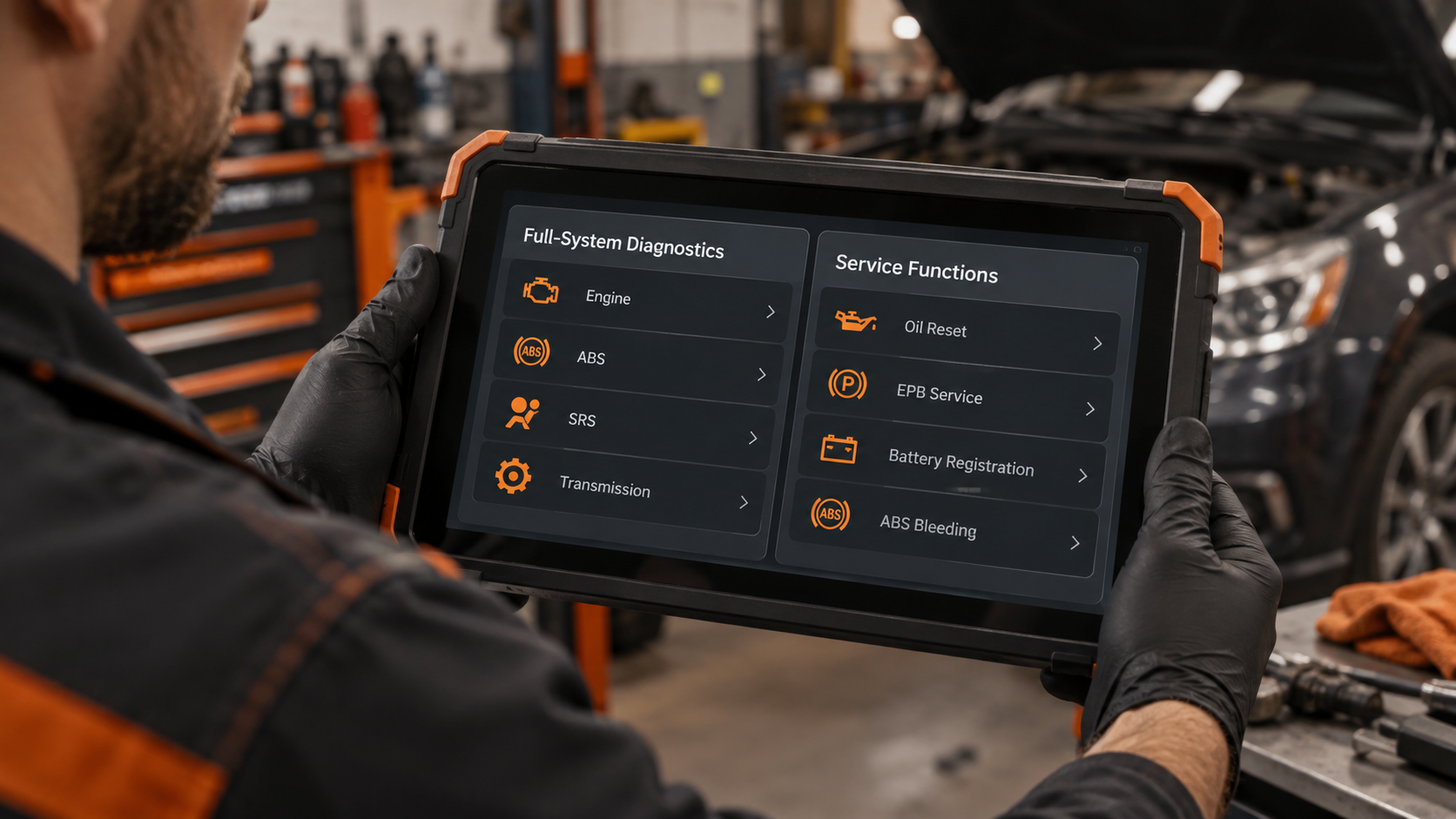
Service functions are another separate capability layer.
Examples can include, where supported, an oil-service reset, electronic parking-brake service, battery registration/reset, steering-angle calibration, ABS bleeding, throttle relearn, DPF regeneration, injector coding, or TPMS-related procedures.
A scanner can offer full-system diagnostics but have a limited service menu. Another can provide many service routines but not the same diagnostic depth on every module.
Do not use the number of advertised service functions as a substitute for checking full-system coverage. And do not use “full-system” as proof that a particular service routine exists. Check each requirement separately.
Full-System Diagnostics vs ECU Coding and Programming
Full-system diagnostics also does not automatically mean ECU coding or programming. These are different capability classes.
Diagnostics reads information about the system: DTCs, live data, ECU information, diagnostic status.
Coding/configuration can change supported configuration or coding parameters where the tool and vehicle allow it.
Programming/flashing can involve installing or updating ECU software/calibration. Programming is a much higher-level capability and can require manufacturer software, subscriptions, interfaces, battery support and specific procedures.
A scanner that can diagnose every supported module is not automatically a programming tool. Do not infer coding or programming from “full-system.” See ECU Coding vs Programming vs Adaptation: What’s the Difference?
Why Exact Vehicle Coverage Matters
Imagine two scanners. Both say: Full-System Diagnostics.
You own a specific vehicle and need to diagnose an electronic parking-brake problem. Scanner A may access that EPB module, read its codes and show data. Scanner B may have broad all-system coverage but lack the same depth for that exact vehicle/year. Or both may access the module, but only one may provide the service routine or active test you need.
The only useful question is: does this scanner support the exact diagnostic function I need on my exact vehicle?
Check official manufacturer coverage resources where available. When the function is important, verify make, model, year, engine/configuration where relevant, module, and exact function.
SCG covers this problem separately in Will Any OBD2 Scanner Work With My Car? OBD2 Compatibility Explained.
Do You Need Full-System Diagnostics?
Not everyone does.
A basic OBD2 scanner may be enough if you mainly want to investigate a Check Engine light, read standardized emissions-related DTCs, check readiness, view basic generic live data, or perform occasional basic DIY diagnosis.
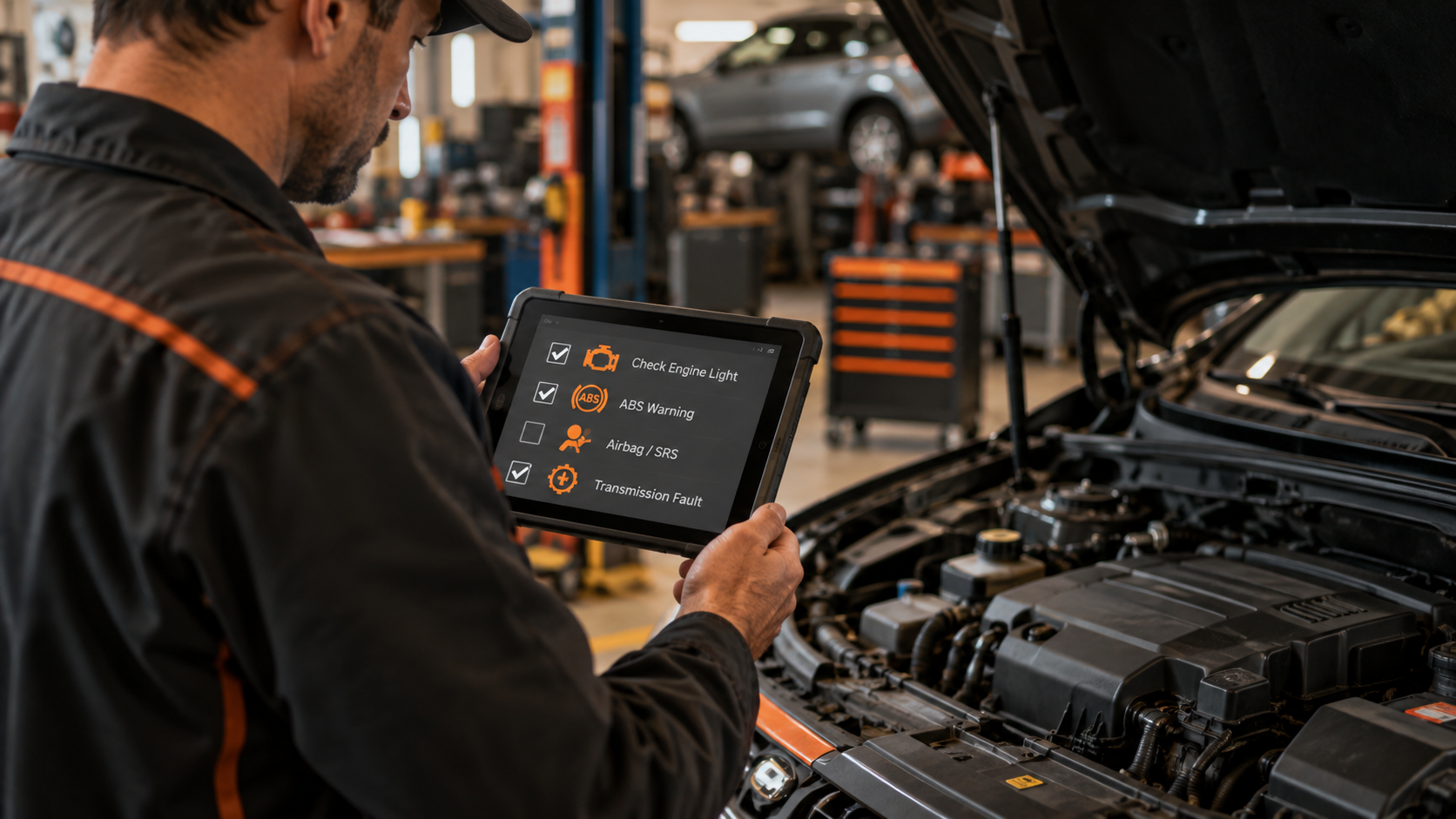
Full-system diagnostics becomes more valuable if you want to diagnose ABS warning lights, diagnose SRS/airbag faults, investigate transmission-module faults, access body/chassis modules, scan a vehicle before or after repair, see faults across multiple modules, perform deeper DIY diagnosis, work on multiple vehicle systems, or diagnose vehicles professionally.
The right tool is not the one with the longest feature list. It is the one with verified coverage for the systems and functions you actually need.
Full-System Diagnostics FAQ
Is full-system diagnostics the same as OBD2?
No. Standardized OBD2 provides a regulated diagnostic foundation focused on emissions-related OBD. Full-system diagnostics refers to broader access to manufacturer-specific vehicle modules beyond that generic layer.
Can a full-system scanner read ABS codes?
A full-system tool is generally intended to access systems such as ABS where supported. But exact coverage depends on the scanner and vehicle.
Can it read airbag/SRS codes?
Many full-system tools provide SRS access on supported vehicles. Verify exact coverage.
Can it read transmission codes?
Many do. Transmission is commonly one of the major enhanced systems supported by multi-system and full-system scanners. Again, vehicle coverage matters.
Does full-system mean all modules?
It generally describes broad all-module/all-system diagnostic coverage, but do not interpret the marketing term as a guarantee of every possible ECU and function on every vehicle. Verify the exact vehicle/module.
Does full-system mean bidirectional?
No. Full-system describes module-access breadth. Bidirectional control describes supported command/active-test capability.
Does full-system mean the scanner can perform ABS bleeding?
No. ABS bleeding is a specific service procedure. A full-system scanner may or may not support it on your vehicle.
Does full-system mean ECU coding?
No. Coding is a separate capability and must be verified independently.
Does full-system mean ECU programming?
No. Programming/flashing is a separate and more specialized capability.
Can a full-system scan tell me everything wrong with the car?
No. It can reveal diagnostic information from many supported modules, but not every mechanical problem creates a DTC, and a DTC does not automatically identify the root cause. A clean scan is useful evidence, not proof that the entire vehicle is fault-free.
Is a four-system scanner the same as a full-system scanner?
Not necessarily. A four-system scanner commonly focuses on engine, transmission, ABS and SRS. A full-system scanner aims for broader access to the vehicle’s supported ECU network.
The Bottom Line
Full-system diagnostics is about diagnostic breadth.
A basic OBD2 scanner gives you standardized emissions-related diagnostic access. A full-system scanner goes beyond that foundation and communicates with additional supported vehicle modules such as ABS, SRS, transmission, body, steering, HVAC and others.
But remember four rules: full-system does not mean every function; module access does not automatically mean bidirectional control; full-system does not automatically include service functions, coding or programming; and coverage must be verified for the exact vehicle, module and function.
If you need to command components after entering those modules, continue to What Is Bidirectional Control on a Scan Tool? Active Tests Explained.
If you are unsure whether a scanner will actually work with your vehicle, continue to Will Any OBD2 Scanner Work With My Car? OBD2 Compatibility Explained.
Ready to compare products? See Best Full-System Automotive Scanners.