Autel MaxiCheck MX808S vs MX900-TS: Which Should You Buy in 2026?
The Autel MaxiCheck MX808S and MaxiCheck MX900-TS look like a simple step-up decision, but the real gap between them is not features, it is protocol support and price. The MX900-TS confirms CAN-FD and DoIP support directly on Autel’s own page; the MX808S does not offer either. If your vehicles are newer and use CAN-FD or DoIP, that difference can matter more than any single reset function. If they are not, the MX808S covers the same core bidirectional ground for a significantly lower price, and Autel’s own page describes “Coding and Adaptations” for it.
Affiliate Disclosure: As an Amazon Associate I earn from qualifying purchases. Scan Choice Guide is a participant in the Amazon Services LLC Associates Program, an affiliate advertising program designed to provide a means for sites to earn advertising fees by advertising and linking to Amazon.com.
MX808S vs MX900-TS: The Short Answer
Best for Newest-Vehicle Protocol Support (CAN-FD / DoIP): Autel MaxiCheck MX900-TS.
Best Value Pick: Autel MaxiCheck MX808S, covering the same core bidirectional ground for a significantly lower price.
MX808S vs MX900-TS: Three Buyer Scenarios
You mostly service pre-2018 vehicles at the lowest price: the MX808S is the lower-priced choice; Autel’s own page also uses the phrase “Coding and Adaptations” for it, though ECU coding is not named, and CAN-FD/DoIP would not apply to these vehicles anyway.
You work on newer vehicles with gateway modules, or handle TPMS sensor replacement regularly: the MX900-TS’s confirmed CAN-FD/DoIP and TPMS programming justify the higher price.
You are outside the United States: the MX900-TS’s US-only restriction removes it from consideration; the MX808S carries no such limit.
Autel MaxiCheck MX808S
The Autel MaxiCheck MX808S delivers confirmed bidirectional control at a significantly lower price than the MX900-TS, backed by 28-plus documented reset and service functions and a 5000mAh battery rated for about 7 hours of continuous use. Autel’s own page describes “Coding and Adaptations” for this model too, though that capability isn’t yet independently confirmed. It connects to the car by cable, with Wi-Fi used for updates, and has no CAN-FD or DoIP support and no TPMS sensor activation or programming, which the MX900-TS confirms, so weigh those gaps against the meaningful price difference.
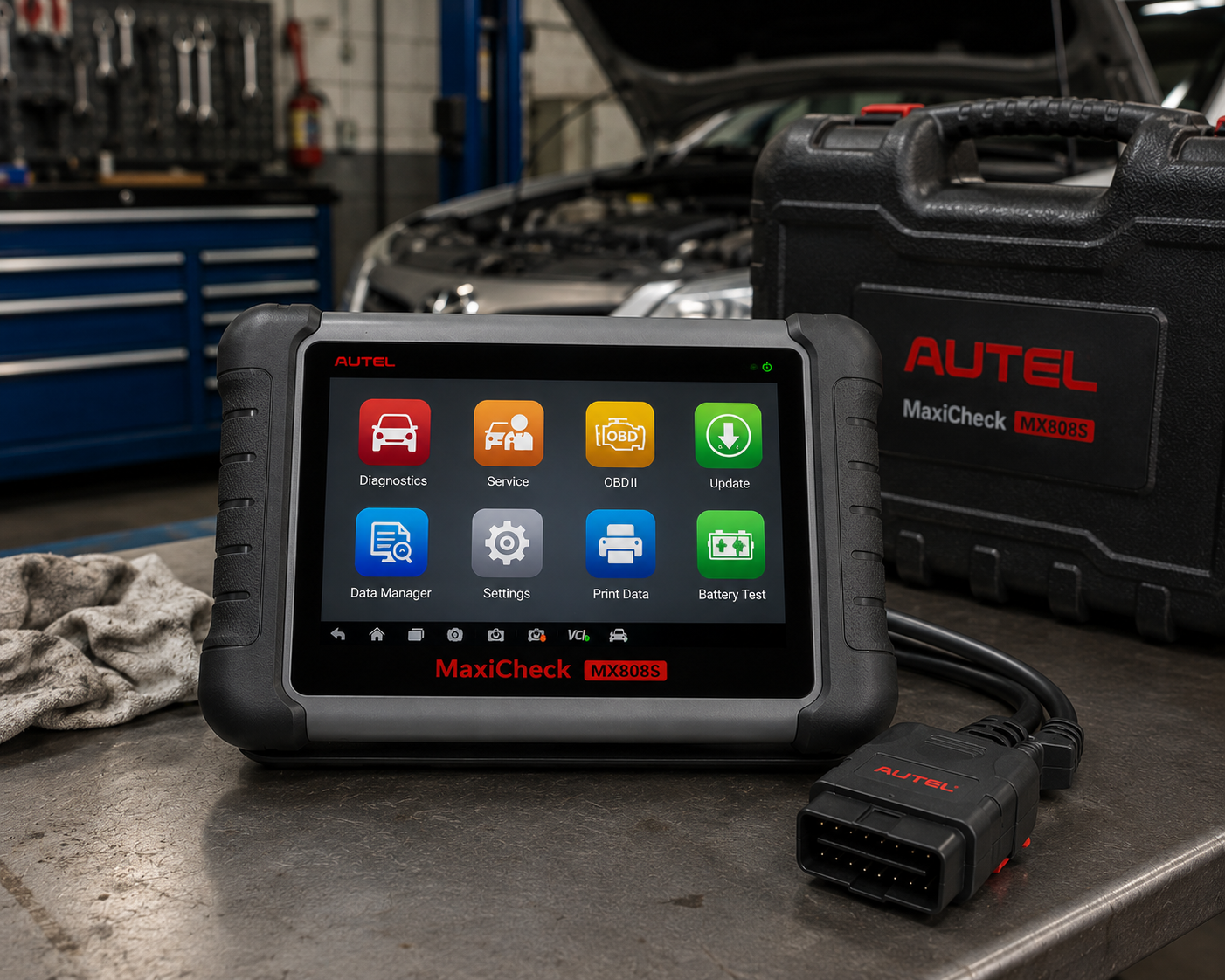
| Pros | Cons |
|---|---|
| Autel's own product page describes "Coding and Adaptations" for this model, unlike the pricier MX900-TS | No CAN-FD or DoIP support, which the MX900-TS confirms |
| Significantly cheaper than the MX900-TS for the same confirmed bidirectional control | |
| 28+ documented reset and service functions | No dedicated TPMS sensor programming function, unlike the MX900-TS |
| No regional use restriction documented, unlike the MX900-TS's U.S.-only limitation | |
| 5000mAh battery rated for approximately 7 hours of continuous use | Wired to the car, no Bluetooth, versus the MX900-TS's dedicated wireless VCI |
| Compatible with Autel's Videoscope accessory |
Autel MaxiCheck MX900-TS
The Autel MaxiCheck MX900-TS confirms CAN-FD and DoIP support directly on Autel’s own page, alongside full TPMS sensor programming, activation, and relearn, not just a basic reset, on a larger 8-inch display with a 7700mAh battery. Bidirectional active tests are confirmed across 40-plus named service functions, connecting wirelessly through the dedicated MaxiVCI V150. It’s significantly more expensive than the MX808S, U.S. use and shipping only, and ECU coding isn’t confirmed here, unlike the cheaper MX808S’s page language, so it earns its premium specifically through newest-protocol and TPMS depth.
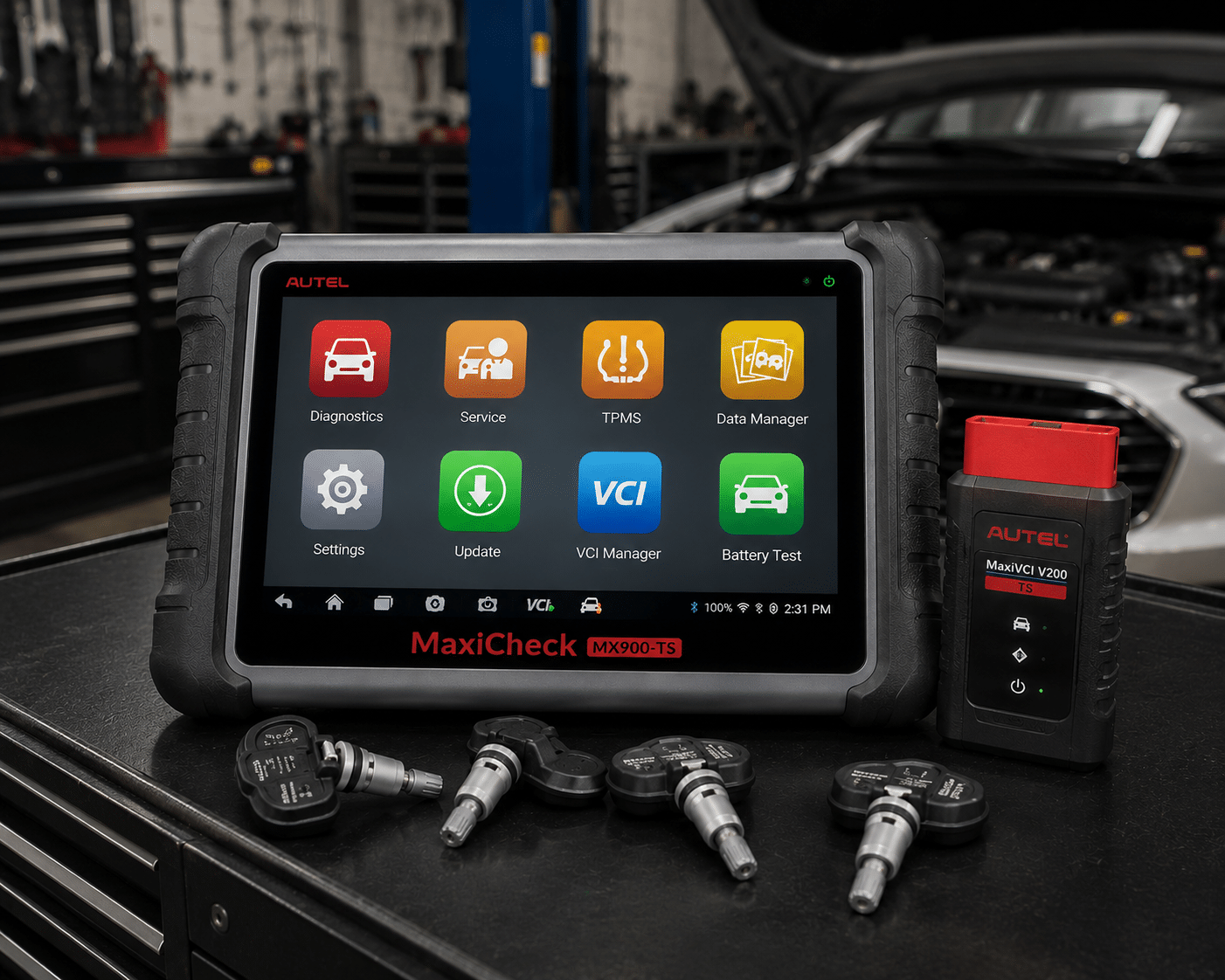
| Pros | Cons |
|---|---|
| CAN-FD and DoIP confirmed directly on Autel's own page | ECU coding: not listed for this model, unlike the cheaper MX808S |
| Full TPMS sensor programming, activation and relearn, not just a basic reset | |
| Larger 8-inch, 1280×800 display and 7700mAh battery | U.S. use and shipping only |
| Wireless vehicle connection via the dedicated MaxiVCI V150 | |
| 40+ named service functions confirmed by Autel | Significantly more expensive than the MX808S |
| Bidirectional active tests confirmed across those functions | Paid renewal required after the first free year, cost not listed by Autel |
MX808S vs MX900-TS at a Glance
| Specification | Autel MaxiCheck MX808S | Autel MaxiCheck MX900-TS |
|---|---|---|
| Price class | Between $350 and $600, significantly cheaper than the MX900-TS | Between $700 and $1,000, significantly more expensive than the MX808S |
| Display | 7-inch, 1024×600 | 8-inch, 1280×800 |
| Battery | 5000mAh, ~7 hours | 7700mAh |
| Vehicle connection | Cable to the car (Wi-Fi for updates), no Bluetooth | Wireless via MaxiVCI V150 |
| CAN-FD / DoIP | Not offered | Confirmed |
| Bidirectional control | Confirmed | Confirmed |
| ECU coding | Autel’s own page says “perform Coding and Adaptations” | Not listed for this model |
| TPMS | Not a named function | Full sensor programming, activation and relearn |
| Service functions | 28+ | 40+ named functions |
| Regional restriction | None documented | U.S. use and shipping only |
Price classes are broad bands, not Amazon prices, and street prices change often. Check the current price on Amazon before you buy.
Price: A Meaningful Gap for a Specific Set of Features
The MX808S sits in the $350 to $600 class, while the MX900-TS sits in the $700 to $1,000 class and is significantly more expensive. That premium buys CAN-FD/DoIP protocol support, a larger screen and battery, and TPMS sensor activation and programming, not a broader set of core diagnostic functions. If none of those three specifically matter for your vehicles, the price gap has no real justification on capability alone.
The Step-Up Question: What Does the TS Add, and Who Needs It?
This page comes from our analysis of Autel’s product pages and manuals for both tablets, the Amazon listings, our review of each model, and independent sources including the National Highway Traffic Safety Administration’s final rule that created the federal tire pressure monitoring standard. We ran both tablets through the same list of jobs on the same kinds of cars and asked the buyer’s question for each: which one do I put on the bench for this vehicle?
The two tablets look alike and sell to different people. The Autel MaxiCheck MX808S is a 7-inch wired tablet with bidirectional active tests and 28 or more service functions. Autel’s own page says it can “perform Coding and Adaptations”, though ECU coding is not named for the model. The Autel MaxiCheck MX900-TS is an 8-inch tablet with a Bluetooth connector called the MaxiVCI V150, built around full TPMS work, with CAN FD and DoIP, 40 or more service functions and a US-only restriction. The extra letters tell the story: TS stands for tire service, and the MX900-TS is the tablet that treats tire pressure sensors as a job of their own.
On price, the MX808S falls in the class between $350 and $600 and the MX900-TS in the class between $700 and $1,000. The MX900-TS is significantly more expensive, and the price gap is large enough that the decision should follow the jobs you do, not the specs you could use. Street prices move, so check Amazon before you buy.
MX808S vs MX900-TS: Best Pick for DIY, Independent Shop and Best Bay
| Category | Winner | Why |
|---|---|---|
| Serious DIY with cars built before 2018 | Autel MX808S | The same bidirectional control and 28-plus services for a significantly lower price. CAN FD and DoIP would go unused. |
| DIY owner who rotates tires and replaces TPMS sensors | Autel MX900-TS | Sensor check, MX-Sensor programming and relearn. The MX808S lists basic TPMS only: sensor ID lookup and reset. |
| Tire shop | Autel MX900-TS | It is built for this job and activates and relearns most known sensors. |
| Mobile mechanic with a mixed customer base | Autel MX900-TS | The newer protocols and TPMS cover the cars that arrive without warning. |
| Independent shop on a budget with older vehicles | Autel MX808S | Lower cost, same core diagnostics on the cars that need no CAN FD. |
| Anyone outside the United States | Autel MX808S | The MX900-TS is documented as US use and shipping only. |
| Best bay tablet for TPMS-heavy work | Autel MX900-TS | 8-inch screen, 7,700 mAh battery and the TPMS tool set. |
MX808S vs MX900-TS: Older Cars vs Newer Cars, Which Tablet Wins by Model Year
1996 to 2007
Both tablets cover 1996 and newer vehicles with AutoVIN and the standard protocols, and Autel documents 80 or more makes for the MX808S. On a 2004 Ford F-150 or a 2006 Toyota Camry, the two do the same work: read and clear all systems, run active tests, perform oil, EPB, SAS and ABS bleed functions. Most cars from this period have no tire pressure monitoring system at all, because the federal rule was still phasing in, so the TPMS tool set matters little. Winner: MX808S, for the lower price.
2008 to 2016
The NHTSA final rule published on April 8, 2005 requires a tire pressure monitoring system in all new light vehicles, and every new light vehicle sold in the US carries one from the 2008 model year. This is where TPMS work begins and where the MX900-TS earns its name. A 2012 Chevrolet Malibu with a tire pressure light after a rotation, a 2014 Ford F-150 with a dead sensor, a 2015 Honda Accord with a replaced sensor: all of these are MX900-TS jobs. The MX808S lists basic TPMS only, with sensor ID lookup and reset but no activation or programming. For every other job in this period, they tie. Winner: MX900-TS for TPMS, MX808S for everything else.
2017 to 2019
Fiat Chrysler vehicles from 2018 put a Secure Gateway in front of the modules, and Amazon names the FCA secure gateway among the MX900-TS functions. BMW F and G chassis cars use DoIP, and Amazon’s listing says the MX900-TS supports it, along with DoIP on Volvo from 2018 and Jaguar and Land Rover from 2017. Autel’s page for the MX808S lists none of these protocols. A 2018 BMW 530i, a 2018 Jeep Wrangler or a 2019 Volvo XC60 is an MX900-TS job. Winner: MX900-TS.
2019 and newer
Amazon says CAN FD works on GM from 2019 for the MX900-TS. Autel’s own page lists CAN FD and DoIP for the tablet and gives no vehicle list, so the examples are Amazon’s, and you should check the exact car. For a 2021 Chevrolet Silverado or a 2022 BMW X3, the MX900-TS is the tablet that lists the protocols. The MX808S does not. Winner: MX900-TS.
| Model years | Winner | Reason in one line |
|---|---|---|
| 1996 to 2007 | MX808S | Same capability for a significantly lower price. |
| 2008 to 2016 | MX900-TS for TPMS, MX808S otherwise | TPMS is required on every light vehicle from 2008. |
| 2017 to 2019 | MX900-TS | DoIP and the Stellantis gateway are listed only on the MX900-TS. |
| 2019 and newer | MX900-TS | CAN FD and DoIP are listed only on the MX900-TS. |
MX808S vs MX900-TS: Make by Make, Which Tablet for Which Car
Chevrolet, GMC, Buick and Cadillac
For GM cars through 2018, both tablets do the same diagnostic and service work. From 2019, Amazon says the MX900-TS supports CAN FD on GM, and the MX808S lists none. On a 2021 Silverado or a 2022 Equinox, the MX900-TS is the tablet. For a GM truck that needs a tire sensor replaced, the MX900-TS is the only one of the two that programs it. Winner: MX900-TS for 2019 and newer and for any tire sensor work, tie for earlier cars.
Ford and Lincoln
Both tablets read Ford systems and handle oil, EPB, SAS, battery registration and ABS bleeding. Neither lists Ford coding or module programming. Ford TPMS is a common shop job, and the MX900-TS is the tablet that does it. Winner: tie for services, MX900-TS for TPMS.
Chrysler, Dodge, Jeep and Ram
The MX900-TS lists FCA secure gateway support per Amazon, and the MX808S does not. A 2018 or newer Jeep or Ram with a closed gateway is an MX900-TS job, with an AutoAuth account and a Wi-Fi connection. Winner: MX900-TS.
BMW and Mini
DoIP for BMW F and G chassis is listed on the MX900-TS and not on the MX808S. Both tablets list battery registration, EPB service and oil resets, which are the services a BMW needs. Neither lists general ECU coding. Winner: MX900-TS for F and G chassis, tie for older.
Mercedes-Benz, Volkswagen and Audi
Both tablets read the systems and run the services. Neither lists coding beyond injector coding on the MX900-TS and the phrase “Coding and Adaptations” on the MX808S’s page, so for coding, read our Autel MP808S review. Winner: tie.
Toyota, Lexus, Honda, Nissan, Hyundai and Kia
These makes use TPMS sensors that the MX900-TS programs and relearns. For routine services, both do the work. Winner: MX900-TS for tire sensor jobs, MX808S for the rest.
Volvo, Jaguar and Land Rover
Amazon says DoIP works on Volvo from 2018 and Jaguar and Land Rover from 2017 for the MX900-TS. The MX808S lists no DoIP. Winner: MX900-TS.
Outside the United States
Autel states that the MX900-TS is subject to IP restrictions and can only be used and shipped within the United States. If you work in another country, this tablet is not for you. The MX808S carries no regional restriction in Autel’s documentation. Winner: MX808S.
MX808S vs MX900-TS: Job by Job, Which Tablet for Which Repair
| Job | Autel MX808S | Autel MX900-TS | Pick |
|---|---|---|---|
| Read and clear codes on all systems | Yes | Yes | Either. |
| Active test on a pump, fan, injector or valve | Yes | Yes | Either. |
| Oil reset, EPB, SAS, ABS bleed | Yes | Yes | Either. |
| Battery registration | Yes (BMS) | Yes | Either. |
| DPF regeneration | Yes | Yes | Either. |
| Throttle and injector coding | Injector reset listed | Yes | MX900-TS. |
| TPMS sensor check, activate and relearn | Not a named function | Yes | MX900-TS. |
| MX-Sensor programming (315 and 433 MHz) | No | Yes | MX900-TS. |
| Connect to a 2019 or newer GM that uses CAN FD | Not listed | Yes | MX900-TS. |
| DoIP on BMW F and G, Volvo 2018+, Jaguar and Land Rover 2017+ | Not listed | Yes | MX900-TS. |
| Unlock a Stellantis Secure Gateway | Not listed | Yes (per Amazon) | MX900-TS. |
| General ECU coding | “Coding and Adaptations” on Autel’s page, not named as ECU coding | Injector coding only | Neither is confirmed. |
| J2534 pass-through | Not listed | Not listed | Neither. |
| ADAS calibration | Not listed | Not listed | Neither. |
| Bluetooth connector | No (cable to the car) | Yes (MaxiVCI V150) | MX900-TS. |
| Use outside the United States | No restriction documented | US only | MX808S. |
Again the table shows a short list of rows that decide the purchase: TPMS, newer protocols, the gateway, the Bluetooth connector and the regional limit. Everything else is a tie, which is why the cheaper tablet is the right buy for anyone who does not need those rows.
Why TPMS Is Its Own Job
The NHTSA final rule, published in the Federal Register on April 8, 2005, established the federal standard requiring a tire pressure monitoring system capable of detecting when one or more tires is significantly under-inflated, in all new light vehicles. Its contents list covers test procedures, including a system reset. The practical effect is that nearly every car built since the 2008 model year has sensors in its wheels, and a tire shop deals with them every day. Three situations come up. After a tire rotation the car needs to know which sensor is in which wheel, which is a relearn. After a tire change, the sensors may need an activation to confirm they respond. When a sensor battery dies or a sensor is damaged, a new sensor must be programmed to match the car.
The MX900-TS lists all three. Autel’s page says it can diagnose and service TPMS, activate and relearn 99 percent of known sensors, and program MX-Sensors. Amazon says it supports 315 and 433 MHz sensors and lists 3,000 or more relearn procedures. That is the whole product concept. The MX808S lists basic TPMS only, with sensor ID lookup and reset in Autel’s manual and no activation or programming, so on a tire shop day it would be the wrong tablet.
MX808S vs MX900-TS: Eight Real Jobs, Start to Finish
Job 1: 2014 Ford F-150, tire rotation and a light that stays on
The truck needs to relearn the sensor positions. The MX900-TS runs the relearn from its TPMS function. The MX808S lists sensor ID lookup and reset only, not the relearn methods of the TS models. Winner: MX900-TS.
Job 2: 2016 Honda Accord, a dead tire sensor
The new sensor has to be programmed to match the car. The MX900-TS programs MX-Sensors and activates most known sensors. The MX808S does not list sensor programming. Winner: MX900-TS.
Job 3: 2012 Chevrolet Silverado, ABS light and a pump test
Read the ABS code, run an active test on the pump and clear the code after the repair. Both tablets do this. Winner: MX808S, because it costs significantly less.
Job 4: 2018 BMW 530i that needs a full scan
The car uses DoIP. Amazon lists DoIP for BMW F and G chassis on the MX900-TS, and the MX808S lists none. Winner: MX900-TS.
Job 5: 2021 Chevrolet Silverado with a module fault
Amazon says CAN FD works on GM from 2019 on the MX900-TS. The MX808S lists no CAN FD. Winner: MX900-TS.
Job 6: 2009 Toyota Camry, oil reset and battery registration
Both tablets list both services. Winner: MX808S, because the cheaper tablet does the same work.
Job 7: 2019 Jeep Cherokee that will not clear a code
The Secure Gateway blocks the tablet until you sign in with AutoAuth. Amazon lists FCA secure gateway support for the MX900-TS. The MX808S lists none. Winner: MX900-TS.
Job 8: A mobile mechanic with a mixed day, TPMS in the morning and a battery in the afternoon
The MX900-TS handles both. The MX808S would handle only the second. Winner: MX900-TS.
Tally: the MX900-TS wins six jobs, the MX808S wins two. For a tire shop or a mobile mechanic the MX900-TS is the clear pick. For an owner of older cars it is the opposite.
The Hardware Difference in Daily Use
The MX808S has a 7-inch, 1024 by 600 screen and a 5,000 mAh battery rated for about seven hours of continuous use. It connects to the car by cable, with Wi-Fi used for updates and no Bluetooth. The MX900-TS has an 8-inch, 1280 by 800 screen, a 7,700 mAh battery and the MaxiVCI V150 Bluetooth connector, which the manual says works up to about 100 meters from the tablet. Both run Android 11 on a Rockchip RK3566 quad-core processor at 1.8 GHz, with 4 GB of RAM and 64 GB of storage; the MX900-TS adds a card slot up to 64 GB. The MX900-TS adds an 8-megapixel rear camera, and the MX808S is compatible with Autel’s Videoscope accessory. The practical effect: the MX900-TS holds a charge through a long shop day and lets you walk around a car or a lift with the tablet while the connector stays plugged in. The MX808S is lighter and cheaper and fine for a bench.
The kit contents differ too. The MX900-TS ships with the tablet, the MaxiVCI V150, a power adapter, a USB Type-C cable, a soft cloth, a quick reference guide and a carrying case. The MX808S ships with the tablet, a USB power adapter, two USB cables, a quick reference guide, a printed user manual and a carrying case.
Accessories and Add-Ons
Amazon names several extras for the MX900-TS: Wi-Fi report printing, Pre and Post Scan, battery diagnosis with the BT506 tester, the MV108S endoscope and cloud management. Autel names Pre and Post Scan. The MX808S is compatible with Autel’s Videoscope accessory. None of these changes the buying decision, but a shop that plans to add battery testing or an endoscope should know the MX900-TS is documented to work with those tools.
The MX808S Is Probably a MaxiCOM MK808Z With a Different Badge
One finding changes how you should shop. Amazon’s listing for the MX808S is titled, in part, a US version of the MaxiCOM MK808S and MK808Z, and independent retailers describe the MX808 and MK808 families as sharing the same Rockchip RK3566 processor, 4 GB of RAM, 64 GB of storage, Android 11 build and 7-inch, 1024 by 600 screen. Autel’s own pages for both models use near-identical specification and capability language, including the same “perform Coding and Adaptations” phrase. Neither Autel page states the equivalence outright, but the pattern across the manufacturer pages, retailers and Amazon’s own title is consistent enough to treat as real. The MX808S sells at a premium over the MK808Z for what looks like the same hardware. If you want this class of tablet and no TPMS, compare the current price of the Autel MaxiCOM MK808Z before you pay the MaxiCheck premium.
The TPMS version of the family is the MaxiCheck MX808S-TS, and the MX900-TS sits above it with CAN FD, DoIP, a bigger screen and the Bluetooth connector.
Updates, Warranty and the US-Only Rule
The MX900-TS includes one free update year, and Amazon says most features stay active after the subscription ends, with a yearly renewal fee for continued updates. Autel gives no renewal cost. The warranty is one year per Autel. The MX808S is described the same way for the first year, and its documentation does not state a renewal cost either. If you plan to keep either tablet for four or five years, expect to pay for updates after the first year, and expect the tablet to keep working on the last software it received.
The US-only restriction on the MX900-TS is real: Autel says it is “subject to IP restrictions and can only be used and shipped within the United States,” and Amazon calls it the US version. A buyer who plans to ship it abroad, work abroad or buy for someone abroad should choose the MX808S.
Where These Two Sit in Autel’s Lineup
- Autel MaxiCOM MK808Z: a Wi-Fi-only tablet with the same hardware as the MX808S, typically at a lower price. Choose it if you want the MX808S’s capabilities for less.
- Autel MaxiCheck MX808S: the Wi-Fi bidirectional tablet reviewed here.
- Autel MaxiCheck MX808S-TS: the same family with TPMS added, per Autel’s model naming. Choose it for TPMS on a tighter budget.
- Autel MaxiCheck MX900-TS: the tire-service tablet with CAN FD and DoIP.
- Autel MaxiCOM MK900-BT: CAN FD and DoIP, 40 or more services and a Bluetooth connector, without the TPMS tool set.
- Autel MaxiSys MS906 Pro: the professional step, with a bigger screen and coding for named brands.
- LAUNCH CRP919EBT: a rival tablet with coding on named brands, CAN FD and DoIP.
MX808S vs MX900-TS: Which One to Buy, Plain Answers
- You work on tires, or replace TPMS sensors, in a US shop: Autel MX900-TS.
- You work on 2019 and newer cars and need CAN FD or DoIP: Autel MX900-TS.
- You own a 2018 or newer Jeep or Ram: Autel MX900-TS, with an AutoAuth account.
- You work on cars from 2008 to 2018 and do no TPMS work: Autel MX808S, or the cheaper MK808Z.
- You work outside the United States: Autel MX808S.
- You want coding: neither; look at the Autel MP808S or the LAUNCH CRP919EBT.
- You want TPMS without CAN FD: the MX808S-TS.
MX808S vs MX900-TS: Mistakes Buyers Make With These Two Tablets
Buying the MX808S and expecting TPMS programming. It lists basic TPMS only, with no sensor activation or programming.
Buying the MX900-TS for ECU coding. Autel lists injector coding only. Neither Autel nor Amazon lists general ECU coding.
Reading “Coding and Adaptations” on the MX808S’s page as a promise. Autel does not list ECU coding for the model by name. Treat the phrase as a manufacturer claim, not a confirmed capability.
Buying the MX900-TS outside the United States. Autel states it can only be used and shipped within the US.
Believing the Amazon active-test and brand counts. Amazon lists 3,000 or more active tests and 150 or 200 brands. Autel’s own pages give no such counts for these models. Both tablets run bidirectional tests; the number should not decide the purchase.
Paying a premium for a badge. The MX808S probably shares hardware with the cheaper MK808Z.
MX808S vs MX900-TS: A Seven-Day Acceptance Test
- Day one: charge the tablet, connect to Wi-Fi, register and download the software.
- Day two: connect to your own car and run a full-system scan. Save the report.
- Day three: run one active test and one reset you actually need.
- Day four: on the MX900-TS, run a TPMS check on a set of wheels. On the MX808S, try the basic sensor ID lookup and reset.
- Day five: test the wireless range (MX900-TS) or the Wi-Fi update link (MX808S).
- Day six: connect to a second car, preferably a newer one.
- Day seven: check the update clock, the warranty date and the return window, then decide.
MX808S vs MX900-TS: Quick Reference, Twelve Situations and the Tablet to Reach For
| Situation | Tablet |
|---|---|
| Tire rotation and TPMS light | MX900-TS |
| Replace a dead TPMS sensor | MX900-TS |
| 2008 to 2018 car, oil and brake service | MX808S |
| 2021 GM truck | MX900-TS |
| BMW F or G chassis | MX900-TS |
| Volvo or Land Rover from 2017 | MX900-TS |
| 2018 or newer Jeep or Ram | MX900-TS |
| Battery registration on any car | Either |
| Work outside the US | MX808S |
| Budget tablet with the same diagnostics | MX808S, or the MK808Z |
| Coding | Neither |
| J2534 or ADAS | Neither |
TPMS Service Step by Step on the MX900-TS
This is the work the extra letters pay for, so here is the real workflow, taken from Autel’s manual. Open TPMS on the Job Menu and identify the car. The TPMS chapter has four parts.
TPMS Check. The tablet activates each sensor and shows its ID, pressure, frequency, temperature, battery status and position. The default order is left front, right front, right rear, left rear. Run this before you touch the wheels to see which sensors respond, and again after the job to confirm they all report correctly. A sensor that does not respond, or that shows a weak battery, is the one to replace.
Sensor Programming. This writes sensor data to a new Autel MX-Sensor. The manual names four ways: Copy by Activation, Copy by OBD, Copy by Input and Auto Create 1-20 Sensors. Programming works only with Autel MX-Sensors, which is the one constraint to plan around: buy MX-Sensors for the work, not generic sensors.
TPMS Relearn. This writes the sensor IDs into the car so it recognizes them. The four methods are OBD Relearn, Automatic Relearn (which needs driving), Stationary Relearn and Copy Relearn. The manual says relearn is generally needed only when the new sensor IDs differ from the old ones, and that not every car supports every method. After a plain tire rotation on a car that learns sensor positions, the relearn is what turns the light off.
TPMS Diagnostics. This reads and clears TPMS codes and shows live data and the ECU information.
The ToolKit adds three small tools: it checks the signal strength of 315 and 433 MHz key fobs, wakes sensors that ship in sleep mode and unlocks one Redi-sensor model. TPMS Retrofit guides you through installing a TPMS system in a car that does not have one, and the manual lists only the cars available for retrofit.
Direct and Indirect TPMS: Which Cars Need This Tool
Not every car with a tire pressure light has sensors in its wheels. A direct system uses a pressure sensor inside each wheel, and it is the kind a TPMS tool programs and relearns. An indirect system has no wheel sensors; it infers low pressure from the speed differences the ABS wheel-speed sensors see, and it only needs a reset after you set the tire pressures. Many cars use the direct kind, which is why a tire shop needs a tool. If your car uses the indirect kind, you do not need TPMS programming at all, and the MX808S does the whole job. Check the owner’s manual: a car with an indirect system will tell you to reset the monitor from the instrument cluster or a menu, with no mention of sensors.
Sensors also come in two frequencies, 315 MHz and 433 MHz, and Amazon says the MX900-TS supports both. Cars sold in the US mostly use 315 MHz and many European and Asian cars use 433 MHz. A tablet that handles both covers the whole customer base. Sensor batteries wear out over the years, so a car that is a few years old may show a weak sensor battery on the TPMS Check screen long before the light comes on. A shop that sees this proactively sells the replacement before the customer is stranded.
Three TPMS Jobs, Planned Out
Plan A: swap a tire sensor
Pair the connector and identify the car. Run TPMS Check to confirm which sensor failed. Program the new MX-Sensor with the method the car needs. Install it, run the relearn the screen asks for, and run TPMS Check again.
Plan B: new wheels with the same sensors
Pair the connector and run TPMS Check in the new wheel order. Follow the relearn the screen offers. Confirm the sensors read correctly.
Plan C: seasonal swap to winter wheels
Many owners keep a second set of wheels with their own sensors. Run TPMS Check on the second set before you fit it, then relearn on the car. Do the same in spring. A shop that does this twice a year per customer has a repeat business built on one tablet.
What the Tablet Does Before and After Any Repair
Autel names Pre and Post Scan among the features. A pre-scan reads every module before you start, and a post-scan reads them again after the repair. The two reports show what faults existed before you touched the car and prove that none remain, or that none were introduced, when you hand the keys back. The report can be saved in Data Manager with vehicle history, images and PDF files, and shared from the cloud report list by QR code, email or SMS. For a mobile mechanic, sending the report by SMS before leaving the driveway is a professional touch that costs nothing. The MX808S does the same scans and saves reports as well; the difference is the TPMS and protocol tool set.
Your First Hour With the MX900-TS
- Wake the tablet. Hold the Power/Lock key at the top right until the screen lights and the LED turns green, then slide the screen up to reach the Job Menu.
- Plug in the connector. Push the MaxiVCI V150’s 16-pin connector into the car’s OBD II port. The car powers it and the LED glows green.
- Pair. Open VCI Manager, pick VCI BT, switch Bluetooth on, tap Scan and choose the device whose name starts with “Maxi-” and ends in a serial number. When it says Connected, the V150’s LED turns solid blue. A V150 pairs with only one tablet at a time.
- Update first. Open Update and download the latest software before your first job. VCI Manager also updates the connector’s firmware through the tablet.
- Identify the car. Use Auto Detect to read the VIN, Manual Input to type it, or Scan VIN/License to read it with the camera. Then choose Auto Scan for all systems or Control Unit for one.
- Read, then clear. Before you erase codes, put the ignition ON with the engine off, and read the codes again afterwards.
The MX808S follows the same pattern with a main cable in place of the Bluetooth connector.
MX808S vs MX900-TS: The Amazon Claims Versus Autel’s Own Pages
| Claim | Amazon | Autel | Our reading |
|---|---|---|---|
| Active tests (MX900-TS) | “3000+ Active Tests” | Active tests, no count | The count is Amazon’s; both tablets run bidirectional tests. |
| Brands (MX900-TS) | 150 brands | US, Asian and European makes | The figure is Amazon’s. |
| Brands (MX808S) | 200 or more brands | 80 or more makes and models | Follow Autel’s figure. |
| Active tests (MX808S) | 3,000 or more | Qualitative description | Autel gives no count. |
| CAN FD and DoIP (MX900-TS) | Yes, with named vehicles | Yes, no vehicles named | The examples are Amazon’s; check your car. |
| CAN FD and DoIP (MX808S) | Not listed | Not listed | Not supported. |
| FCA gateway (MX900-TS) | Yes | Not named on the store page | Amazon’s claim. |
| ECU coding | Injector coding only (MX900-TS) | “Coding and Adaptations” (MX808S page); injector coding (MX900-TS) | General ECU coding is not confirmed for either. |
| Where it works | US version | Only in the United States (MX900-TS) | Autel states the restriction. |
The pattern is consistent. Amazon adds counts and vehicle examples that Autel’s pages do not give, and Autel adds restrictions that Amazon only hints at. Follow Autel for what the tablet does and Amazon for the vehicle examples, and check your own car before you commit.
MX808S vs MX900-TS: Who Should Buy Neither
- Anyone who needs ECU coding on a BMW, Mercedes or VW. Look at the LAUNCH CRP919EBT or the Autel MP808S.
- Anyone who needs J2534 pass-through programming. Look at the LAUNCH PRO3S+ Elite.
- Anyone who needs ADAS calibration. Neither tablet lists it.
- Anyone whose only job is to read a check engine light. A reader costs significantly less.
MX808S vs MX900-TS: The Bottom Line for This Pair
If you replace TPMS sensors, work on 2019 and newer cars, or run a US tire or mobile shop, buy the Autel MX900-TS. If you work on 2008 to 2018 cars without TPMS work, or you work outside the United States, buy the Autel MX808S, and check the cheaper MK808Z before you pay for the MaxiCheck badge. The two tablets share most of their everyday diagnostics, so the decision is made by three questions: do you handle tire sensors, do you see cars that need CAN FD or DoIP, and are you in the United States? If all three answers are no, save the money.
MX808S vs MX900-TS: Eighteen Vehicles and the Tablet We Would Hand the Technician
| Vehicle | Typical job | Pick |
|---|---|---|
| 2005 Ford F-150 | ABS light, oil reset | MX808S |
| 2007 Toyota Camry | Battery registration, oil reset | MX808S |
| 2010 Chevrolet Malibu | Brake service, steering angle | MX808S |
| 2012 Honda Accord | TPMS sensor replacement | MX900-TS |
| 2013 BMW 328i | Battery registration, EPB | MX808S |
| 2014 Ford F-150 | Tire rotation, TPMS light | MX900-TS |
| 2015 Nissan Altima | Oil reset, throttle relearn | MX808S |
| 2016 Chevrolet Silverado | TPMS relearn after wheel swap | MX900-TS |
| 2017 Hyundai Sonata | ABS bleeding | MX808S |
| 2018 BMW 530i | Full-system scan (DoIP) | MX900-TS |
| 2018 Jeep Wrangler | Code will not clear | MX900-TS (AutoAuth) |
| 2019 Volvo XC60 | Full-system scan (DoIP) | MX900-TS |
| 2019 Land Rover Discovery | Full-system scan | MX900-TS |
| 2020 Subaru Outback | Seasonal TPMS swap | MX900-TS |
| 2021 Chevrolet Silverado | Module fault (CAN FD) | MX900-TS |
| 2022 Chevrolet Equinox | Module fault | MX900-TS |
| Any car in Canada or Europe | Diagnostics and resets | MX808S (no US-only restriction) |
| Any car needing ECU coding | Coding | Neither |
Count the picks: the MX808S is the pick on seven of the eighteen, the MX900-TS on ten, and neither on one. If your weekly list looks like this one, the MX900-TS is the better buy; if it looks like the first few rows, save the money.
Five TPMS Mistakes to Avoid
Programming a sensor that is not an MX-Sensor. The manual says programming works only with Autel MX-Sensors. Buy the right sensor before you start the job.
Skipping the pre-job TPMS Check. Run it before you remove the wheels, so you know which sensors work. A sensor that already reads dead tells you what to bring to the job.
Doing a relearn when none is needed. The manual says relearn is generally needed only when the new sensor IDs differ from the old ones.
Forgetting the driving relearn. Automatic Relearn needs driving. If the car supports only that method, plan a short drive and check the light afterward.
Treating every light as a sensor fault. A tire pressure light can mean a low tire. Check the pressures first; a dead sensor shows a different pattern on the TPMS Check screen than a low tire does.
CAN-FD and DoIP: The MX900-TS’s Real Advantage
This is the single most concrete difference between the two. Autel’s own page confirms CAN-FD and DoIP for the MX900-TS; the MX808S’s spec sheet does not list either. Amazon names CAN FD on GM from 2019 and DoIP on Volvo from 2018, Jaguar and Land Rover from 2017 and the BMW F and G chassis for the MX900-TS. On an older mixed fleet, this gap may never come up.
ECU Coding: The Surprising Reversal
This is worth reading carefully because it runs against the price pattern. The cheaper MX808S uses the phrase "perform Coding and Adaptations" on Autel’s own product page, though Autel does not list ECU coding for this model by name. The pricier MX900-TS doesn’t use this language anywhere in Autel’s own materials for this specific model; only its Injector Coding function is documented. Neither model lists ECU coding by name at this time.
TPMS: Only the MX900-TS Goes Beyond a Basic Reset
The MX900-TS documents full TPMS sensor programming, activation and relearn, including MX-Sensor programming. The MX808S’s product page lists basic TPMS only, and its manual describes sensor ID lookup and reset. For shops that regularly handle tire sensor replacement, this is a real, not cosmetic, difference.
Connectivity: Wi-Fi-Only vs a Dedicated Wireless VCI
The MX808S connects with a main cable, with Wi-Fi used for updates and no Bluetooth option. The MX900-TS uses Autel’s MaxiVCI V150, a separate wireless interface module. Neither is objectively better for every shop; a cable connection is simpler to set up in a single bay, while a dedicated VCI is built for a tech who needs to walk around the vehicle during a bidirectional test.
Regional Restriction: A Real Limitation on the MX900-TS
The MX900-TS is documented as U.S. use and shipping only. The MX808S carries no such restriction in its own documentation. If you are outside the United States, this alone may decide the comparison regardless of any feature gap.
Screen, Battery and Physical Build
The MX900-TS’s 8-inch, 1280×800 display and 7700mAh battery are both larger than the MX808S’s 7-inch, 1024×600 screen and 5000mAh battery. For all-day shop use with the screen active continuously, the larger battery is a genuine, if secondary, advantage.
MX808S vs MX900-TS: Five Questions to Answer Before You Pay
1. Do you touch tire pressure sensors? If yes, the MX900-TS is the answer, because the MX808S lists basic TPMS only and the MX900-TS checks, programs and relearns sensors. If you only rotate tires on a car whose sensors work, a plain relearn is the most you will need.
2. Do you live outside the United States? If yes, the MX808S is the answer, because Autel documents the MX900-TS for US use and shipping only. This one question settles the decision for every buyer outside the country.
3. Is your newest car older than 2018? If yes, the MX808S gives you the same bidirectional control and 28 or more services for a significantly lower price class, and CAN FD and DoIP would go unused.
4. Do you work on a Jeep, a BMW G-series, a Volvo or a recent Chevrolet? If yes, the MX900-TS is the answer, because the protocols those cars use are listed on its pages and not on the MX808S page.
5. Do you need ECU coding? Neither tablet is the answer. Autel’s page says the MX808S can perform coding and adaptations, but ECU coding is not named for the model, and the MX900-TS lists none. Buy a tablet that names the brand you code, such as the Autel MS906 Pro for BMW and Porsche.
Run the five questions in order and stop at the first answer that applies. Question one or two settles it for most buyers. For the rest, the car in your driveway decides.
Frequently Asked Questions
Is the Autel MaxiCheck MX900-TS better than the MX808S in 2026?
It depends on what you need. The MX900-TS adds confirmed CAN-FD/DoIP support and full TPMS programming, but neither tablet has general ECU coding confirmed; the MX808S’s page says “Coding and Adaptations”, and it costs significantly less.
Does the MX808S support CAN-FD or DoIP?
No. Neither protocol is listed in the MX808S’s documented specifications.
Which one supports ECU coding?
Neither has ECU coding confirmed. The MX808S’s own Autel page states it can “perform Coding and Adaptations,” a real manufacturer claim not yet independently confirmed. The MX900-TS’s coding capability is not referenced anywhere in Autel’s own materials for this model.
Can the MX900-TS be used outside the United States?
Autel documents it as U.S. use and shipping only. The MX808S carries no such restriction.
Which is better for TPMS work?
The MX900-TS, which documents full sensor programming, activation and relearn. The MX808S lists basic TPMS only, with sensor ID lookup and reset.
Which tablet resets tire pressure sensors?
The MX900-TS. It checks, activates, relearns and programs sensors. The MX808S lists basic TPMS only.
Can the MX808S connect to a 2021 Chevrolet Silverado?
Autel’s page for the MX808S lists no CAN FD, so there is no basis to expect full communication. The MX900-TS lists CAN FD and DoIP.
Does either tablet do ECU coding?
Neither lists general ECU coding by name. The MX808S’s page says “Coding and Adaptations” and the MX900-TS lists injector coding only.
Can I use the MX900-TS in Canada or Europe?
Autel says it can only be used and shipped within the United States. The MX808S carries no such restriction.
Which is better for a 2012 Ford F-150?
The MX808S for services such as oil, brake and battery work, because it costs significantly less and does the same job. The MX900-TS if the truck also needs TPMS work.
Is the MX808S the same as the MK808Z?
The evidence says the hardware is the same and the MX808S sells at a premium. Autel’s pages do not state the equivalence outright. Compare prices before you buy.
Does either tablet unlock a Jeep Secure Gateway?
Amazon lists FCA secure gateway support for the MX900-TS only. You need an AutoAuth account and a Wi-Fi connection.
How long do updates last?
One free year on both. After that Amazon says a yearly renewal fee applies, and the tablet keeps working on the software it has.
Which is better for a first-time DIY buyer?
The MX808S, unless the cars are 2019 or newer or you replace TPMS sensors. It costs significantly less and covers the common jobs.
MX808S vs MX900-TS: Bottom Line
Choose the Autel MaxiCheck MX808S if you want confirmed bidirectional control at the lower price and your vehicles do not require CAN-FD/DoIP. Choose the Autel MaxiCheck MX900-TS if you regularly work on newer vehicles with gateway modules or need full TPMS sensor programming, and you are located in the United States. For the full specification breakdown and sourcing on either model, see our individual reviews linked above, or browse our professional automotive scan tool buying guide for additional options in this price range.
Editorial Note
Every specification and capability claim above is sourced directly from the manufacturer’s own product pages, cross-checked against Amazon’s listing where applicable. Where a claim could not be confirmed, that is stated explicitly rather than assumed.