Knowledge Hub
The 10 OBD2 Modes Explained: Mode 01 to Mode 0A

Plug in an OBD2 scanner and you may see terms such as Mode 01, Mode 03, Mode 06 or Mode 0A.
They are not scanner quality levels.
They refer to standardized diagnostic services used to request different types of OBD information, or, in some cases, request a diagnostic action.
The easiest way to remember them is: 01 = now, 02 = when it happened, 03 = stored code, 04 = clear/reset, 05 = legacy O2 test results, 06 = monitor test results, 07 = pending code, 08 = control/test, 09 = vehicle information, 0A = permanent code.
But there is an important limitation before we go further: these generic OBD2 modes do not mean your scanner can diagnose every module and every function in the vehicle.
Standardized OBD’s scope is centered on legislated emissions-related communication between the vehicle and external test equipment. Modern full-system scan tools can go far beyond that through manufacturer-specific diagnostics.
With that distinction clear, here is what each OBD2 mode actually does.
Quick Reference: OBD2 Modes 01–0A
| Mode | Main Purpose | Practical Meaning |
|---|---|---|
| 01 | Current diagnostic data | What is happening now |
| 02 | Freeze-frame data | What was happening when a fault was captured |
| 03 | Stored emissions-related DTCs | Confirmed/stored fault codes |
| 04 | Clear/reset diagnostic information | Clears supported emissions-related diagnostic information |
| 05 | O2 sensor monitor test results | Legacy/non-CAN oxygen-sensor test results |
| 06 | On-board monitor test results | Results from ECU-run monitor tests |
| 07 | Pending DTC information | Fault detected but not yet in the same status as a confirmed/stored code |
| 08 | Control of system/test/component | Requests certain supported control/test functions |
| 09 | Vehicle information | VIN/calibration-related information where supported |
| 0A | Permanent DTCs | Emissions-related codes retained until the OBD system verifies the fault is resolved |
Not every vehicle supports every possible item within every mode. And not every scanner displays the mode number to the user. A scanner may simply label the function Live Data, Freeze Frame, Read Codes or Vehicle Info.
Mode 01: Current Data
Mode 01 is the part of generic OBD2 most users encounter as Live Data or Data Stream. It can request current emissions-related diagnostic information and parameter values, commonly called PIDs.
Depending on the vehicle, examples can include engine RPM, vehicle speed, coolant temperature, calculated engine load, fuel-system status, short-term fuel trim, long-term fuel trim, oxygen/lambda-related data, throttle-related data, intake/manifold data, and readiness/status information.
Why Mode 01 matters. A DTC tells you that a diagnostic condition was detected. Mode 01 can help you observe what supported parameters are doing now. That makes it useful for testing a diagnostic hypothesis. For example, a code suggests a mixture problem. Instead of immediately replacing a component, you can inspect relevant live data and ask whether the numbers support that theory.
What Mode 01 does not mean. Seeing a PID does not mean you know how to interpret it. A value can be normal in one operating condition and abnormal in another. For the practical interpretation process, continue to How to Read OBD2 Live Data.
Mode 02: Freeze-Frame Data
Mode 02 requests freeze-frame diagnostic data. Think of it as a snapshot associated with a fault event. Depending on the vehicle and available data, it may show parameters such as RPM, vehicle speed, coolant temperature, load, fuel trims and other supported PIDs.
Why Mode 02 matters. Suppose the fault occurred on a cold start, at idle, during acceleration, at highway speed, or under heavy load. That context can materially change the diagnostic direction. A code without context says “this fault was detected.” Freeze frame can help answer “what was the vehicle doing when the diagnostic system captured the fault?”
Important mistake to avoid. Do not clear codes before saving useful freeze-frame information. Mode 04 can reset diagnostic information, so evidence should be recorded first.
Mode 03: Stored Diagnostic Trouble Codes
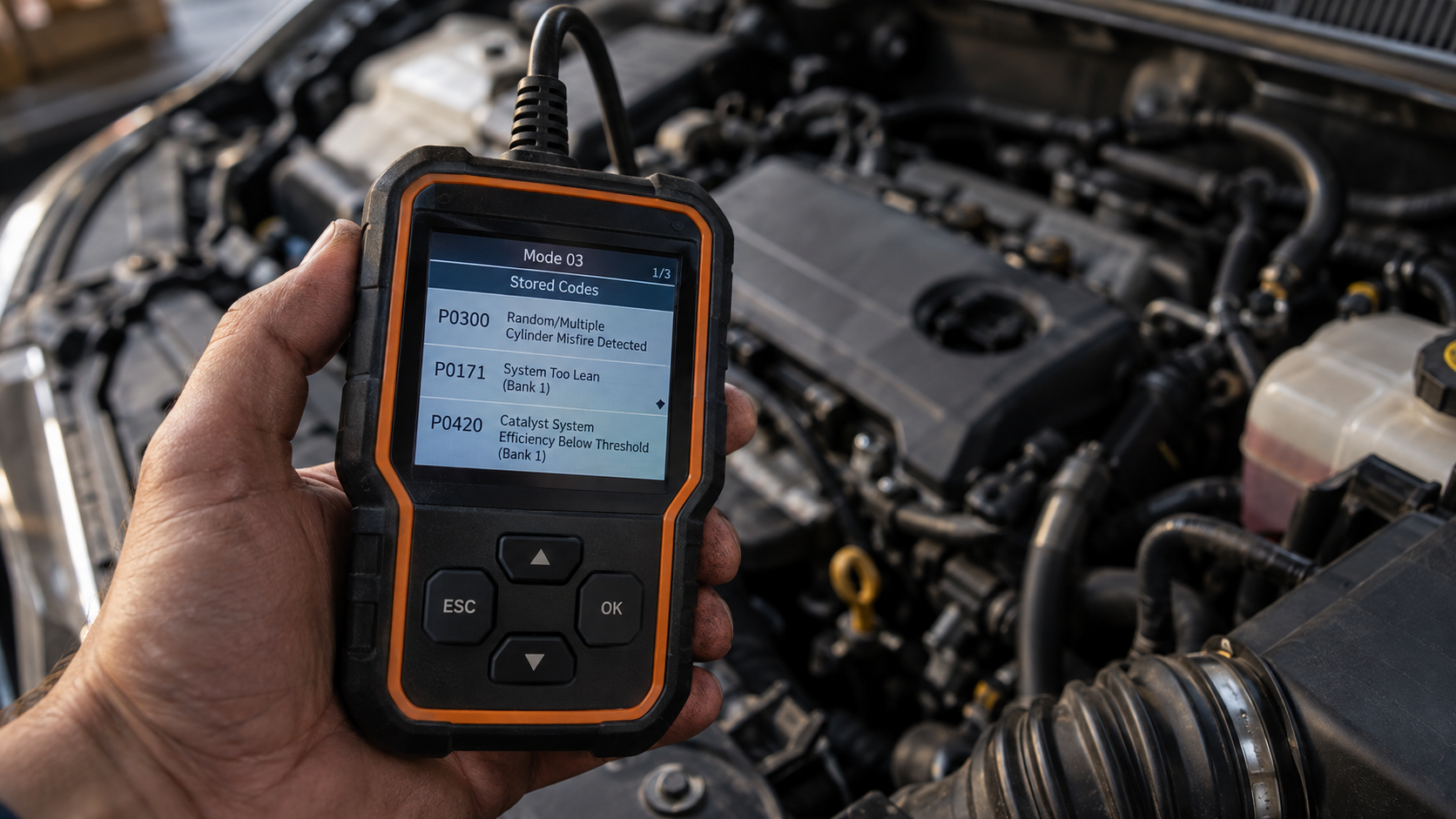
Mode 03 requests stored emissions-related DTCs. This is the classic Read Codes function associated with the Check Engine light and generic OBD2 diagnostics. Examples look like P0300, P0171 and P0420.
Why Mode 03 matters. It narrows the investigation to a diagnostic condition detected by the vehicle. But remember: a DTC is not automatically the failed part. P0171, for example, does not mean “replace Component X.” The root cause still has to be diagnosed. For the full explanation, read OBD2 Codes Explained: How to Read Diagnostic Trouble Codes.
Mode 04: Clear/Reset Diagnostic Information
Mode 04 requests clearing/resetting of supported emissions-related diagnostic information. This is what many scanners present as Clear Codes, Erase Codes, or Clear DTCs.
What users often misunderstand. Clearing a code does not repair the fault. It changes diagnostic information/status where supported. If the underlying condition remains and the vehicle detects it again, the fault can return. Clearing can also remove diagnostic evidence and affect readiness status.
Better workflow. Before using Mode 04: save the codes, save freeze frame, record useful data, investigate the fault, repair the confirmed cause, clear/reset at the appropriate stage, and verify the repair. For the complete workflow, read What to Do After Your OBD2 Scanner Finds a Trouble Code.
Mode 05: Oxygen Sensor Monitoring Test Results
Mode 05 is associated with oxygen-sensor monitoring test results in the older/legacy OBD implementation. This is one of the most confusing modes because modern vehicles do not necessarily expose O2 monitor information through Mode 05.
Current scan-tool documentation notes that this Mode 05 O2-monitor function applies to older implementations and that later vehicles expose the relevant monitoring information through Mode 06 instead.
What Mode 05 can contain. Historically, it can include oxygen-sensor monitor test results such as threshold/switching-related measurements where applicable.
Why Mode 05 matters less on many modern vehicles. With CAN-era implementations, relevant monitor-test information is generally handled through Mode 06 rather than a separate Mode 05 workflow. So: no Mode 05 data does not automatically mean the vehicle has no oxygen-sensor diagnostics. Check Mode 06 and the scanner’s enhanced diagnostic capabilities.
Mode 06: On-Board Monitor Test Results
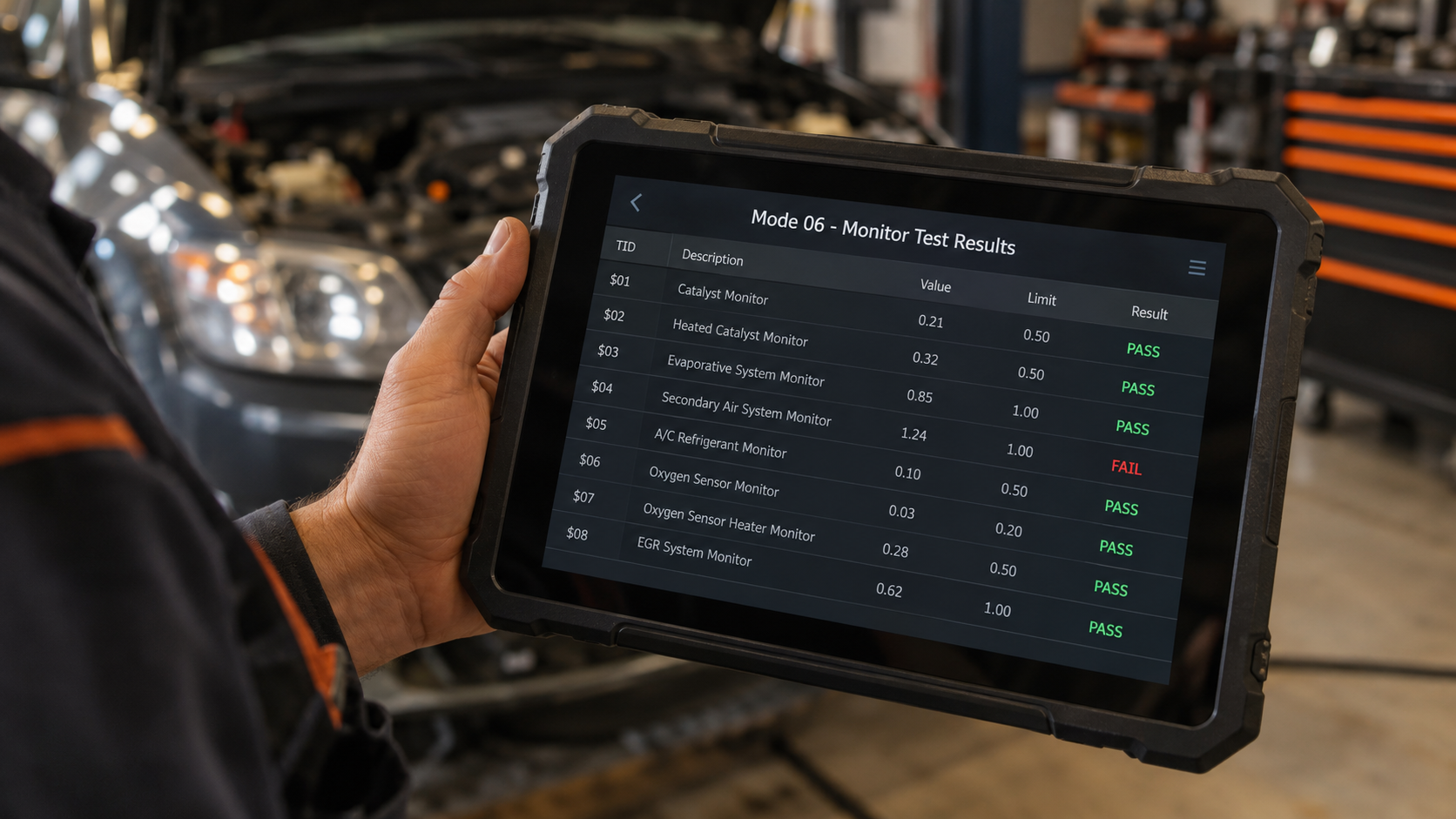
Mode 06 is one of the most technically useful, and most misunderstood: generic OBD functions. It requests results of tests the vehicle’s on-board diagnostic system has already performed.
Depending on implementation, these can relate to monitors such as catalyst monitoring, EVAP-related monitoring, misfire-related information, oxygen/lambda-related monitoring, and other emissions-related monitor tests. Results can involve identifiers and values evaluated against limits.
Why Mode 06 is powerful. A DTC often appears after diagnostic criteria have been met. Mode 06 can expose test-result information behind supported on-board monitors. That can sometimes help identify a developing or marginal problem before the user has a simple “replace this part” answer.
Why Mode 06 is difficult. The data can be technical. Identifiers, units and scaling need to be interpreted correctly. Vehicle/manufacturer implementation matters. So Mode 06 should not be reduced to “value failed = replace sensor.” It is another layer of evidence.
Mode 07: Pending Diagnostic Trouble Codes
Mode 07 is commonly associated with pending emissions-related DTCs. A pending code represents a fault condition that has been detected but has not necessarily reached the same confirmed/stored status represented by Mode 03.
Why Mode 07 matters. It can help with intermittent faults, early-stage troubleshooting, checking whether a fault begins to reappear after codes were cleared, and repair verification.
Imagine that you repaired a fault and cleared the stored code. The Check Engine light is still off. But the same fault begins to be detected again. Pending-code information can provide an earlier warning that the problem may not actually be resolved.
Pending does not mean fake. Do not interpret “pending” as “ignore it.” It means the diagnostic status is different from a confirmed/stored DTC. The exact diagnostic logic depends on the monitor and vehicle.
Mode 08: Control of an On-Board System, Test or Component
Mode 08 requests control of an on-board system, test or component where the standardized OBD implementation supports it. This sounds like modern bidirectional control. There is a relationship, but they should not be treated as identical concepts.
Why the distinction matters. Modern professional scan tools advertise bidirectional/active tests that can include manufacturer-specific commands across many modules. Mode 08 belongs to the standardized OBD diagnostic-service context.
Therefore: a scanner supporting Mode 08 does not automatically mean it has the broad OEM active-test capability marketed as “full bidirectional control.” And the reverse comparison should not be reduced to one mode number either. For the complete capability explanation, read What Is Bidirectional Control on a Scan Tool? Active Tests Explained.
Mode 09: Vehicle Information
Mode 09 requests vehicle information. Depending on what the vehicle supports, this can include items such as VIN, calibration identifiers, calibration verification information, and other standardized vehicle/module information.
Why Mode 09 matters. It can help the scanner or technician confirm vehicle identity and calibration-related information available through generic OBD. It is also a reminder that OBD2 is not only about fault codes. The standardized interface can provide identification and diagnostic-context information too.
What Mode 09 does not do. It does not turn a generic scanner into a complete OEM programming tool. Reading calibration-related information is not the same thing as rewriting or programming an ECU. See ECU Coding vs Programming vs Adaptation: What’s the Difference?
Mode 0A: Permanent Diagnostic Trouble Codes

Mode 0A requests emissions-related DTCs with permanent status. This mode exists for an important reason: a fault should not appear “fixed” merely because somebody connected a scanner and erased the ordinary stored code.
What makes a permanent DTC different? A permanent DTC is not treated like a normal stored code that the user simply erases with the scan tool. The OBD system must determine, through its diagnostic logic and required monitoring, that the malfunction is no longer present before the permanent status is removed.
Why Mode 0A matters. It makes this distinction clear: clearing a code is not the same as repairing a fault. After a real repair, the vehicle may need appropriate operating conditions before the relevant monitor runs and verifies that the problem is gone. That is why a permanent code can remain visible after a repair even when an ordinary stored code has been cleared.
Mode 03 vs Mode 07 vs Mode 0A
These three are easy to confuse.
Mode 03: Stored/confirmed DTC. The vehicle has stored an emissions-related diagnostic trouble code in the applicable status.
Mode 07: Pending DTC. A fault has been detected but is in a pending diagnostic status rather than the same confirmed/stored status.
Mode 0A: Permanent DTC. A qualifying emissions-related DTC is retained in permanent status until the OBD system verifies that the fault condition has been resolved according to its diagnostic logic.
The practical memory aid: 07 = watch it, 03 = stored/confirmed, 0A = prove the repair. That is simplified, but useful.
Mode 05 vs Mode 06
Another common source of confusion.
Mode 05 historically focuses on oxygen-sensor monitoring test results in older/non-CAN implementations.
Mode 06 provides on-board monitor test results and is the more relevant path for much monitor-result data on modern CAN-based vehicles.
So if an O2-related Mode 05 screen is empty on a modern vehicle, do not immediately conclude “the scanner cannot test oxygen sensors.” The relevant information may be available elsewhere, including Mode 06 or manufacturer-specific data.
Are There Really “10 OBD2 Modes”?
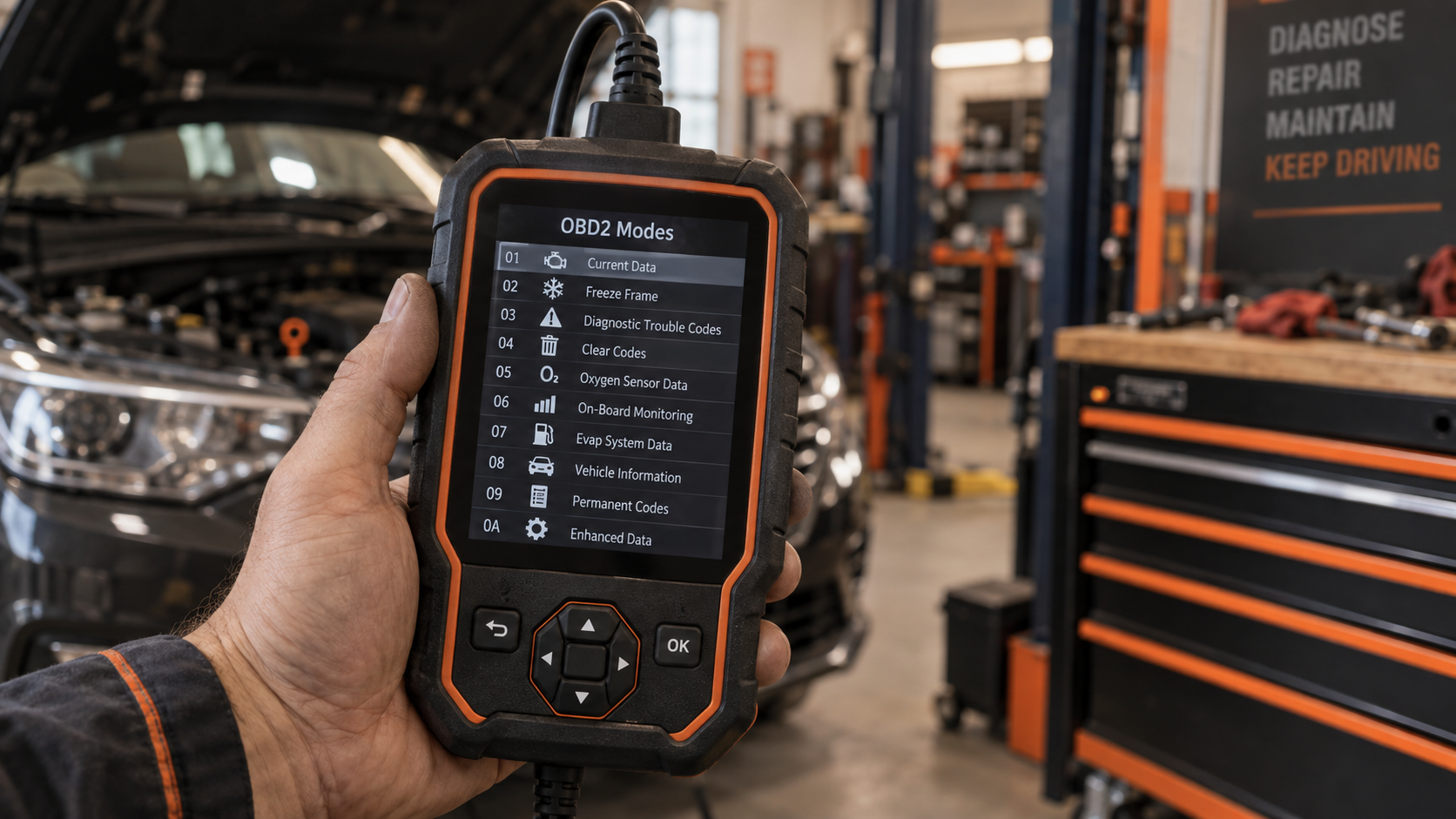
For the classic consumer explanation, Modes 01 through 09 plus 0A are commonly presented as the ten OBD2 diagnostic modes/services.
But standards evolve. The underlying SAE standard has been revised repeatedly, and its data-identifier registry continues to be maintained.
The useful consumer lesson is not to memorize a frozen historical table. It is to understand what the mode labels on a scanner represent and where generic OBD ends.
Does Every Vehicle Support Every Mode?
No. Support can depend on model year, vehicle implementation, protocol, regulatory requirements, engine/propulsion type, the requested data item, and scanner/software support.
Even within a supported mode, not every possible PID, test or information type has to be available on every vehicle.
That is why “supports all 10 OBD2 modes” should not be interpreted as “supports every diagnostic function on every car.” Those are completely different claims.
OBD2 Modes vs Full-System Diagnostics
This distinction is essential when buying a scanner.
Generic OBD2 is primarily centered on regulated emissions-related diagnostic information. A modern vehicle can also contain modules for ABS, airbags/SRS, body electronics, steering, transmission, parking brake, HVAC, ADAS and many other systems.
Accessing those modules generally requires enhanced/manufacturer-specific diagnostic capability beyond simply advertising the generic OBD modes. For the deeper explanation, read What Does Full-System Diagnostics Mean on a Scan Tool?
OBD2 Modes vs Manufacturer-Specific Diagnostics
The standardized modes create a common diagnostic foundation. Manufacturers can provide much more diagnostic information through enhanced/OEM-specific systems, including additional codes, additional data parameters, module-specific tests, service functions, active tests, and coding/adaptation functions.
This is why two scanners that both support generic OBD2 can have dramatically different real-world capabilities. See Generic vs Manufacturer-Specific OBD2 Codes: What’s the Difference?
Which Modes Matter Most to a Typical DIY User?
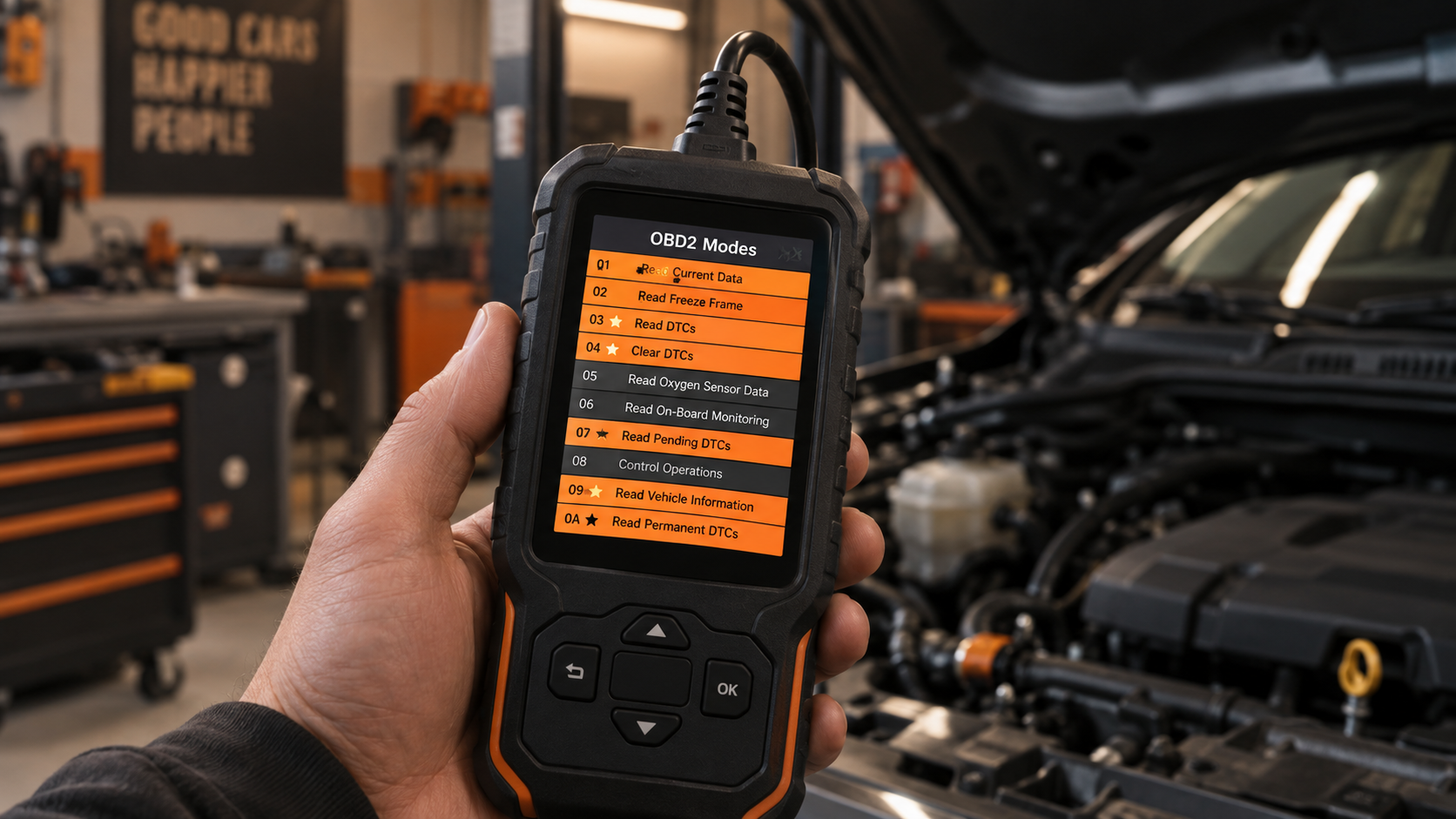
For many car owners, the most frequently useful functions correspond to Mode 01 (live/current data), Mode 02 (freeze frame), Mode 03 (stored DTCs), Mode 04 (clearing/resetting after evidence has been saved and at the appropriate stage), Mode 07 (pending codes), Mode 09 (vehicle information), and Mode 0A (permanent codes on applicable vehicles).
Mode 06 becomes especially valuable as the user moves deeper into diagnostic analysis. Mode 05 is more relevant to legacy implementations. Mode 08 should not be used as a shortcut for judging a scanner’s full modern bidirectional capability.
Common OBD2 Mode Mistakes
Mistake 1: Thinking “10 modes” means full-system diagnostics. It does not.
Mistake 2: Clearing codes with Mode 04 before saving evidence. You may lose useful diagnostic context.
Mistake 3: Treating Mode 07 pending codes as meaningless. They can be diagnostically useful.
Mistake 4: Trying to erase a permanent Mode 0A code as if it were an ordinary stored code. Fix the cause and allow the OBD system to verify the repair.
Mistake 5: Assuming no Mode 05 data means no O2-monitor information. On modern implementations, relevant monitor results may be available through Mode 06.
Mistake 6: Equating Mode 08 with every OEM bidirectional test. Modern manufacturer-specific active-test capability is much broader and vehicle-dependent.
Mistake 7: Assuming a scanner that advertises every generic mode supports every PID or test on every vehicle. Mode support and exact vehicle/data/function support are not the same thing.
FAQ
Which OBD2 mode shows live data?
Mode 01 is used for current diagnostic data and PIDs.
Which OBD2 mode shows freeze frame?
Mode 02.
Which mode reads stored trouble codes?
Mode 03 requests stored emissions-related DTCs.
Which mode clears OBD2 codes?
Mode 04 requests clearing/resetting of supported emissions-related diagnostic information.
What is OBD2 Mode 05?
It is associated with oxygen-sensor monitoring test results in legacy/non-CAN implementations. On modern CAN-era vehicles, relevant O2 monitor-test information is generally handled through Mode 06.
What is OBD2 Mode 06?
Mode 06 provides on-board monitor test results. It can expose useful test-result information from emissions-related monitors and is valuable for deeper diagnosis.
What is OBD2 Mode 07?
Mode 07 is commonly used to retrieve pending emissions-related DTC information.
Is Mode 08 the same as bidirectional control?
Not exactly. Mode 08 provides standardized requests for supported control/test/component operations within the OBD context. Modern scan-tool “bidirectional control” often includes much broader manufacturer-specific active tests.
What is OBD2 Mode 09?
Mode 09 requests vehicle information such as VIN and calibration-related information where supported.
What is Mode 0A?
Mode 0A requests permanent emissions-related DTCs. These are not simply erased like ordinary stored codes; the OBD system must verify that the underlying fault is no longer present.
Does every OBD2 car support all ten modes?
No. Exact support varies by vehicle, model year, protocol, regulatory requirements, requested data and scanner implementation.
Does supporting all OBD2 modes mean a scanner can diagnose ABS and airbags?
No. Generic OBD2 mode support is not the same as enhanced/full-system manufacturer-specific diagnostics.
The Bottom Line
The ten familiar OBD2 modes are easier to understand when you stop treating them as a list of numbers. Think of them as different diagnostic jobs: 01 asks what is happening now, 02 asks what was happening when the fault was captured, 03 is the stored fault that was detected, 04 clears/resets supported diagnostic information, 05 is what legacy O2 monitoring reported, 06 is what the on-board monitors tested, 07 asks whether a fault is pending, 08 requests a supported control/test, 09 reports vehicle/calibration information, and 0A asks whether a permanent fault record is still awaiting verified resolution.
The most important lesson is not the numbers. It is the boundary: generic OBD2 modes provide a standardized emissions-related diagnostic foundation. They do not equal complete vehicle diagnostics.
Use the mode that answers the diagnostic question you actually have. Then move beyond generic OBD when the vehicle system or function requires it.
Continue to Generic vs Manufacturer-Specific OBD2 Codes: What’s the Difference? or What Does Full-System Diagnostics Mean on a Scan Tool?
Once you know which functions you need, compare the Best OBD2 Scanners.